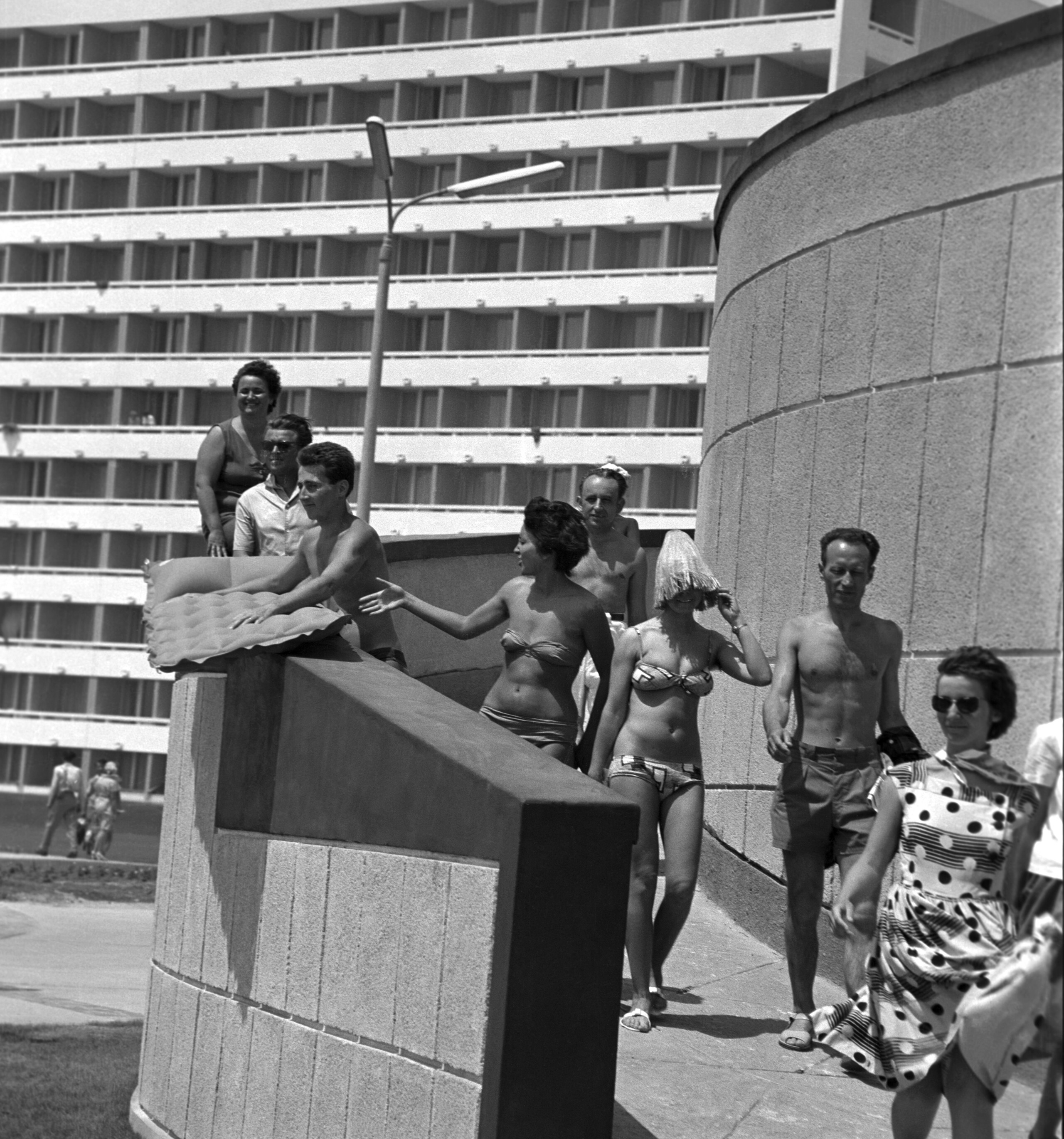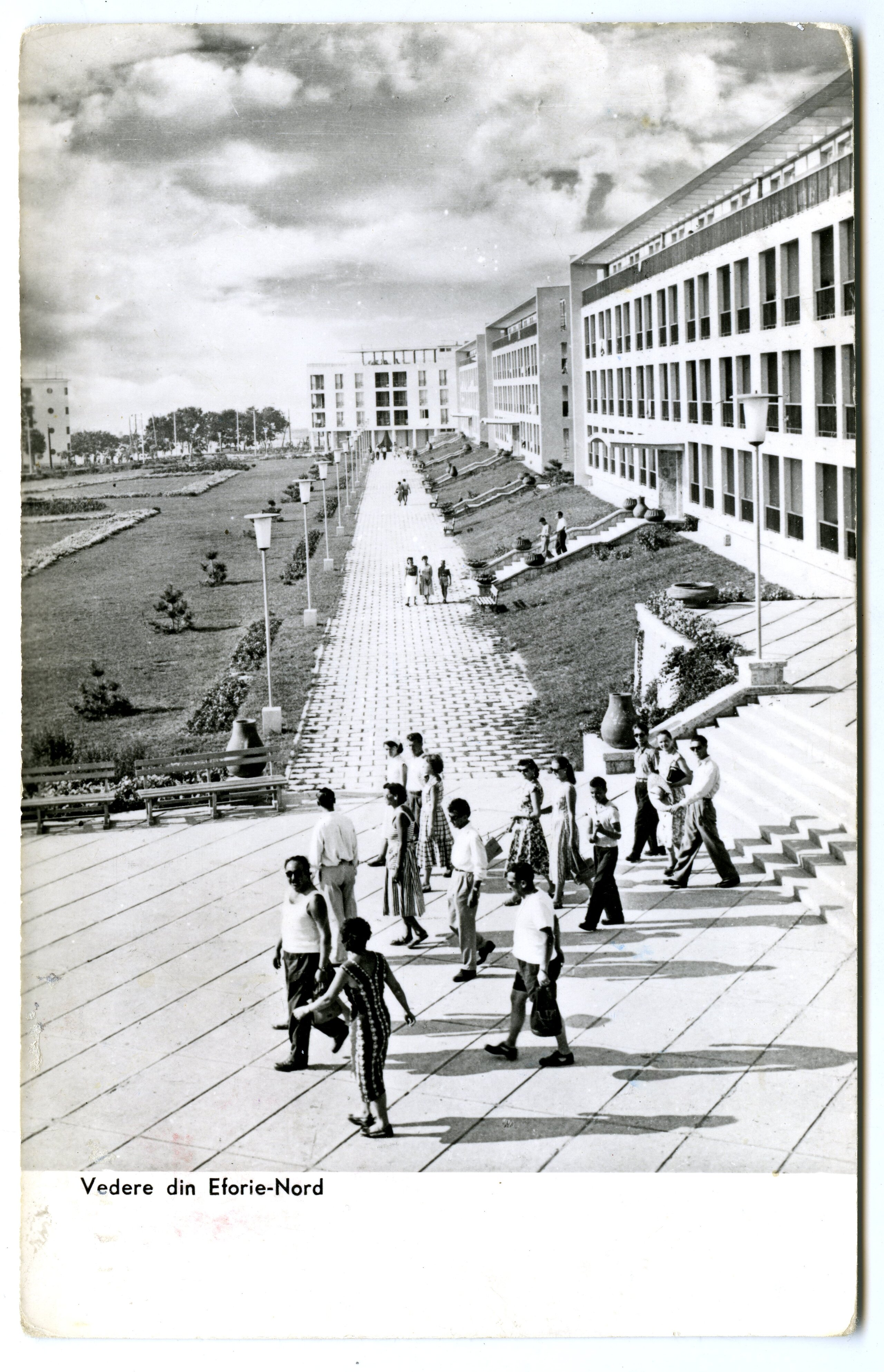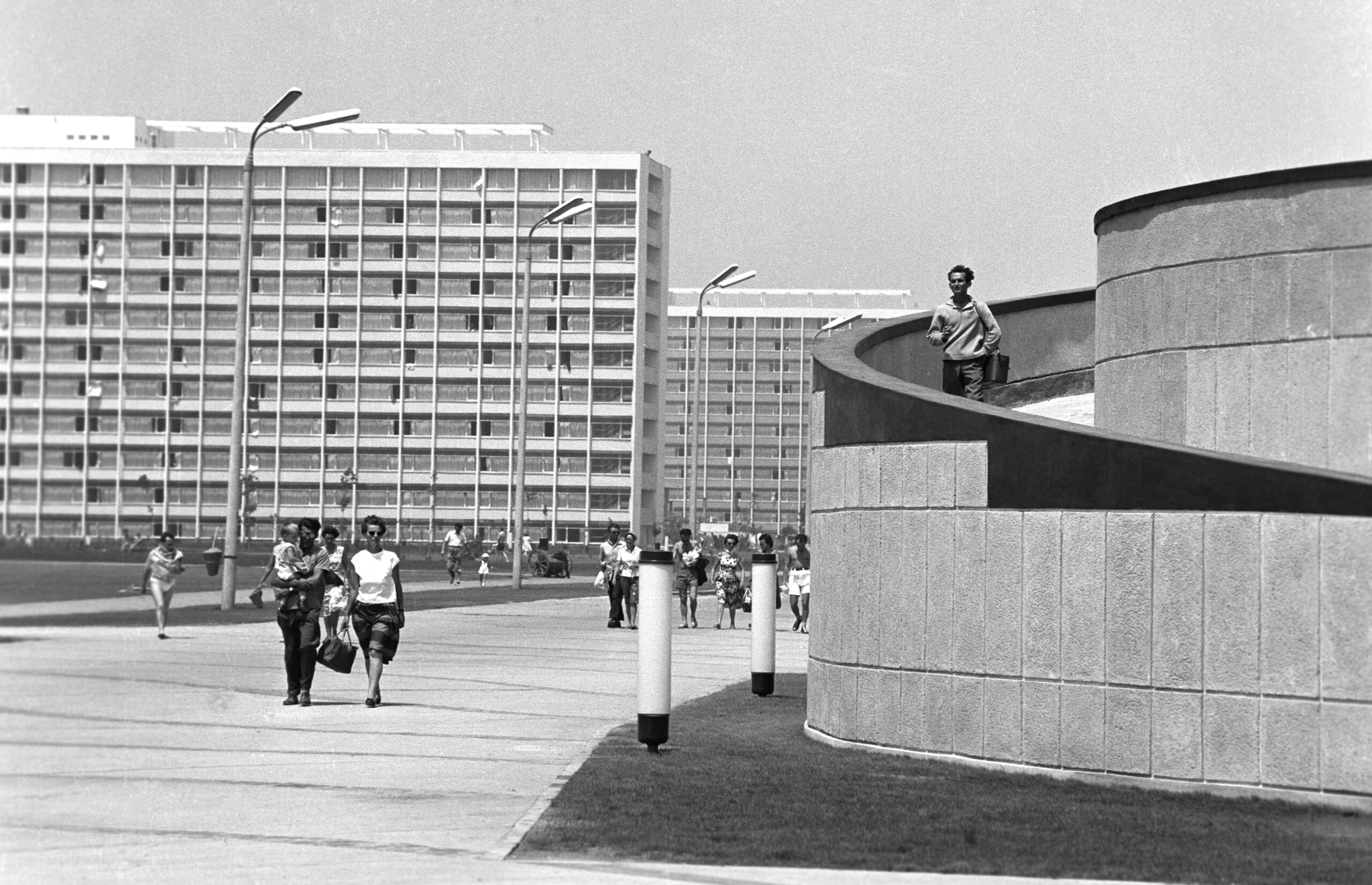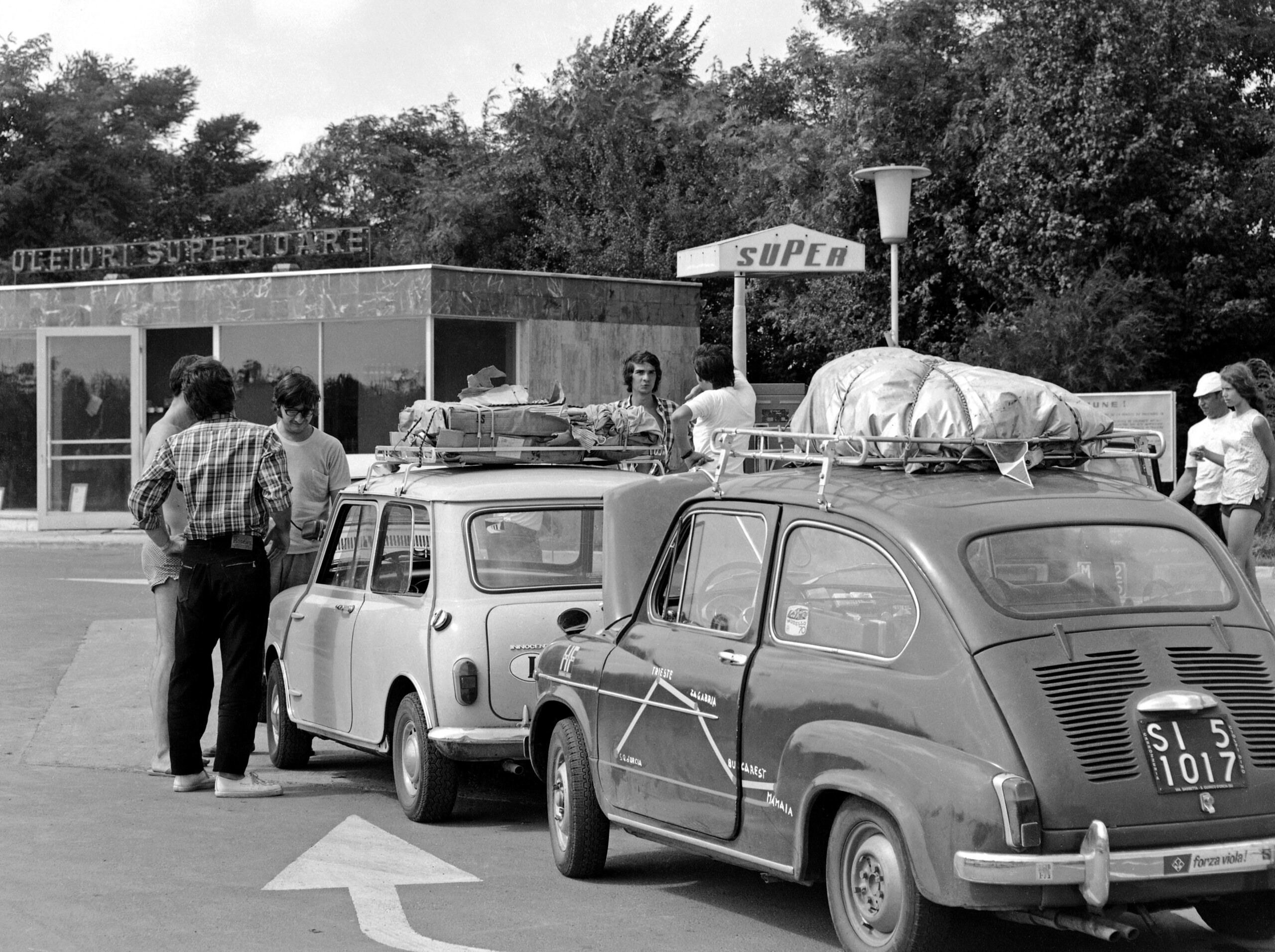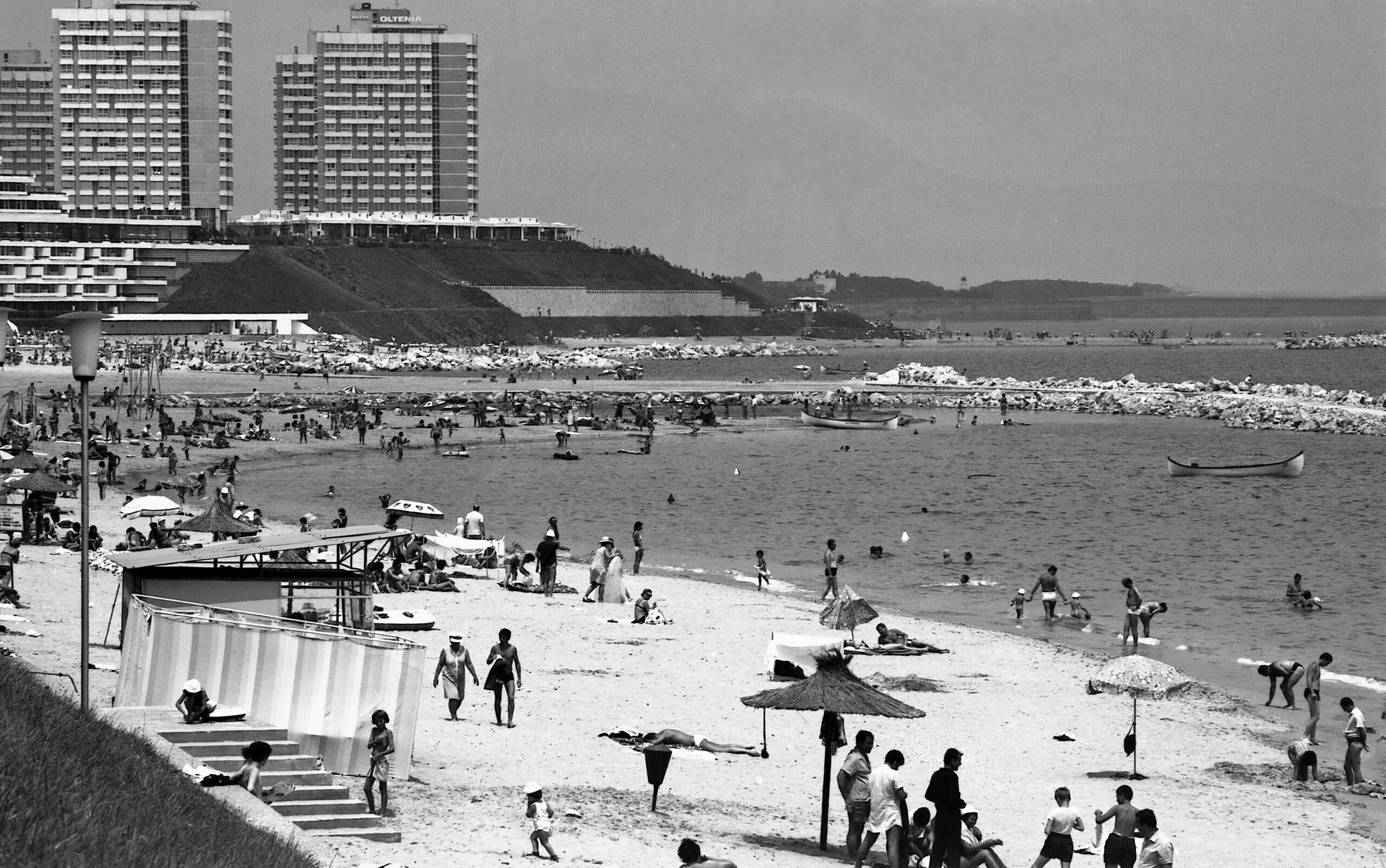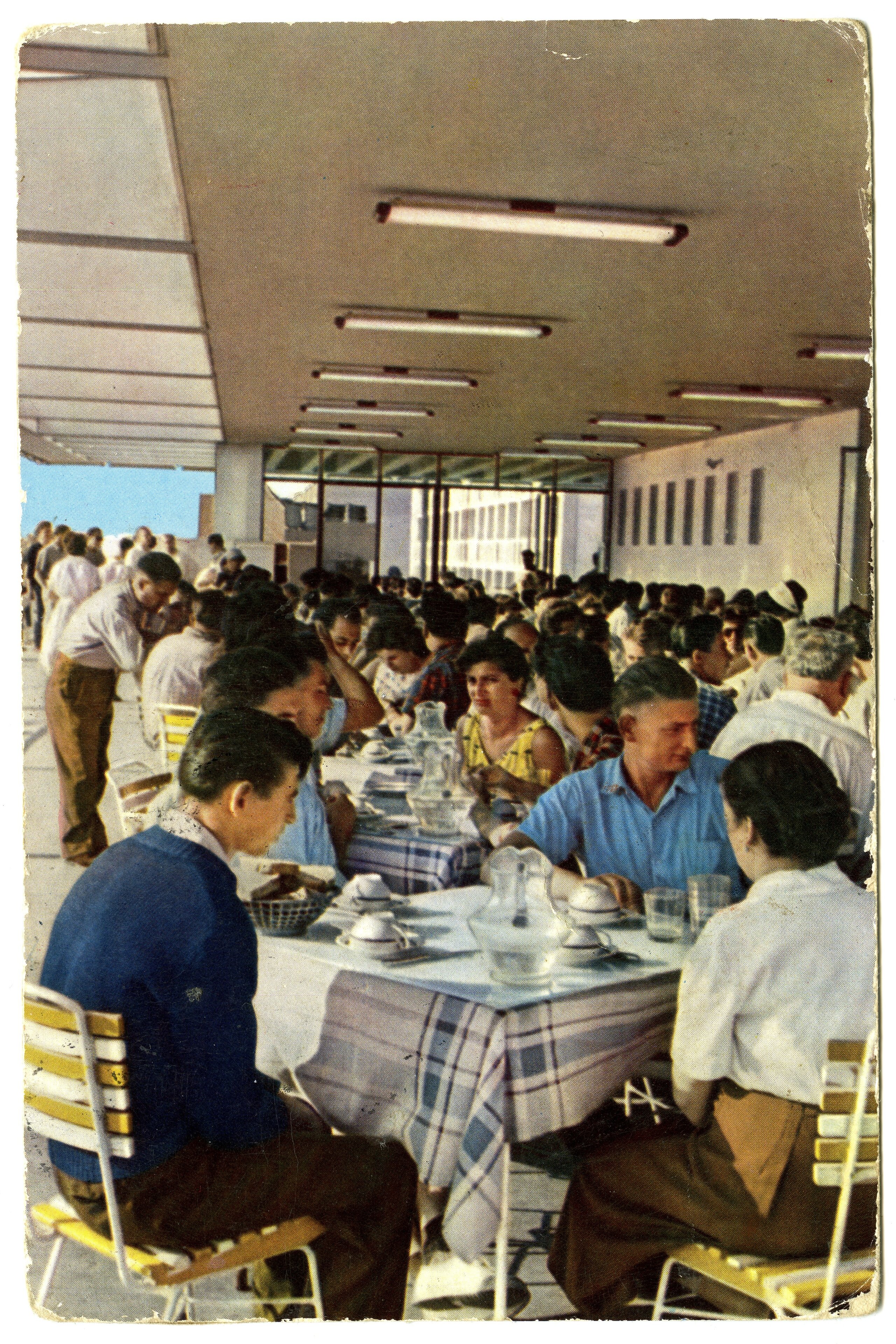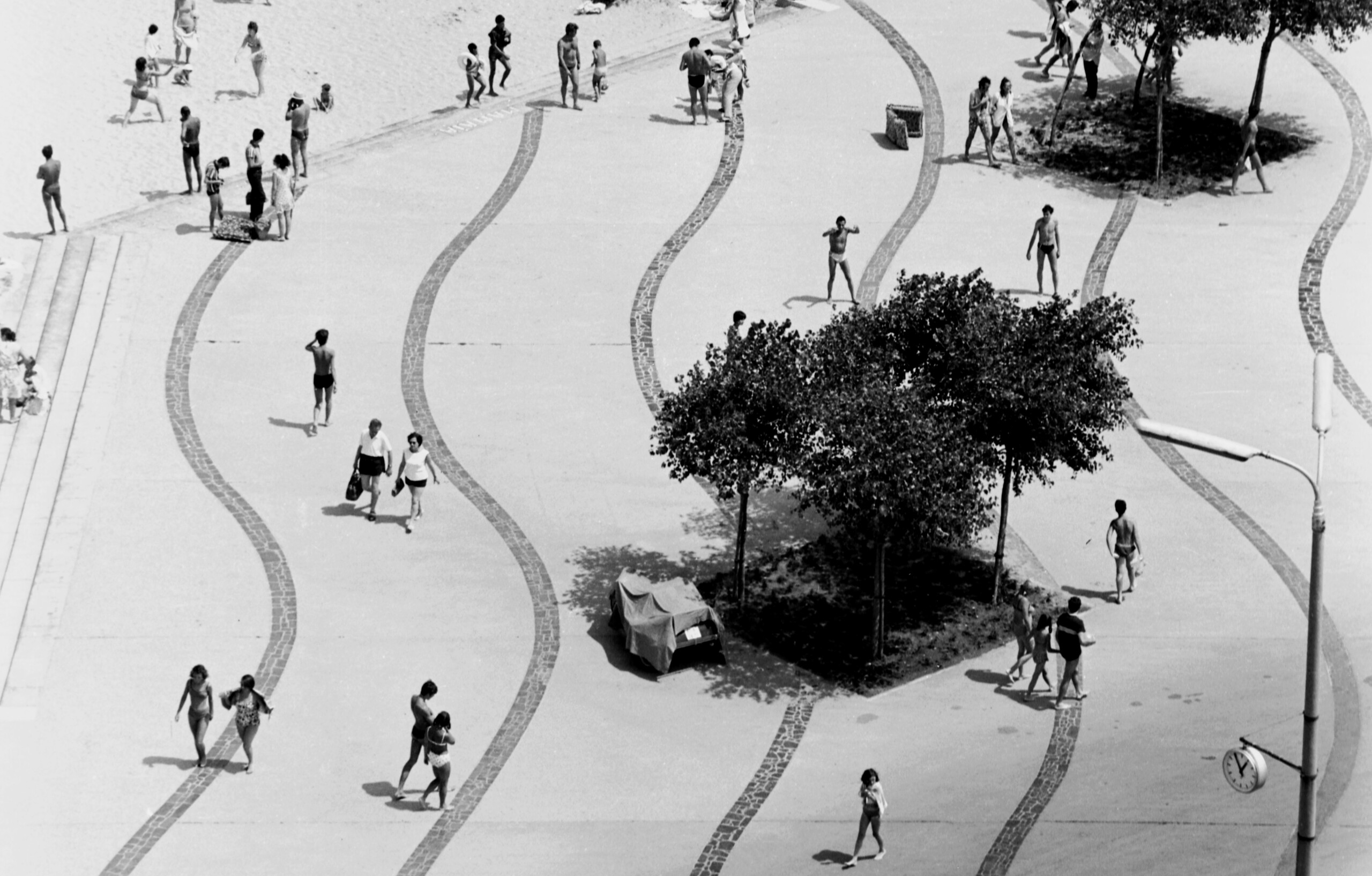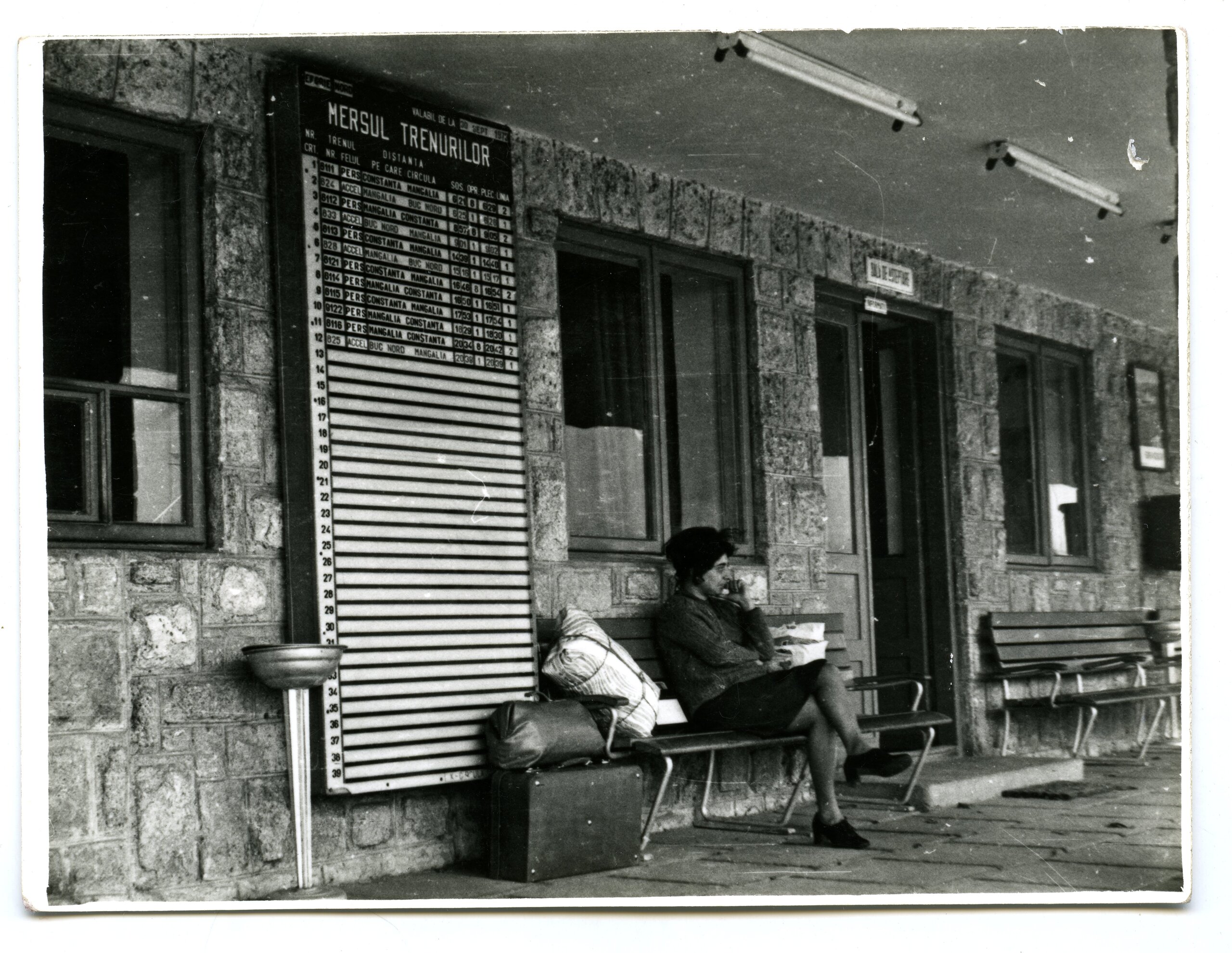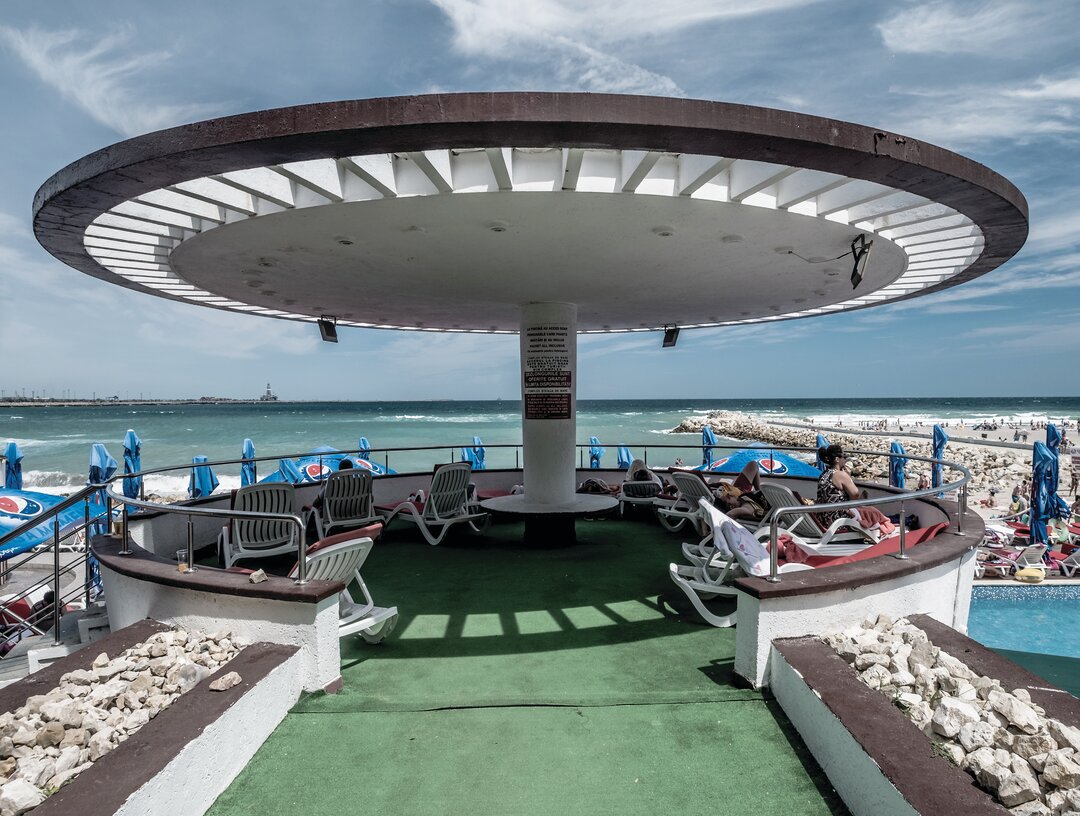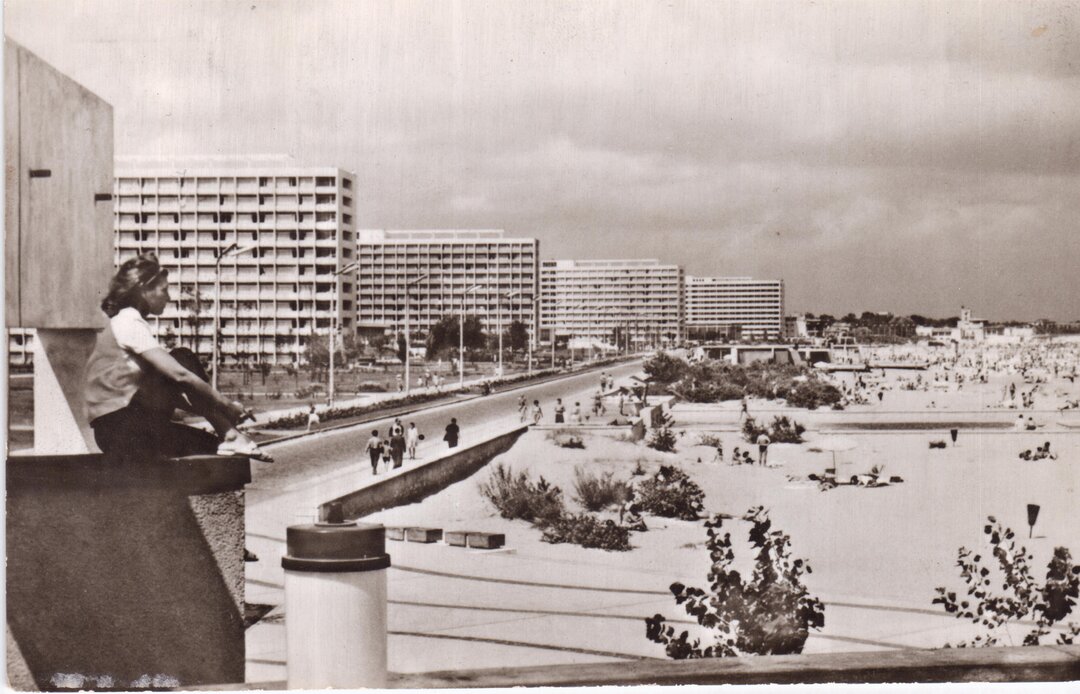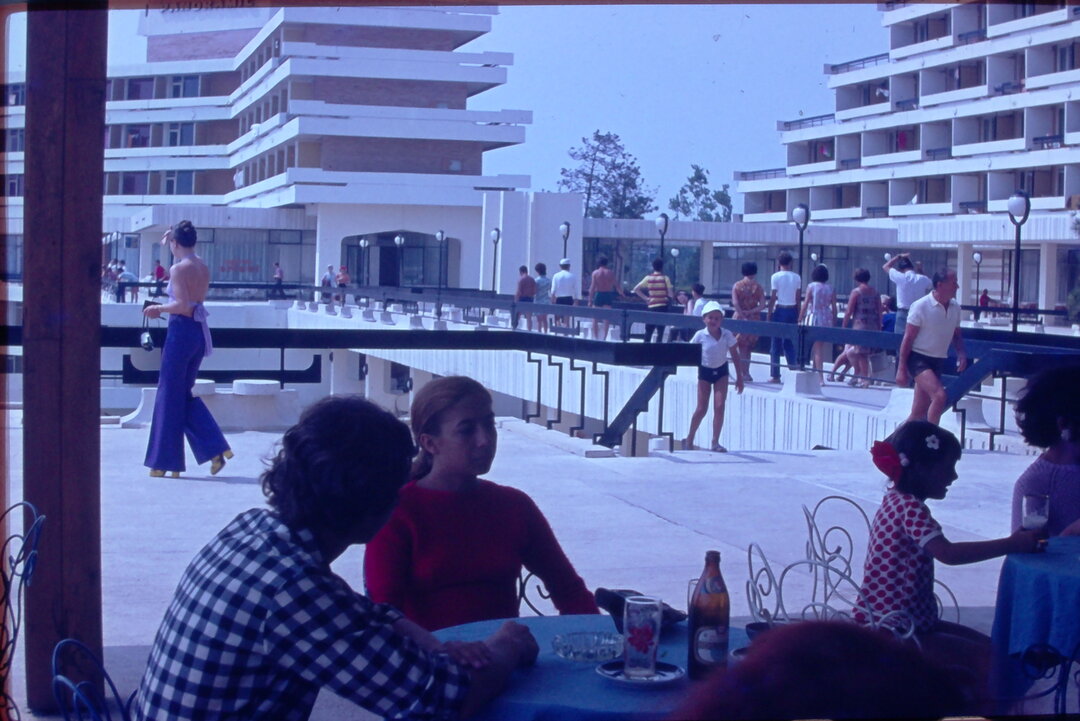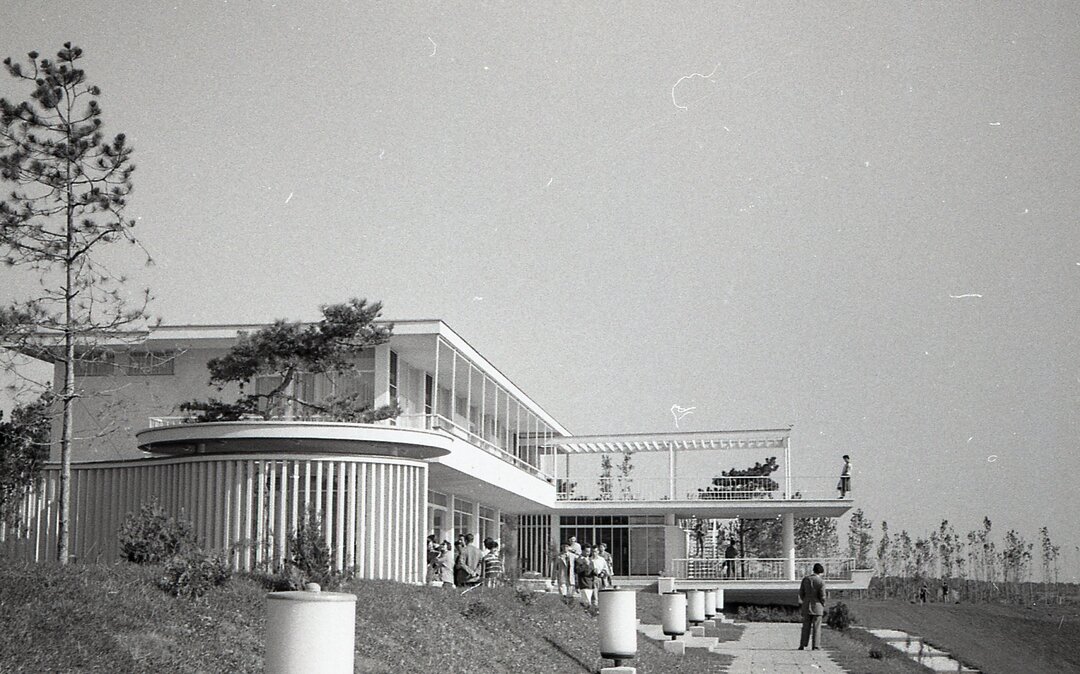
Seaside. A published chronology

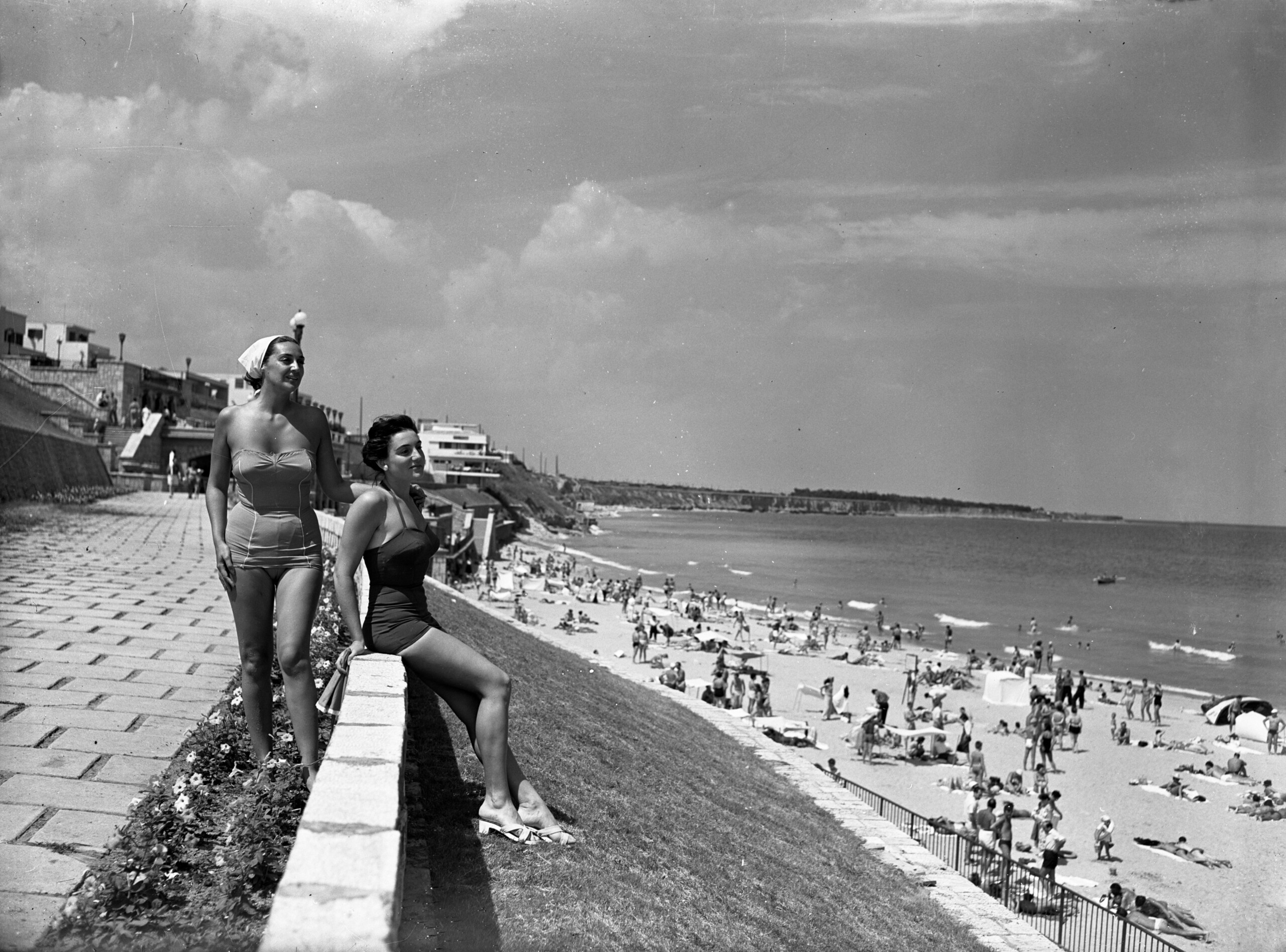
1948, 1956, 1959, 1962, 1968, 1971, 1974, 1982, 1985, 1989
Even if the above figures seem to represent a random string of years, their choice reflects a changing pattern from the perspective of tourism and leisure on the Romanian coast during the communist period. The red thread I have chosen is dance, a cultural element less studied in research on tourism in this historical stage, from the nationalizations in 1948 to the fall of the communist regime and the end of Nicolae Ceausescu's dictatorship at the end of 1989.
In parallel to punctuating the successive cycles of political freeze and thaw with their effects on the evolution of Romanian tourism, we tracked a number of socio-cultural variables, such as leisure, entertainment scene and nightlife. The post-war younger generations matured, socialized and participated in leisure activities in a cultural and technological environment quite different from that of their parents, a trend that was accentuated in the 1970s and 1980s with the internationalization of the audiovisual streams of the emerging globalization.
As a theoretical reference point, I refer to what Alexei Yurchak calls "the internal paradoxes of life under socialism"1, with the aim of exploring the socialist entertainment on the seaside starting from the following questions: "Where, when and how did tourists spend (and dance) on the Romanian seaside? How was this type of recreation categorized at the time?".
For the documentation, I used the corroboration of information from several archival sources: press articles from the period(Scînteia, România libera, Munca, Dobrogea nouă, etc.), relevant through the presentations and projections about leisure, which I have nuanced and supplemented with documents from the former Securitate's funds about tourism and the seaside, reports from the Research Institute "Radio Free Europe/ Radio Liberty" ("RFE/ RL"), specialized publications from the National Institute for Research-Development in Tourism, as well as interviews with tourism workers who worked as disc-jockeys (DJs) before 1989.
With the far-reaching political and economic changes, the change of regime brought into question the democratization of holiday leave in relation to access to seaside resorts. Until then, only sick workers on social security schemes went to the seaside, while summer rest and the pleasures of the seaside were the monopoly of the wealthy(Adeverul). The discourse of the press was constantly marked by binary oppositions, reminiscent of the times before, when "under the iron heel of capitalism" working people had no holidays in the mountains or at the seaside, where "the landowners or bankers were hunting"(Viața sindicală, Luptătorul). Under the new regime, workers used their holidays to gain new strength to build socialism. The socialist rhetoric also had an impact on urban toponymy: at the seaside, the "Carmen Sylva" resort was named "Vasile Roaită" in 1948.
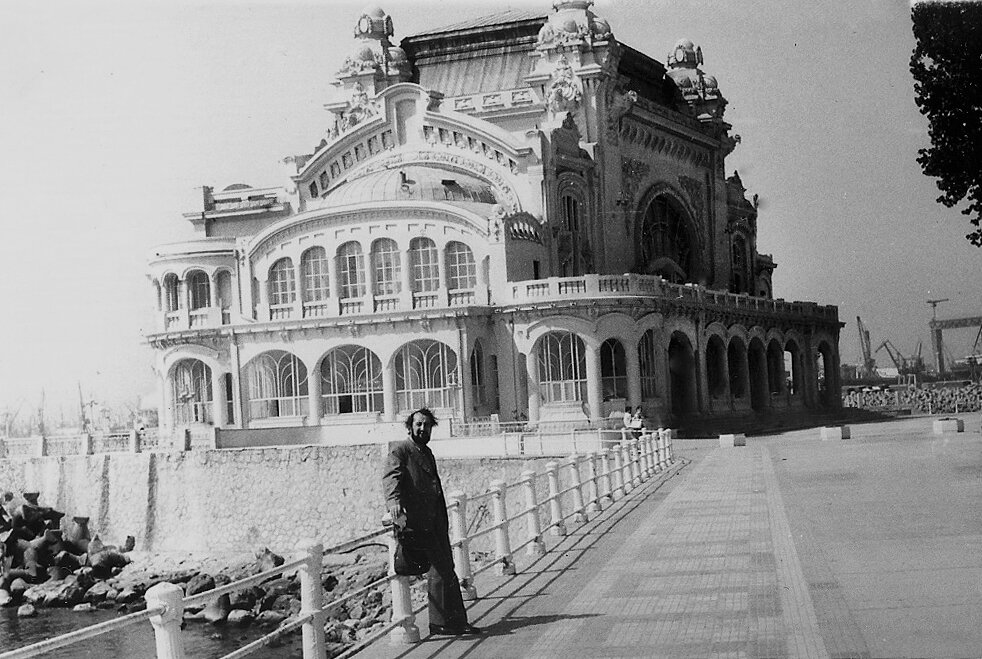
Vasile Roaită was also the scene of a social transition process that was repeated in other recreational areas. The summer of 1948 appears as one of the few moments when the remnants of the old world coexisted with the new world of popular democracy in the generous spaces of the climatic resorts. The central press triumphantly announced the changing face of the seaside, where "the 'grangurii' have disappeared and the working people have arrived"(România libera). An article in Viața syndicală reported that there was a casino2 at Vasile Roaită, renamed the Rodica Casino, where former rentiers, landowners and industrialists danced "like in the jungle". Another text railed against "the debauched life practiced at the casino on the waterfront, where the dances and revels of the rich girls continue"(The Fighter). Journalists noted that the representatives of the old order kept their distance from the workers, just as the latter watched the casino scenes in revolt, feeling "strangers to this world and far above these rotten remains". Things were not to stay that way, as the General Confederation of Labor3 decided that the casino would be transformed from a "place of debauchery" into a workers' cultural home. Thus, a short text in România libera announced that, on August 8, 1948, "one of the 'institutions' traditionally devoted to frivolity and bourgeois debauchery was transformed into a place of rest and spiritual enrichment". This trend was also recorded in the Dictionary of the Contemporary Romanian Literary Language published in 1955, where the term "casino" was associated with a place of bourgeois society, with the statement that: "In the old casinos in our country today there are canteens and clubs for working people".
The change in the casino's function was also reflected in the entertainment model, which took on an explicitly educational dimension, organized around the library, where workers "could read instructive and wholesome literature and where the entertainment was imbued with working-class common sense"(Trade Union Life). However, there was a new basic problem: the limited involvement of citizens in the new cultural-educational activities, in addition to "artistic entertainment, cinema, festivals, chermezes, music, organized by various trade union groups"(Universul). In the view of the General Confederation of Labour, the holiday was not a "political holiday", as the union criticized the old concept of idleness and the atmosphere of a "bourgeois holiday" in which people organized their time according to their own wishes(România libera). Political and cultural work was supposed to include conferences, reading good books, informing about domestic and international politics, reading newspapers and organizing wall gazettes. Many of these were organized in former casinos(Trade Union Life).
In the course of 1951, the casino in Constanta was to be transformed into a "grand Cultural Palace," and the resorts' leisure infrastructure was improved with a park, solarium, club, reading room, open-air theater and sports fields, as well as radio amplification stations for a sonorous ambiance(România libera). It was the time of the Stahanovites, and the language of class struggle still dominated the newspapers. At the resort's central club "Vasile Roaită" (the former casino), where once there were "lusty young men, with cigars in the corners of their mouths, women flaunting their jewelry and toilets", the workers had a library with a reading room, chess tables, table tennis and musical instruments(Universul). The following year, Mamaia's casino was transformed into a workers' club, destroying the reputation of a place where "once upon a time all sorts of idlers squandered the money they had squeezed out of the workers' toil on gambling"(Scînteia). In 1953, the year of Stalin's death, militant rhetoric was still thundering in the pages of the press, which reported that the mansions of former bourgeois and landowners, once "places of revelry and debauchery", had been renovated and turned into clubs, cultural centers and libraries. And yes, the former casino in Vasile Roaită was once again held up as an example of a "true hotbed of culture, a place dear to the industrious builders of socialism". However, the cultural-educational activity seemed to be a weak point, given that in most resorts "the method of organizing so-called entertaining evenings, whose only point in the program is dance music, was practiced to the point of boredom"(Contemporanul). Dancing had been banned from the casinos, but not from the resorts.
In the following years, the press carried articles about the various developments in the spa resorts, the journalistic language became more temperate, and the vilification of the people of the former regime was gradually abandoned. On September 1, 1955, the National Tourist Office "Carpathi" started its activity, with the mission of expanding foreign tourist trips in the country and the visit of other countries by Romanian tourists, i.e. an international tourism interrupted by "the last world war and the period of "cold war" that followed"(Scînteia). The ideological relaxation was also reflected in tourism. The purpose of a vacation in the country was beginning to be seen in a different light: in addition to the "physical and moral comfort" that would make people fit for work, it would also give them the chance to remember beautiful days at the seaside. The ambitious recreational plan included the construction of a bowling alley and two nautical bases in Mamaia, the equipping of the resorts with cinema projection equipment and the organization of state theatre tours in the resorts(Munca, Dobrogea Noua).
As the seaside resorts prepared for the summer, the central press commented in 1956 on a series of changes that were to define the working man's holidays. In addition to the attention given to the development of parks and green spaces in Mamaia, Techirghiol, Eforie, "Vasile Roaită" and Mangalia, measures were taken to improve the food outlets with the opening of new shops, restaurants, confectioners, grocery and grocery stores, as well as refreshment kiosks and mobile trolleys serving drinks directly on the beaches; local bus lines were to ensure the mobility of citizens between resorts(Romînialiberă,Scînteiatineretului). The local press, however, reported from the field about delays and a "lack of good citizenship", a sign that there were gaps between ambitious plans and results(Dobrogea nouă). However, the discourse focused on caring for the service of the population emphasized the new vision of rest leave and shaped the concept of "social tourism"4 as a service provided for the benefit of the working people of the country. Leisure seemed no longer to be dominated by cultural-educational activities, as young people had a wide range of entertainment options at their disposal, from dance evenings at the club to open-air theater or film performances, walks in the rose park, cold beer buffets and souvenir shops.
The former casino, now the cultural center of "Vasile Roaită" was also to undergo a major transformation, as a large restaurant(Dobrogea Noua) was to be built there under the Ministry of Food Industry. The subordination of the casinos in "Vasile Roaită" and in Constanța to public catering establishments, as well as the abandonment of the function of the cultural hostel, show the possible failure of the instrumental concept on which the socialist leisure was initially based. On the other hand, the new commercial use of the two casinos also reflected the waning of the ideological zeal of the late 1940s in favor of a more pragmatic approach adapted to the socio-cultural context. The authorities were beginning to question profitability. It was not by chance that a commercial layout published by the local daily Dobrogea Noua in February 1958, i.e. during the off-season, invited the Constantine public to spend pleasant hours of entertainment and entertainment at the "Matineele dansante"(sic!) held at the Casino Restaurant every Thursday, Saturday and Sunday from 5.00 pm to 8.00 pm. The publicity strategy was also adapted to the summer season, with a layout published in the băcăuan party newspaper Steagul Roșu, in which the Constanta Public Food Trust promoted "Selected drinks, antren and dancing" at the Cazinou, Modern and Vraja Mării restaurants in Neptun and Terasa Mării in Eforie, as well as the Cazinou restaurant in the "Vasile Roaită" resort. In June 1958, the opening of a new restaurant was announced at the Casino in Mamaia, where the club of the Cultural Centre of the Trade Unions was also operating, organizing both educational (conferences, literary evenings) and recreational activities (sea trips, dance evenings, films). There, too, and in general in the documentation of the cultural hostels, there were mentions of the "club disco", but without being associated with dancing(Dobrogea Noua). The notion of "disco" originally defined a collection of tap-drums, a piece of furniture incorporating a record player or a place for storing records. Adapted to the cultural club, the disco meant a room where people could listen to music on records, usually classical operas. In the 1960s, the casino building in Mamaia became a shopping center, housing shops and catering establishments.
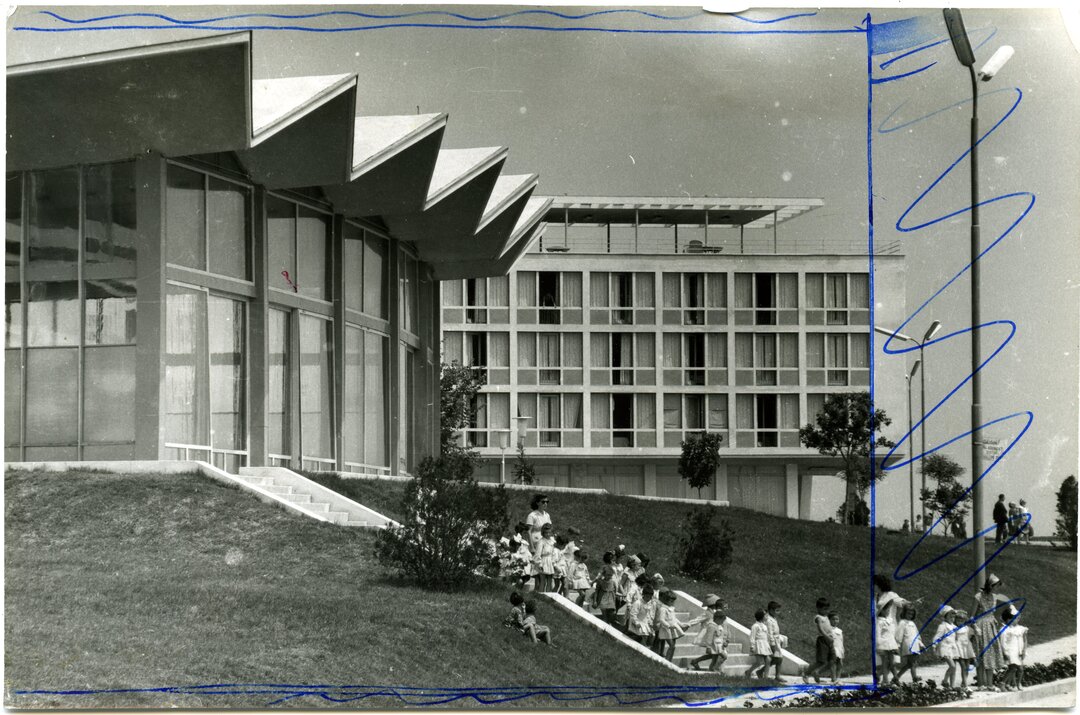
Efforts were focused on increasing accommodation capacity, improving living and eating conditions, as well as on infrastructure works, such as strengthening the embankments, asphalting and sewage projects. The embellishment of the resorts, the installation of a radio station with 600 loudspeakers and a leisure plan with cultural and sporting activities completed the main objective, that all "those who come for rest and treatment should feel as well as possible"(Munca, Dobrogea nouă). In 1957 the new resort of Costinești was mentioned, and the end of the sixth decade brought some major changes: the National Tourist Office (O.N.N.T.) "Carpați" took over the entire material basis of tourism and had the task of organizing domestic tourism with commercial (non-subsidized) offers; other news spoke of a larger number of foreign tourists, cruises organized jointly with other countries of popular democracy and substantial investments in Eforie and Mamaia(Romînialibera). An article in Flacăra magazine praised the work of the architects who had transformed Eforie into a "graceful and ultramodern seaside resort" with a "symphony of lines and angles, created in a lively rhythm, in concrete, marble and glass". N.T.O. hotels were springing up for foreign guests, an early indication of the double standard that would later shape socialist tourism. The revelation of the resort, however, was the grand restaurant, a "huge 'crystal palace' (80% glass, 20% concrete)", complete with fluorescent neon lights outside, where Romanian and foreign tourists could spend "an evening of music and dancing".
The beginning of the decade marked new investments on the seaside, documented in the magazine Arhitectura R.P.R., which devoted ample space to the hotel complexes and facilities in Mamaia and Eforie, as well as other urban development projects in the region. On March 14, 1962, a decree changed the name of the town "Vasile Roaită" to Eforie, which was to have as its component towns the seaside resorts Eforie Nord and Eforie Sud. The press began to use the expression "the Black Sea resorts", which was established and later used by the newspapers of the time. The Romanian tourists fell into three categories: those sent by trade unions, those coming via NGOs or on their own(Munca).
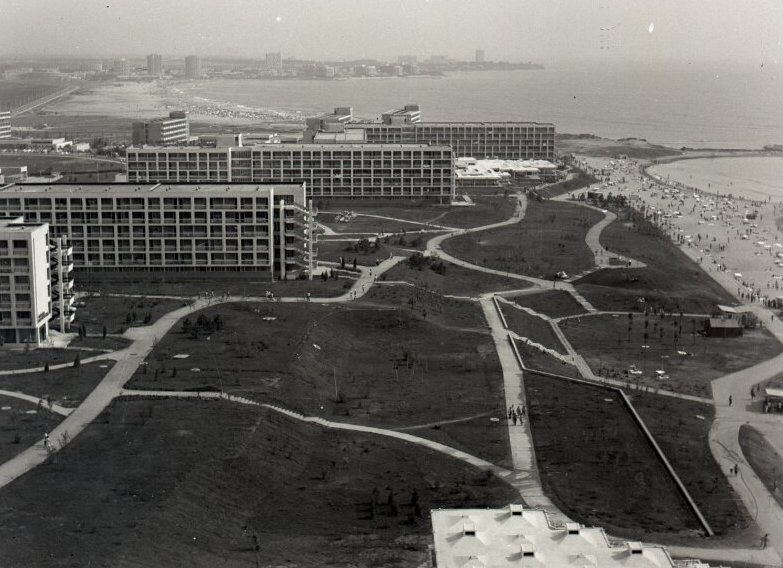
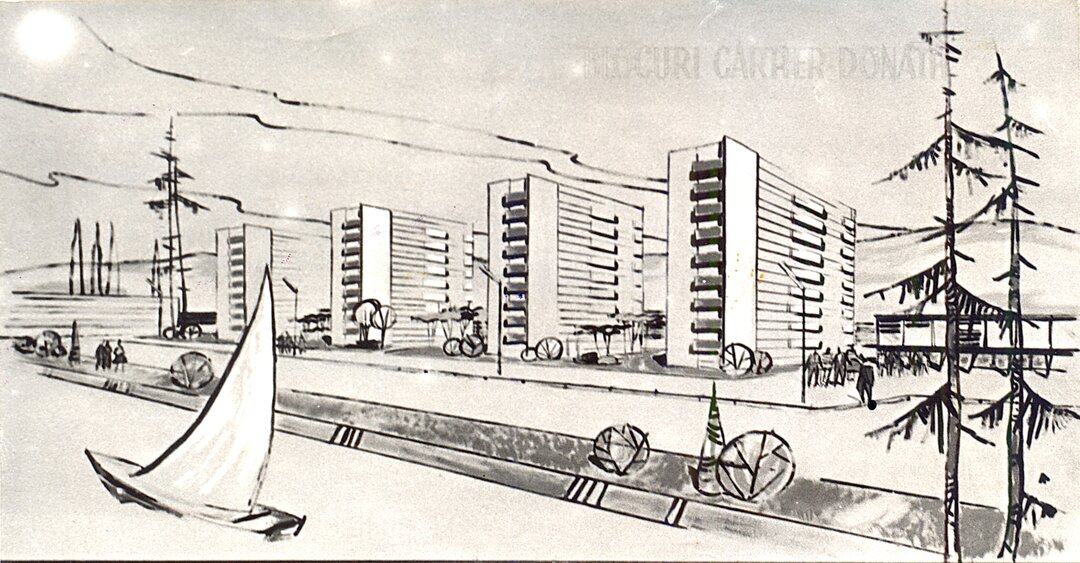
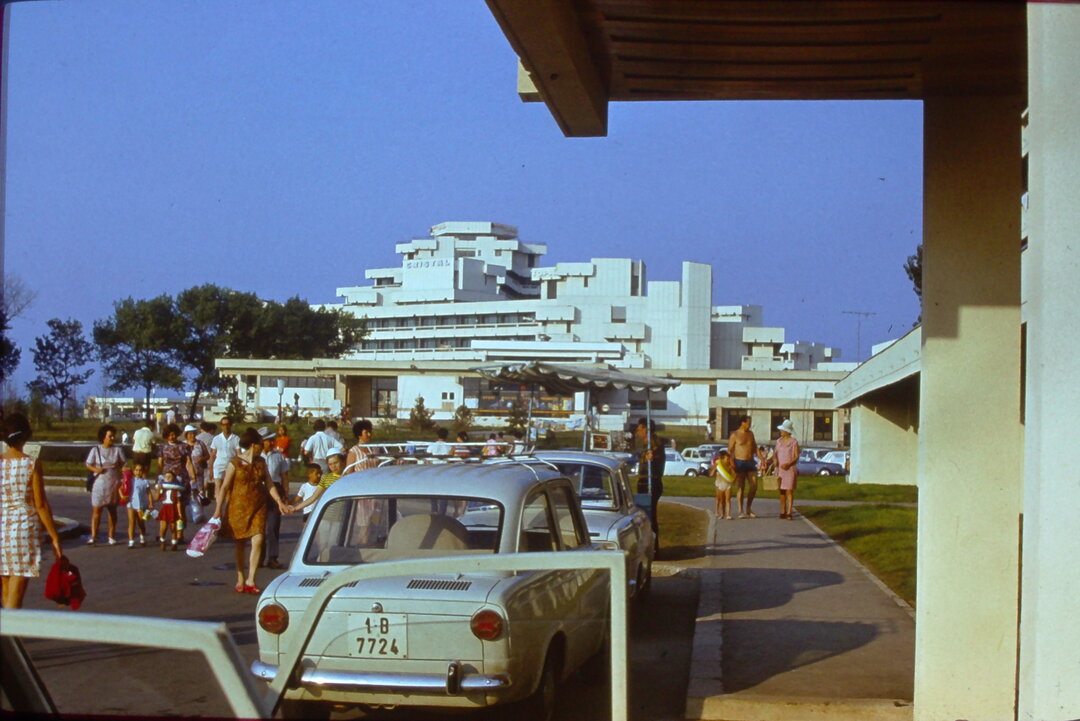
An article in Flacăra summarized the typical program that the average tourist could enjoy in Eforie, a varied combination of educational, cultural and recreational activities including two evenings of dancing. In Eforie, activities took place at the central club and at numbered cultural points: six in Eforie Sud and two in Eforie Nord, similarly equipped with TV, library, records and club games, chess, backgammon, backgammon, and rowing. Mamaia was beginning to differentiate itself, perhaps partly because the foreign tourists staying there - more than 120,000 visitors - came from 36 countries on either side of an Iron Curtain that was still permeable before the Cuban missile crisis of October 1962. Mamaia was known as the "Pearl of the seaside resorts" because of its spectacular growth in just five years, from 14 hotels with 2 815 beds in 1958 to 33 hotels with almost 15 000 beds in 1963, its concern to provide ultramodern comfort, facilities and services designed for an international public, which positioned the resort as a "Riviera of socialism"(Scînteia tineretului, Steaua Rossa, Tribuna). For Eforie Sud, there was talk of opening a "complex of rest houses" with a "restaurant-canteen", while in Mamaia, in addition to 14-12 storey hotels, a casino-bar, a theater, two open-air cinemas and an amusement park on the lakeshore were being completed(Romînia Liberă).
Gradually, it was planned to diversify the leisure facilities with several points of interest in 1964. At Eforie, the former Vraja Mării buffet was redeveloped into a themed night bar in Romanesque style. In Mamaia, villa 29 on the shores of Lake Siutghiol was being transformed into a Romanian restaurant (Miorița), and the three-storey Melody club-bar was being finished, including "a club for amusement games, a night bar with about 400 seats, and booths for orchestra and music-hall performers"(Romînia Liberă). However, as the presentation of the project in the 1/1966 issue of Arhitectura magazine shows, when the building was put into service "a number of functions changed their destination, which led to some confusion and misuse of the spaces - unused terraces, artificially separated entrances, etc.", a symptom of a vision gap between the designer - the Institute of Studies and Design for Construction, Architecture and Systematization (I.S.C.C.A.S.) - and the beneficiary - the Mamaia Hotels and Restaurants Enterprise (I.H.R.).
In addition to the beaches and the accommodation infrastructure, the seaside was becoming a point of attraction for leisure and nightlife. Mamaia had four dedicated venues: Melody, Perla, Casino and Miorița. Other venues were adapting to complete the landscape, but the problems were, more recently, light music and striptease. An investigative report published in 1966 by the Scînteia tineretului noted the discrepancy between the "elevated atmosphere" on the seaside, where "architectural and service efforts are not only aimed at modern comfort but also at a clear aesthetic functionality", and some orchestras that did not show "artistic and decent decorum". Five restaurants played noisy and haphazard music, a repertoire devoid of melodic and lyrical pieces, and Romanian light music was missing. People in positions of responsibility blamed the orchestras, which adapted to the demands of the clientele, because "that's the way it's sung all along the coast. Foreigners like this kind of music". The manager of the Albatros restaurant added: "You should know that young people like this music today. I have a 16-year-old boy and he had the same taste. I slapped him twice and he calmed down. A year later, even the daily Dobrogea Noua didn't really appreciate those "noisy orchestras with a Beatles-style repertoire". In terms of variety programs, Eforie stood out because each night bar (Barul Roman, Western, Cancan, Union and Potcoava de Aur) put on its own show(Scînteia tineretului, Contemporanul). The weak point here was the striptease numbers that did not fit in with the norms of socialist ideology. The historian Cristian Vasile found in the archives a report of the Propaganda and Agitation Section, dated July 8, 19685, which identified this deviation in 5 night bars: Cazinou in Mamaia, Vraja Mării, Potcoava de aur and Cancan in Eforie Nord, and Cazinou in Constanța. At the Potcoava de Aur, the striptease acts followed a story: "the first one suggests the dance of a mechanical puppet who undresses, covered only with a vine leaf; the second a scene related to the medieval custom of the chastity belt, and the third a dancer in search of the bathroom who drops her towel and thus remains completely naked for a few seconds"6. The press had not formulated the criticism so explicitly, presumably not to turn it into an advertisement. The Youth Scintilla was scolding the Golden Horseshoe for the cabaret program which contained some "strident vulgarities that should be brushed off (see the chastity belt scene)".
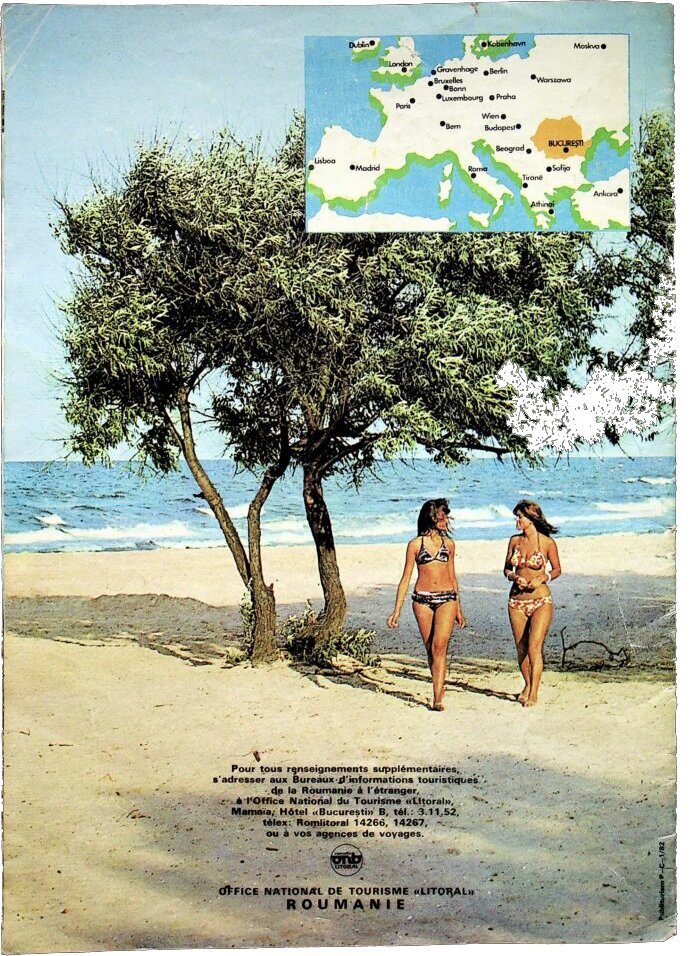
After 1966, Romanian tourism had entered the stage of consolidating the mass tourism offer not only "on the domestic market and that of the socialist countries, but also on the markets of a number of Western European countries", notes Eugeniu Nicolescu, author of a study on tourism marketing7. The accommodation infrastructure added the "famous constellation" of Mangalia (Saturn, Jupiter, Venus, Aurora, Olympus, Neptune) to the "salba of coastal resorts"(For Socialism). The external context was favorable, as the UN had proclaimed 1967 as the International Year of Tourism, an occasion on which Romania decided, along with other European countries, to receive tourists without visas on a reciprocal basis(Lumea, Buletinul oficial). Foreign tourists from the West represented an important source of hard-currency earnings, and attracting them became a priority in the following years.
The international tourist companies Club Méditeranée8 (France), Club339 (Sweden) and Neckermann10 (FRG) started to bring organized groups to Mamaia, where dedicated accommodation and hotel services were built, on the model of all-inclusive holidays. Western tourists, members of these clubs, enjoyed entertainment programs with crayfish dinners (a favorite Nordic dish), Neckermann evenings (with specific German dishes) and Romanian evenings at the Miorița restaurant(Dobrogea nouă, Munca). There was no lack of dancing, with "Romanian dance evenings with foreign tourists", a reflection of the controlled liberalization of the second half of the 1960s, when contacts between Romanians and citizens of other countries were not monitored and limited. Westernization was further accentuated in 1967 with the introduction of new means of entertainment, 80 amusing pinball-type mechanical games and a 12-lane bowling alley(the Red Star). Last but not least, in 1968, the Bureau of Youth Tourism (B.T.T.) was established, a training ground for guides and staff to serve youth groups from abroad.
The earliest mentions of the disco as a DJ-hosted dance venue I have identified in the press from 1969. They were located in Mamaia, at the Swedish clubs 33 and Continentresor, where "a music critic chooses and comments on the best quality light and dance music"(Dobrogea nouă, Scînteia). The press did not specify that all these were private venues, where entrance was paid in foreign currency. Gibi and DJ Vladone, who worked in tourism in '71-'73, helped me to reconstruct the emergence of these first seaside discos. Club 33 was strategically located in a wing of the Bucharest Hotel, the ticket was $1 and it was closed circuit. Andrei Partoș remembers working at the time as a receptionist at the Hotel International, where Club 33's owner and his daughter were staying. Partoș attended the inauguration of Club 33, "a professional disco, with vinyl records and a serious sound system"11. The discotheque operated by Continentresor was called Continent and was located on the ground floor of the Hotel Dacia, in a section of the restaurant. The press of the time mentioned that it was organized by the N.T.O. in collaboration with the Swedish tourism company, and my interlocutors added that Cornel Guriță, the lead singer of the "Olimpic 64" band, contributed to the creation of the disco. Later, in 1973, the Continent was transformed into the Black and White disco, with entry by lei.
Another type of disco was beginning to take shape in the country with the growing activity of student and youth clubs. They organized many other related activities besides dancing. DJ Vladone told me that Athenaeum of Youth, Club 45 at the House of Culture of the 2nd Sector, Club 303, Club A and other faculty clubs were the places where the first generation of disc jockeys was formed, who then worked in the tourist discos on the seaside in the 70s.
At the turn of the century, the political factor was starting to make its presence felt in tourism. The end of 1970 was marked by the meeting of the Executive Committee of the C.C.C. of the P.C.R.C. and the government on November 25, when Ceaușescu criticized the economic efficiency of international tourism, saying that "in the tourist service activity, the level of expenditure remains high compared to the volume of foreign exchange receipts"(Dobrogea Noua). The tourism product for export was profitable, but Ceaușescu was dissatisfied with the slow rate of depreciation. In his book, Eugeniu Nicolescu also suggested an explanation: the "ever sharper international competition" and the fact that Romanian tourism was focused on attracting foreign tourists from the "mass" segment who were not too demanding compared to a more modest but cheap tourist product. Thus, the tourist infrastructure was rather standardized, focused on a single category of comfort, and the facilities and leisure services were low in comparison with similar resorts in Spain, Italy and Yugoslavia12. Romanian tourism scored high in the non-marketable offer, i.e. urban planning, green spaces, beaches, etc., but was deficient in the "profitable offer"13, i.e. the leisure network for sport, entertainment and shopping, which would have brought higher earnings in foreign currency: swimming pools, water sports facilities, bars and discotheques, the commercial network, merchandise and souvenir assortment, etc.
The year 1970, however, brought a few novel projects for the nightlife: in Jupiter, the Paradis tourist complex provided a non-stop program, with a night bar, day bar, brasserie and two swimming pools, and was apparently more often than not booked entirely by foreign firms(Informația Bucureștiului). At Venus, the bar Calipso ingeniously combined the colors red and black on its facade(Flacăra). The local press mentioned the Acapulco bar with a South American music program and a night bar with stereophonic music in Eforie Nord, the Grota Nimfelor in Eforie Sud, and the Auto-night-club in Venus, a themed bar where the tables were made from car wheels. In Mamaia, a Viennese garden with café-concert music had been set up on the terrace of the Hotel Perla, and a disco with music and dancing for young people was opening on the ground floor of the same hotel. Informația del București announced that this was also "the first public disco in the country", with 260 seats, a program from 9pm to 3am and 800 modern dance tunes "at the disposal of music lovers". Called Scotch-Club Stereo, or Scotch Club 45, or simply Scotch Club, the disco also had an interesting story, as it was the materialization of a diploma project entitled "Design, layout, organization and equipment of a disco-bar", supported by business student Otto Bottner(România libera, Scînteia tineretului). A former table tennis champion, Bottner is remembered by my interlocutors, Gibi and DJ Vladone, as one of those who at the time had exceptional professional equipment, having relatives abroad. In 1971, the Scotch Club had already acquired the reputation of an attraction not to be missed, and in 1972 two disc jockeys were working there and the place was full(Dobrogea nouă, Contemporanul). Additional recreational areas were appearing in the resorts, with terraces and restaurants in Mangalia Sud, then, in Jupiter, a bowling alley, sports fields, a disco and a kindergarten at the Tismana hotel for the children of tourists, and in Venus, the Calipso bar had been extended with a brasserie, a bowling alley and a bowling alley(Dobrogea nouă).
International tourism was booming. In addition to Neckermann, new travel companies were concluding contracts with the NTO: Flug Union, Flug Ring, Hummél-Turopa, Kaufhof and Touristik Union International (TUI) from the FRG, the West German ADAC automobile club, Clarkson's from England, Ultramontes from Belgium, Gefco from France and numerous Swedish companies, Continentresor, Vingresor, Trivselresor, Club 33 and Europaresor. O.N.T. was concerned with diversifying the means of recreation and leisure by building swimming pools, sports fields, discotheques, maxi-schess, bowling and mini-bowling, water sports centers, hunting and fishing(Dobrogea nouă, România libera). Among the exclusive venues, Gibi remembers Sunquest, opened in 1971. The place was built according to an English design, there was a snack bar on the ground floor, a disco upstairs, the staff was English (bartenders, DJ), and the cargo came weekly from England by charter.
In February 1971, I.H.R. Mamaia organized a contest for disc jockeys for the disco-clubs in the resort(Informația Bucureștiului). Then, bizarrely, in July 1971, a text appeared calling for the revitalization of the cultural-artistic and entertaining life on the seaside, where the discos, "these newer kinds of night clubs for young people", had a strange, "if not violent" atmosphere, and, what's more, nobody knew what was being played there or what the repertoire was(Dobrogea nouă). What had happened?
The year 1971 was, in fact, clarifying the vision of the party's top leadership of what socialist society should look like. In tourism, and in particular on the coast which concentrated "about half of the country's hotel capacity and about two thirds of the total capacity offered to international tourism"14, it was necessary to harmonize a Western-inspired offer with socialist norms, a process which was not without paradoxical effects. From the perspective of professionalization, in 1971 the relevant institutions were set up, starting with the Ministry of Tourism, the Litoral N.T.O. Centre, the Training and Further Training Centre for Hotel and Tourism Industry Managers (C.F.P.C.I.H.T.)15, and the Centre for Studies and Design for Tourism Promotion16. As far as political interference was concerned, 1971 heralded two major limits, the effects of which became more acute over time. The first was Law no. 23 on the defense of state secrecy(Official Bulletin), which formalized the restriction of direct contacts between Romanian and foreign citizens. The second limit came from the Theses of July17, i.e. 17 proposals for measures put forward by Nicolae Ceausescu and unanimously adopted by the Executive Committee of the P.C.C.R.'s C.C.C. at its meeting of July 6, 1971. In general terms, the Theses condemned "manifestations of cosmopolitanism, the various artistic fashions borrowed from the capitalist world" and aimed at "the socialist, patriotic education of the young generation through work"18. DJ Vladone recalls that the measures applied in the discotheques lasted for about a week, during which the opening hours were shortened to eight, non-alcoholic drinks were served and the music was exclusively Romanian. But the takings were disastrous, so the previous model was reverted to, and the authorities started to regulate the industry, especially as the number of discos was multiplying rapidly. Black and White, Colibri, Sansegal-Club, Select and Tabăra-Nord in Mamaia, then Can-Can, Marea Neagră, Steaua de Mare and Acapulco in Eforie Nord, Grota Nimfelor and Oltenia in Eforie Sud, Discoteca-Barul Tineretului in Neptun, Club 66, Meteo and Tineretului in Jupiter, the Cleopatra discotheque and night bar in Saturn and, last but not least, Zodiac, Orizont and Egreta in Venus-Mangalia Nord(România libera, Flacăra, Dobrogea nouă). In 1973, the Agency for Tourist and Leisure Services was set up, which was in charge of the technical equipment of 12-14 discotheques it had taken over, and in April 1974 the institution announced a "competition to select presenters for the discotheques to be organized in Bucharest, on the seaside and other places in the country"(România libera). Just that....
On the afternoon of Thursday, July 18, 1974, at the seaside, at Neptun, the big powers were discussing the fate of seaside leisure. It was a meeting of the P.C.C.R. Executive Committee, with 33 people, plus 13 invited comrades, plus Nicolae and Elena Ceaușescu. The transcript of the meeting gives not only a rough transcript of the discussion, but also a negative framing of some aspects of tourism. The president had a problem with bars that operated until 4 a.m., even though there was a ruling that they should be open until 1 a.m., and with those programs that came in contradiction with socialist morals and principles. "Even people from abroad who come to us," Ceaușescu added, "don't come to stay in bars until 4 in the morning.19 From the regime's point of view, international tourism was becoming a necessary evil: it was indispensable in terms of foreign exchange and image capital for socialist Romania, but it presented a danger for Romanian youth, and not only for Romanian youth, because of the harmful influence of capitalist ideas, which were reflected in consumer habits, fashion trends and the different conceptions brought by foreign tourists. The answer to the problem came in the form of the progressive isolation of Western guests through a double concentration: a temporal one, i.e. targeting arrivals at the peak of the season, which was somewhat natural from a commercial perspective, and a spatial one, which came with preferential treatment: hotels, accommodation, better quality food and services, priority in service (meals, other services), and exclusivity, such as access to shops selling in foreign currency (Shop), private beaches, discos with foreign currency entry and closed-circuit clubs.
The effects of this double standard policy in Romanian tourism have been multiple and contradictory, and I will mention two: on the one hand, the ghettoization of Romanian citizens in a category II tourism has increased over time, due to the progressive deterioration of the economy and the material base. In a letter intercepted by the Securitate, a tourist complained in 1977 that: "In general, at the beach-table, the elevator I felt discrimination that I cannot describe in any other way than that of the currency"20. Also in the letters intercepted by the Securitate, a woman was outraged by the fact that in Venus there was a big difference "between unionists and N.T.O.s, and in the accommodation and the food. It's a mockery, as if the union gives you tickets for nothing"21. The sociologist Mircea Kivu describes the division of tourists into categories according to social position in: (1) the nomenklatura who relaxed in isolation at Neptun, in villas and hotels managed by the Party Household; (2) the "resourceful" who participated in the secondary economy fueled by the mutual exchange of services and stayed at Mamaia, Neptun, Olimp and Eforie; (3) the "unionists" who came with tickets through the UGSR in resorts rated as modest (Saturn, Venus) and (4) those who, for various reasons, went to the seaside on their own and stayed in host families22. Tourists tended towards a vacation pattern according to aspirations and relationships.
On the other hand, the same double standard of tourism was shaping a new geography of the seaside. It became "the most westernized part of the Romanian landscape", as DJ Mircea Zane put it. The discotheques were an inexhaustible source of Western music, with DJs, anxious to keep up to date with the Western charts, interacting with each other. On January 1, 1975, the Tourist and Leisure Services Agency was transformed into the Leisure and Industrial Production for Tourism Enterprise (I.A.P.I.T.), under the Ministry of Tourism(Official Bulletin). Access to the DJ profession was to be conditional on obtaining a multi-category certificate, which had to be renewed periodically. Towards the end of the decade, the leisure and dance areas were divided according to the resort, the specifics and the public, but also, and not least, the DJ, whose personality defined the disco brand. Some DJs were permanent employees of I.A.A.P.I.T., some worked in the BTT network, others were self-employed with a license, and some also worked "on the side". Those who worked in foreign currency discos were employed as collaborators by foreign tour operators who managed night bars and discos, with entrance fees in foreign currency and opening hours until 3-4 in the morning. Companies such as TUI, Neckermann or Marina Holiday supplied the equipment and music, and the staff (DJs, bartenders, cashiers) were paid according to the local pay scale, as was the case at Scandinavian, Sunquest, Club Castel and Casino Casino in Mamaia, Rainbow in Neptun, Club Paradis in Jupiter, etc.
However, regulation of the sector was moving forward rather slowly, perhaps also because the profitability imposed by the revenue plans set by the state went hand in hand with the circumvention of the rules laid down by the regime, from the opening hours to the repertoire, which should have integrated the best of Romanian pop and light music. In practice, people stayed on past the official closing time of 1am, and DJs elegantly avoided the odds by keeping a tape of Romanian tunes on hand in case of a check. In 1979, the publication Flacăra drew attention to "so-called 'pirate discotheques', without authorization or proper status", operated by enterprising individuals with the right equipment and tools, who were in the business of electronic music equipment and recording services. This is the case of Dorel Văduva, a music collector, former stuntman turned dealer, taken for a pittance in a 1973 article-anchor inRomânia libera (Romania liberă) and later mentioned by Florin-Silviu Ursulescu as the supplier of music cassettes, "on which tapes were printed non-stop"23.
Tourism receipts kept on the upward trend, and the press continued to write about the novelties of the season announced in the already traditional annual press conference organized by the Ministry of Tourism and the Central Tourist Office of the Litoral(România libera). The resorts already had their own brand, and the investments were also reflected in the dynamics of the leisure areas, diversified by I.A.P.I.T. with open-air amusement parks where western music flowed freely, remembers Doru Cetățeanu, DJ. The resort of Costinești was in full swing with numerous festivals, a radio-amplification station had been built and Radio Vacanța Costinești was on the air, the Ring and Vox Maris discotheques were landmarks, the former with a generous open-air dance floor, and the latter with modern technical facilities and a more premium positioning. Last but not least, 'bling' in the youth resort was becoming a socio-cultural phenomenon24.
The structure of nightlife entertainment had reached a balance between 'disco halls (...) and places where you can listen to live music'", noted the publication Săptămîna, which, from 1981 onwards, proposed a selection of the top seaside discos, announcing a new generation of presenters in addition to the "veterans" of the field. The central press was more critical, recommending that the music programs be revised, as "at this time songs from foreign charts were being abused, Romanian music appreciated by young people being non-existent"(România libera).
In 1982, problems began to appear, in the wake of the second oil shock and the disruptions caused by the foreign debt crisis, which made obtaining foreign currency the regime's main concern. The following year, the minister in charge, Nicolae Gavrilescu, commented in the central press on the effects of the world economic crisis on Romanian tourism, namely the fall in the number of foreign tourists, "the main source of economic efficiency in this sector of activity", but also a 5.5% increase in domestic tourism. An "RFE/ RL" report showed that West German tour operators had given up half of their orders25.
Seaside entertainment was gaining a video component through the entrepreneurial spirit of workers in the industry, who saw the commercial potential of the new technology. From 1982 onwards, the publication Săptămîna noted the proliferation of video discotheques on the seaside and dance programs containing "top video sequences". Doru Cetățeanu told me about his idea to set up a baby-club in Mamaia with a cartoon program, which was very popular with young and old alike. The transition from Betamax technology to the more affordable VHS contributed to the proliferation of video libraries across the country, but also to the specialization in video of informal networks of Western music buyers and recordists, including disc jockeys, who specialized in video. The bulk of the videotape business, however, was to be developed by the Securitate, through the entrepreneur Zamfir26. On the seaside, the new medium was also gaining ground through "training courses for sound and video library presenters" organized by the B.T.T. from 17 to 20 May 1984 in Costinești, and through investments made by I.A.P.I.T.
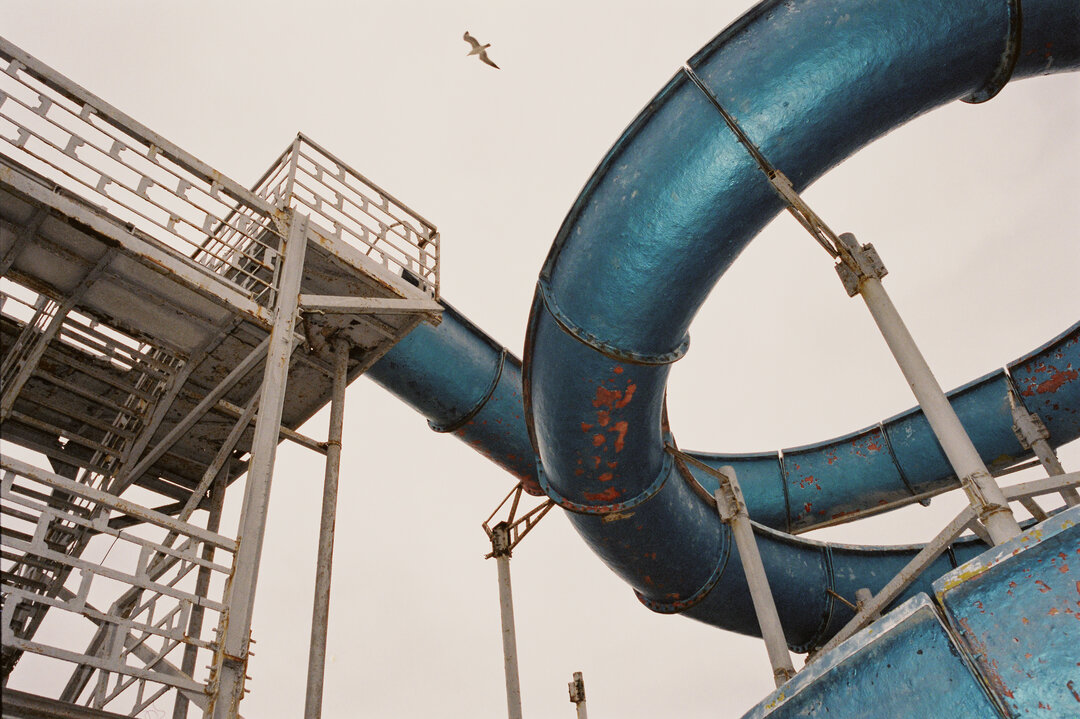
In January 1985, a plan for the rational use of energy was adopted, in the context of a long and very cold winter. Energy saving was also affecting tourism, as the opening hours of public eating establishments, including bars and discotheques, were not to exceed 22.00. Not for foreigners. The start of the summer season brought a series of renovations and modernizations, a new amusement center in Saturn, five water slides in Mamaia, Eforie Nord and Mangalia, and 29 video arcades in all resorts(Flacăra). For Costache Zmeu, deputy minister of tourism, the extension of the network of video libraries in tourism was intended to offer "working people, especially on vacation, a more pleasant and, at the same time, more instructive stay". In addition, through collaboration between I.A.P.I.T.I. and the Ministry of Tourism, closed-circuit TV networks in hotels were being expanded on the seaside, with programs broadcast by cable from video cassettes(Flacăra)27. Ion Tudorancea, an engineer at the I.A.P.P.I.T., told me that the programs, made up of films, music, cartoons and sports, were approved by the Council of Socialist Culture and Education (C.C.C.E.S.)28. It was the same body that approved the lists of songs played in discotheques, regulations that disc jockeys complied with little or not at all. How far and how these rules were circumvented in cable TV practice remains to be seen. Except.
A circular issued by the C.C.C.E.S. in June 1985 and signed by Suzana Gâdea, the institution's president, stipulated that "all videotape libraries, regardless of their subordination, the owner of the equipment or the operating regime, will cease their activity"29. Only discotheques with their own equipment could continue to operate, plus video and foreign tourists' discotheques and discotheques with payment in foreign currency. The I.A.P.P.I.T. had its own equipment, but on July 21, 1985, it issued a delegation on the basis of which an employee was to collect at the head office "all video cassette recorders and color televisions in the equipment of the video discotheques of the I.A.P.I.T."30. On December 15, 1985, the C.C.C.E.S. approved a series of strict rules for the organization of disco programs31, such as Romanian songs in the proportion of at least 2/3 of the total music presented and the translation into Romanian of texts in foreign languages. In addition, it was forbidden to organize in public video club programs, except, of course, for venues for foreign tourists, with the payment of entrance fees in foreign currency. The public offensive against video libraries for Romanians only served to push the phenomenon into the private sphere, and in a short time, watching movies on video cassettes became "a national pastime", remembers DJ Tinu Sebeșanu.
The music and movies that circulated on video cassettes played an important role in shaping a new cultural phenomenon that had an impact on the dance component of the disco - the break-dance craze. In the press, the first mentions appeared in 1984, with a short text about the dance that was all the rage in the United States, "a sort of mix between disco and acrobatics"(Scînteia tineretului). In parallel with the infusion of Western pop culture coming through music and films, through discos and video theatres, cultural centres began to organize dance classes and train amateur groups for youth competitions and shows. Andrei Partoș recalls that breakdance groups from all over the country would often come to Vox Maris and ask to be allowed to give short demonstrations on the disco floor. With the seaside setting the tone, Sorin Lupașcu, a DJ at the Ring disco, picked up on the trend and then organized breakdance competitions in Iasi, at the student disco Club CH. The breakdance phenomenon is also linked to the creation of the Youth Dance Music Competition in 1985. Valerian Mareș, the organizer of the three editions (1985 in Bucharest, 1987 and 1989 in Costinești), told me how the contest was supposed to solve two major problems of the time: the lack of Romanian dance music in the discos and the fact that only foreign music was played in these places. Many songs presented in the competitions were accompanied by contemporary dance choreographies, including breakdance groups.
The year 1986 was proving bad for tourism in a number of ways: the Chernobyl nuclear accident had greatly thinned the ranks of foreign tourists to the Eastern Bloc countries, and many of those who did visit the country expressed their dissatisfaction with the bad food and discomfort with the reduced street lighting32. In the summer season, even if it got darklater, energy savings cast the coastline into desolate darkness. Also in 1986, it was decided that the night-club program on the foreign currency would also end at 10 p.m., a decision that reduced cooperation with foreignfirms and tourist groups. Opinions are divided on the reason for the decision - a diplomatic incident in the Cazinou foreign exchange nightclub in Mamaia, a hooligan demonstration near a foreign exchange nightclub in Neptun, the loud music that was playing from the lake to Ceausescu's villa in the evening. On top of all this, however, there was the general irritation of the higher party and state leadership (Nicolae and Elena Ceaușescu) that working people had to come on vacation to rest, not to have fun, so that they would be fit for work when they returned from their vacation. In other words, a return to the vision of the 50s.
Over the next three years, the industry adapted to the austere conditions with a variety of different solutions: solar panels were used to heat domestic and swimming pool water , exotic landscapes were created with ornamental trees and shrubs, hotel facades were painted in pastel colours, restaurant lounges were reorganized with more intimate spaces, etc.(Picturesque Romania, The Bell). For recreation, some hotels offered the service of "renting TV sets with internal video circuit" or organized clubs where "tourists, without leaving the hotel where they were staying, could watch films, play games or simply dance in a pleasant atmosphere". In Eforie Nord there were aerobics centers in Eforie Nord, and in Mamaia a "roller-ring track (a place for roller-skating)" was built(România libera). The summer season included musical and entertainment shows, Costinești remained the "cultural-artistic capital" of the seaside, and for music-hall entertainment the bars Melody in Mamaia, International in Olimp, Calypso in Venus and Paradis in Jupiter were mentioned(România libera, România pitorească, Flacăra). Discos were still present in the landscape, but their publicistic framing seemed to suffer a downgrade; the Săptămîna lacked a selection of the top places in the resorts and recommendations about DJs, and the "Agenda B.T.T." column in the Scînteia tineretului placed the disco in the mold of a place that was not just for dancing, but was also "a place where a series of cultural-educational activities take place: meetings with well-known musicians and actors, who present mini-shows of young music and short recitals that are very popular with young people".
The chronological journey through the leisure and night-time entertainment on the coast of the communist period has generated a seemingly paradoxical association of places: casino, cultural hostel, restaurant with music and antren, disco, video and disco. They all hosted moments of socializing and relaxation for holidaymakers who were enjoying a break from the daily routine. As the regime began to restrict and control social life, the seaside was one of the few spaces that accommodated creative projects and initiatives uncontaminated by propaganda.
The reconstruction of the places of entertainment and dance shows how not only the architecture, appearance and function of the entertainment venues were transformed, but also the way leisure was conceived, the vision of the holiday and the profile of the tourist for whom it was intended. Broadly speaking, there are moments of ideological (de)tension, but at the same time a number of paradoxes also emerge that do not fit in with the political determinants of the time. On the other hand, the historical reconstruction, coupled with a sociological and anthropological perspective, reveals seaside tourism as a space of negotiation between three categories of actors: consumers, decision-makers and workers in the field. The latter are a less well studied category of mediators. Beyond the anecdotal stories and characters that populate the collective imaginary of the seaside during the communist period, the analysis of everyday, utilitarian and routine practices reveals numerous examples of (minimal) deviations from the rules that eventually led to their re-negotiation.
I conclude with one last trip back in time, to the Casino in Eforie Sud, in the summer season after the revolution, via a report in the pages of the weekly Flacăra. Yes, it's the former casino in the "Carmen Sylva" resort, which became a cultural hostel when the place was renamed "Vasile Roaită" and then transformed into a restaurant that adapted to the new tourist geography of the seaside resort of Eforie Sud. In those days of August 1990, the place was full, well-stocked, with prompt service and an extended restaurant and disco program. Except that the establishment had emerged from communism looking "like a canteen".
1 Alexei Yurchak, Everything Was Forever, Until It Was No More: The Last Soviet Generation, Princeton University Press, 2006, p. 8.
2 The former "Movilă" casino, built in modernist style by Atta Cerchez, cf. Sergiu Iosipescu and Raluca Iosipescu, "Movilă Tekirghiol - Carmen Sylva - Eforie. Cercetări pentru reconstituirea peisajului istoric", Journal of Historical Monuments no. 2-3, 2018-2021.
3 Trade union body established in 1906, then reorganized in 1945 as the General Confederation of Labour, as the only workers' union. In 1966 it reverted to its original name, Uniunea Generală a Sindicatelor din România, www. ugsr.ro/despre-noi-ugsr.
4 Defined, in 1971, as tourism "practiced by large circles of people with low purchasing power. It is facilitated by very special, affordable services, cf. Dragomirescu, C. M. Ștefănescu, "Glossary of terms used in the geography of tourism", in Proceedings of the II National Colloquium on the Geography of Tourism, Bucharest, 1971, p. 59. The state subsidized this form of tourism with holiday vouchers that included accommodation, meals and train tickets, distributed through the factories' unions.
5 Cristian Vasile, Intellectual and artistic life in the first decade of the Ceaușescu regime. 1965-1975, Humanitas Publishing House, Bucharest, pp. 71-74. See also 'Striptease shows under communism', www.lapunkt.ro, August 2021.
6 Idem.
7 Eugeniu Nicolescu, Marketingul în turism, Bucharest, Editura Sport Turism, 1975, pp. 250-251. In 1967, conventions on the abolition of visas for business and private travel were signed with Bulgaria and Yugoslavia, in 1968 with Norway, Czechoslovakia, Austria, Finland, Sweden, in 1969 with the USSR, and in 1971 with the GDR and Poland(Official Bulletin).
8 Founded in 1950, Club Méditerranée, also known as Club Med, offered members vacation packages with accommodation, food, drinks, recreational activities and entertainment, all included in a fixed price. In Mamaia, the Club Méditerranée vacation village opened in 1967 and was called "Thalassa".
9 Club 33 was a brand of the Swedish travel company Vingresor. "Club 33" designated a package of services for travelers between 18 and 33 years of age.
10 Neckermann offered all-inclusive holiday packages at affordable prices and helped to popularize travel abroad for families and individuals who did not have the resources or means to organize their own holidays. The newspaper Dobrogea nouă mentioned several hotels (Sirena, Tomis, Parc) as hosts for tourists brought by Neckermann since 1963.
11 Andrei Partoș worked as a DJ on the seaside and was music editor at Radio Vacanța Costinești in the 1980s, "Despre discotecile anilor '70-'80", November 15, 2017, https://andreipartos.ro/andrei-partos-despre-discotecile-anilor-70-80-partea-i.
12 A comparative survey conducted in 1970 by O.N.T.
13 Eugeniu Nicolescu, op. cit., pp. 255-256.
14 Eugeniu Nicolescu, op. cit., p. 245.
15 With funding from the United Nations Development Program.
16 Reorganized in 1974 as the Economic Research Centre for the Promotion of International Tourism, then transformed into the Institute of Domestic Trade and Tourism Economics in September 1977.
17 The July 1971 thesis is sometimes erroneously positioned as a direct effect of Ceaușescu's Asian tour of China, North Korea, North Vietnam and Mongolia. Recent studies place the end of controlled liberalization towards the late 60s.
18 Nicolae Ceaușescu, Proposals for measures to improve political-ideological activity, Marxist-Leninist education of party members, of all working people, Editura Politică, Bucharest 1971, p. 13.
19 ANIC, CC of the RCP, Chancellery Section, only 82/ 1974, ff.15. Decree no. 51 of May 30, 1975 stipulated that the opening hours of restaurants, night bars and similar establishments could not exceed 1 a.m.
20 CNSAS, Directorate for Research, Exhibitions, Publications, Educational Programs Service, "Romania under surveillance" project, accessible online at http://www.cnsas.ro/documente/judete/Constanta/10.pdf, pp. 4-6.
21 CNSAS, op. cit.
22 Mircea Kivu, "Refrene comuniste - vacanță la mare", in Dilema veche, no. 545, July 24-30, 2014.
23 Florin-Silviu Ursulescu, "Cine dădea muzică la toată România?", in Radu Lupașcu (coord.), Arta Sunetelor. Antologie, Editura Adenium, Iași, 2015, pp. 21-32.
24 Mariana Iancu, "Andrei Partoș, vocea Costineștiului de altădată", https://adevarul.ro/stiri-locale/constanta/andrei-partos-vocea-costinestiului-de-altadata-2177660.html.
25 Ioana Angelescu, "Tourism" in Radio Free Europe Research, RFE-RL Situation Report/ 9, May 24, 1983, p. 23.
26 Liviu Tofan, Stejărel Olaru, "It was like in the movies. Security's Biggest Deal", March 2024, Matca Literară, https://matcaliterara.ro/a-fost-ca-n-filme-cea-mai-mare-afacere-a-securitatii/.
27 Also in January, it was decided to reduce the Romanian Television's programming to a historical minimum of two hours during weekdays (since January 14, 1985).
28 Ministry of Culture titles between 1971-1989.
29 Bacău County Archives, Bacău County Committee of Culture and Socialist Education Fund, File 1/ 1985, f. 201.
30 IAPIT, Delegation no. 4561/ 21.06.1985 (Ion Tudorancea archive).
31 Arhivele Județene Bacău, Fond Comitetul Județean de Cultură și Educație Socialistă Bacău, Dosar 8/ 1985, pp. 42-67.
32 Carmen Pompey, "The Tourist Trade", in Radio Free Europe Research, RFE-RL Situation Report, July 17, 1986.