Seaside. A published chronology

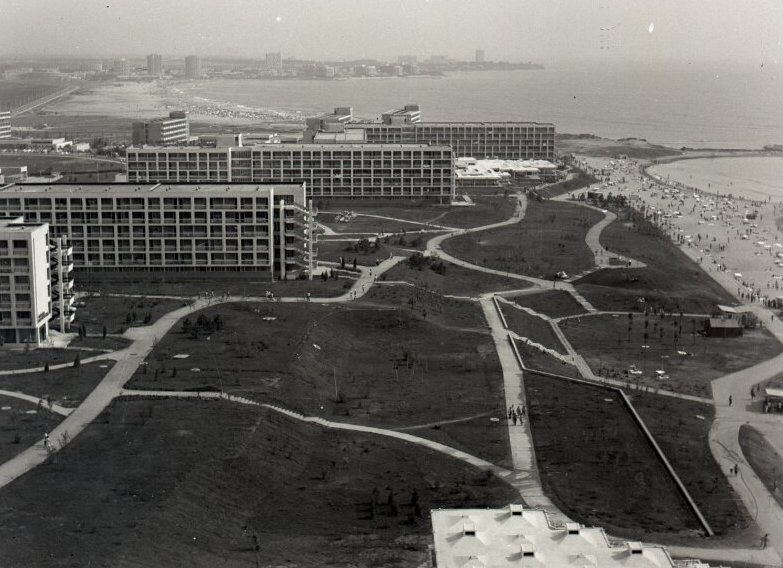
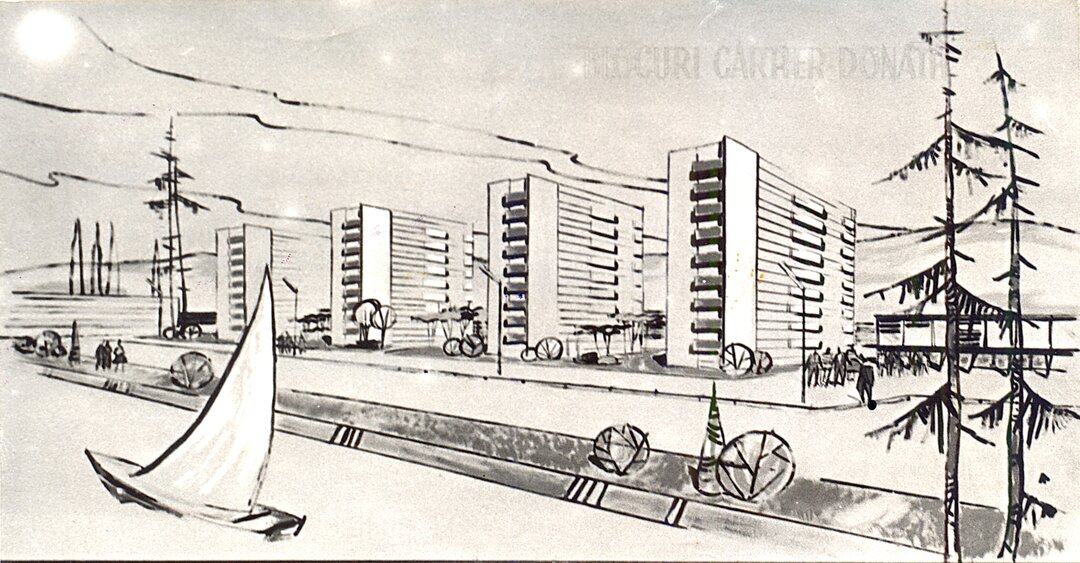
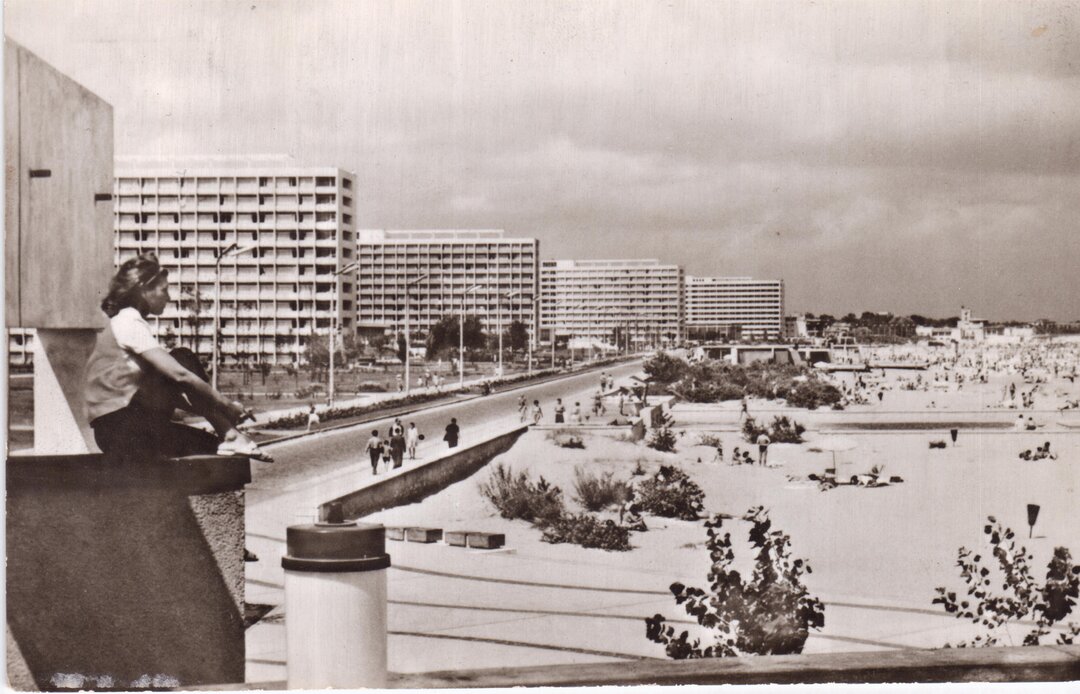
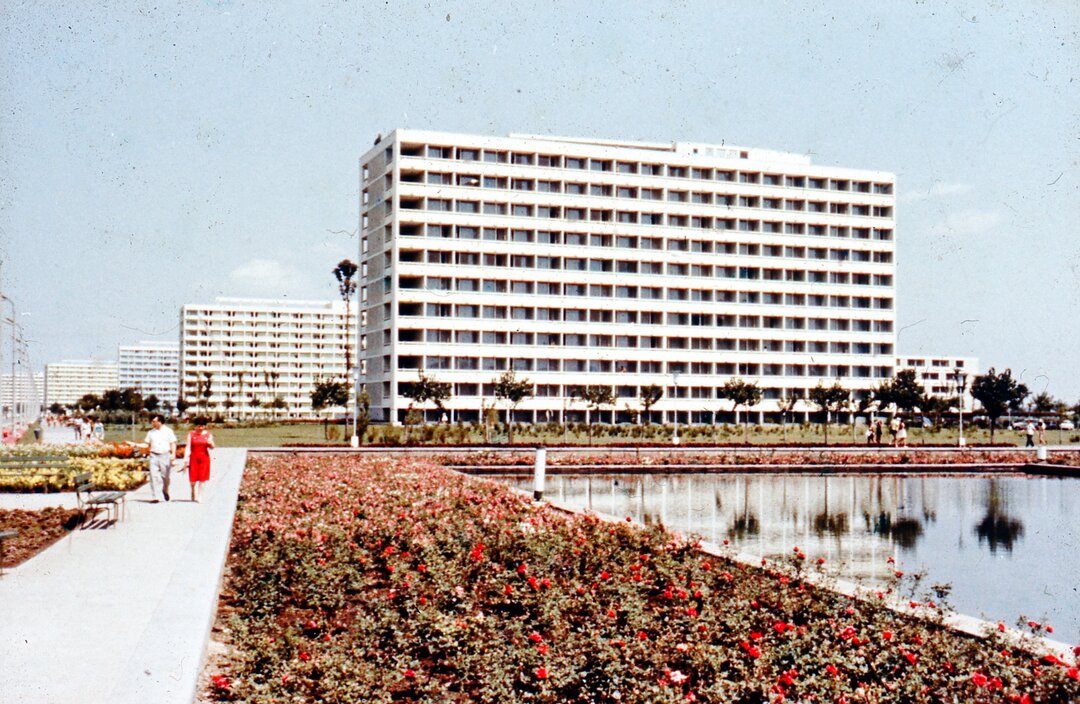
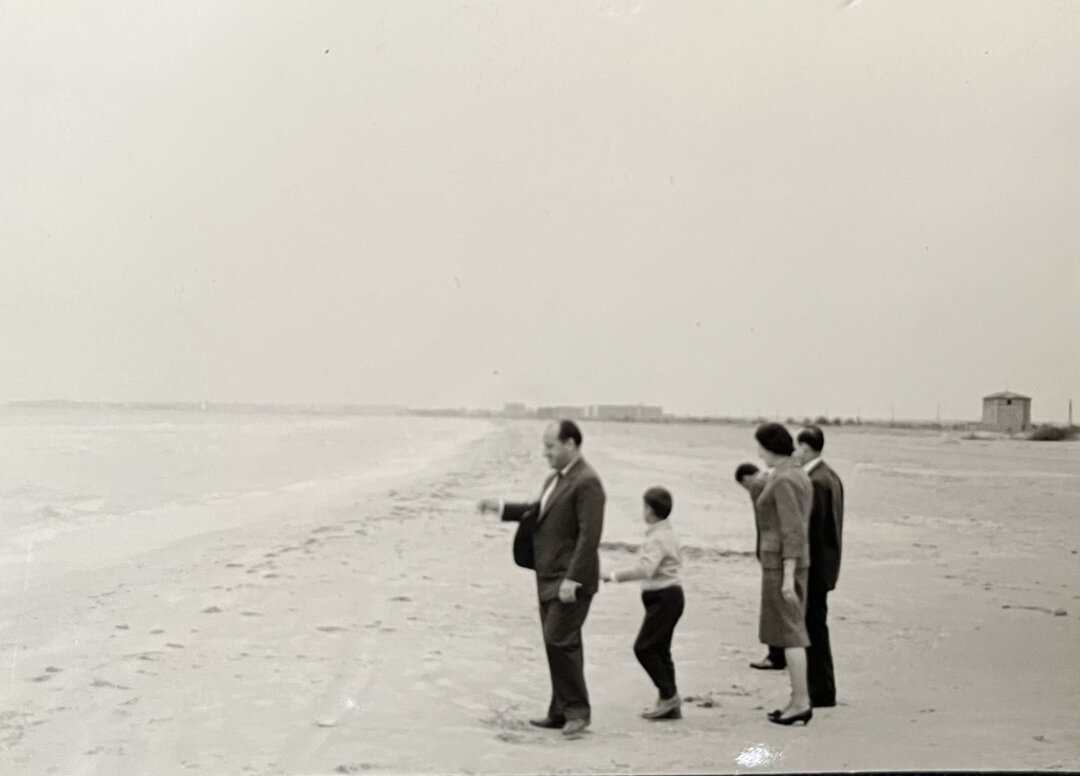
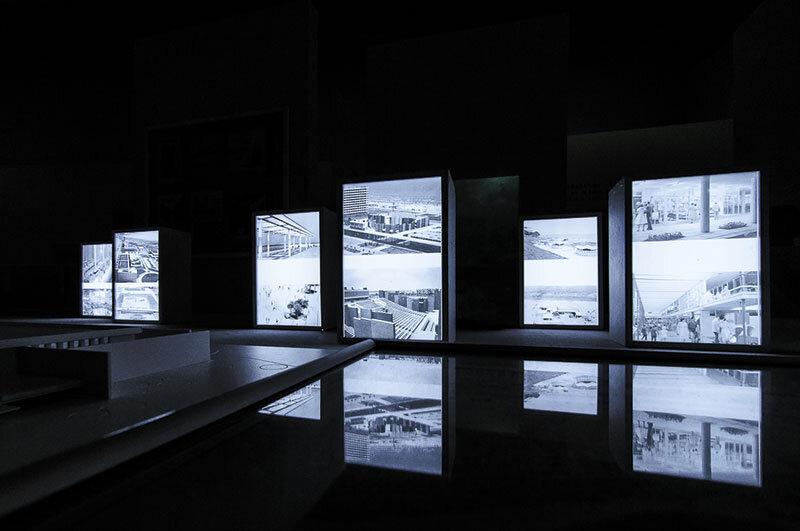
The current shape of the Romanian seaside was materialized after a particularly ambitious project started in the mid-1950s, the first architectural expressions with a different aesthetic began to appear at the end of the same decade. The extensive team led by Cezar Lăzărescu (the newpeople1, as he referred to them in an early monograph of events), created a utopian scenography that corresponded to the socialist ideals of the period in a country in full development1.
Tourism, identified as a response to the essential needs2 of the human being (evolved man with spiritual concerns, in addition to those of the working class), gained an extraordinary impetus in the 1960s - the local case is not unique, as there are precedents in other countries in Eastern Europe, and even in the West. In the case of the coastline, specific architectural programs, based on an internationalapproach3 to functional solutions, are interwoven with the almost wild natural setting, with a clear intention to protect the specific element2. The architectural plasticity that encouraged optimism and the spirit of seaside holidays3 became a canon for the image of the place in those years. Very soon, the work of the design collective came to be recognized as an experiment, both creatively and constructively, and the achievements were later translated into urban projects in the rest of the country1.
In introducing the spaces that provided holiday entertainment - resort shopping malls, restaurants and bars - reference should be made to the nefarious, but at least amusing at the moment, term socio-cultural amenities. It often appeared in the technical jargon of the period, either in this or in the construction jargon, and encompassed almost all functions that did not include the residential, administrative or industrial components. It was used several times in the RPR's Arhitectura RPR magazine from the 60s onwards.
Preferred in the syntagma endowments, not construction (on the premise that it is closer to a current term of the period, facility4), it defines specialized programs to meet immediate human or spiritual needs4. In any case, now, it seems at least an artificial way of categorizing taverns where the Romanian worker served meals by day and partied in the evening, or shops that induced the superficial illusion of consumption. A little later, however, things would be linked to the propaganda tool that these destinations were supporting.
Almost naturally, the seaside project synchronized with the general interest in commercial and tourism programs. According to the directives of the 3rd Congress of the P.M.R., the aim was to double the volume of merchandise trade by 1965, with a simultaneous increase in the number of commercial establishments by a further five thousand premises5. In the following five-year period (1966-1970), huge investments were planned in various establishments belonging to the Ministry of Internal Trade, with three quarters of the budget being directed to tourist and commercial establishments on the Black Sea6. New premises dedicated to this particular programme will be built, and existing premises will be adapted to the needs of the moment, extended or reorganized6.
Within this permanent framework of the development of the new sector, a contemporary variant of original architecture with an indigenous character has also been sought7. The more than expressive nature and the punctual (non-typical) treatment of the commercial complexes, but also of the service units, contributed to the sedimentation of the new style8.
ACTIVE LEISURE. It seems very difficult to convince a people who work six days a week of the spiritual implication of their efforts. But if you link it with the idea of leisure, not as an opposite, but as a complementary element of human activity, intimate9 and organic, things change. In the socialist spectrum, leisure goes beyond the valence of rest and detachment, to it is added an active, sustained component. For there to be a balance and usefulness of time, not just a passive state of the individual, both action and effort are required.10 Ironically, this was sought and motivated by recent scientific and technical progress, which would have predicted a rise in cultural levels, orienting the society of the time towards a leisure society in the very near future.9
This type of controlled leisure, which was ordered to have a cultural valence10, is correlated with the new practice of tourism. As an area of activity fully financed and administered by the state, it was aimed at a series of results in the field of workers' education and culture, social and political implications, not a commercial end7. As desired, the man of that time was to identify himself with a high spiritual development, based on adherence to various social programs that would arouse his potential8.
In the last 20 years, tourism has developed more than fivefold, influenced in particular by the built environment, which in turn is determined by this human need to rest by satisfying curiosity and discovering nature1. At the time, it was speculated that the volume of tourist activities would double every ten years7.
The propaganda scenery, was composed of extraordinary architectural objects, whose function was not only to feed and entertain the tourist, but also to educate - at once through a strong visual stimulus, but also through the prism of other activities they integrated and promoted. Moving beyond rigid approaches focused strictly on solving spaces and functions, the new retail and food programs complemented the surrounding environment. They were literally open to the natural setting - which attracted the visitor's interest, took into account the specificity of the site and the typology of the terrain, and these principles were declared essential in the design process1.
In an attempt to support and motivate the approach to the natural element and the plastic approached, through the architects' response, as well as the cultural value of the final product, Cezar Lăzărescu draws a parallel with the evolution of resorts in consumer economies, which was guided by profit1 (ultimately driving tourists away). Even if at the time, more than 50 years ago, it was a professional supposition, with a political desideratum behind it, it ends up becoming a fateful premonition for the state of today's resorts and especially the former shopping centers and restaurants of that time.
In the early 1960s, aesthetically and formally, architectural practice in the West was engaged in a collective effort to detach itself from the purist rationalism of the modern idiom and move towards a more lyrical approach to building11. The changes that had taken place in the preceding years were confusing in terms of language, but also an opportunity for a new orientation - functionalism was no longer an absolute factor in architectural expression11. The design teams tried to come up with contemporary solutions for the commercial spaces, restaurants and bars on the seaside (as for the other objects that made up the complexes), seeking to create a new image of their own, which would break away from existing traditions11. In fact, these spaces dedicated to leisure, in terms of their shape, volume and, above all, materiality, are more reminiscent of the practice of European architects overseas in the second half of the 20th century than of what was happening on the continent. Perhaps not by chance, Cezar Lăzărescu, having had the chance to travel widely at a time when this was an intangible privilege of the profession, even reached America11 - where, at the time, architects such as Richard Neutra (who, in 1967, also visited the Bucharest School of Architecture during a tour of the socialist countries12, receiving the title of Doctor Honoris Causa), Marcel Breuer and others, who came before or immediately after the War, were working. He was moved by Frank L. Wright's principles of organic architecture, situating man in the natural element and facilitating, through architecture, a direct and harmonious communication with the environment11. It seemed only natural to him that tourism programs should have a localcolor2, that they should relate to the particular elements of the place where they are to be realized. Moreover, in retrospect, he himself said that he would not describe seaside architecture as modern, modern being somethingperishable11, being more interested in the success and appreciation of the works over the years and, above all, their place in time.
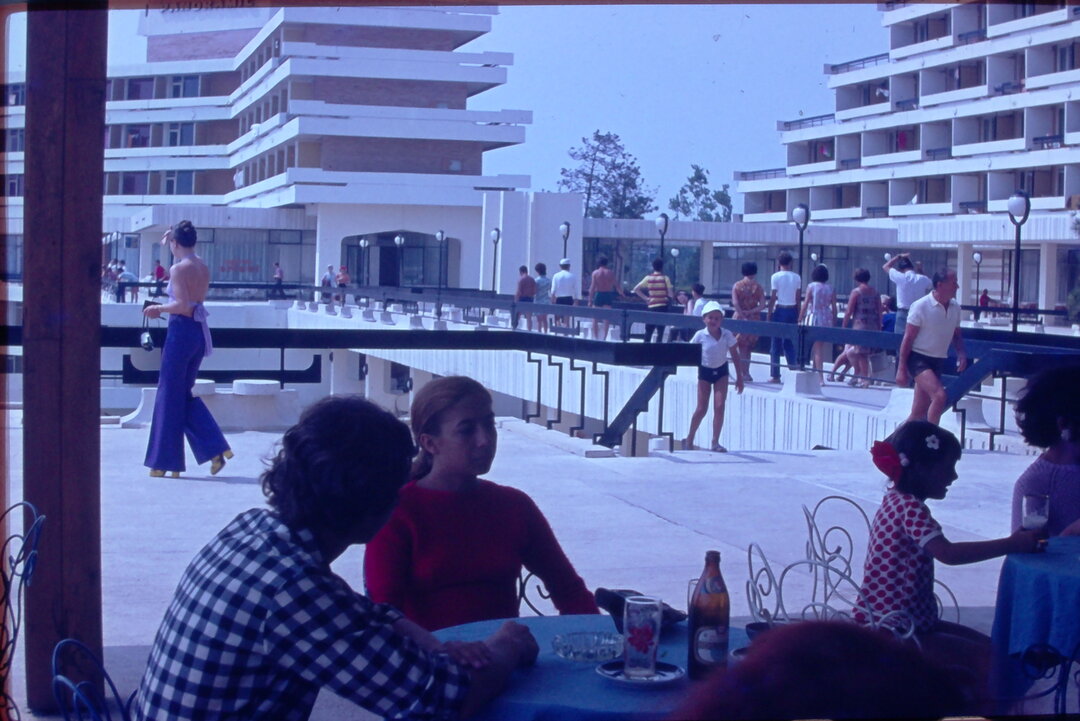
In addition to new and attractive architecture and a natural belonging to the site, tourist facilities for commerce and catering have to take account of the versatility of the use of the space, as tourism brings together people of very different ages, nationalities and backgrounds6. Indeed, they did; at once through the large number of functions brought together, such as: various groupings of shops diversified in terms of profile and public, small spaces with a cultural flavor, but above all through the way they were used according to the changing needs of tourists (from the canteen serving meals during the day in the evenings to its transformation into a disco at night). In the following, a few emblematic programs in each category will be briefly presented, each representing an individual project that has marked for years the image and collective memory of the resorts where it was located.
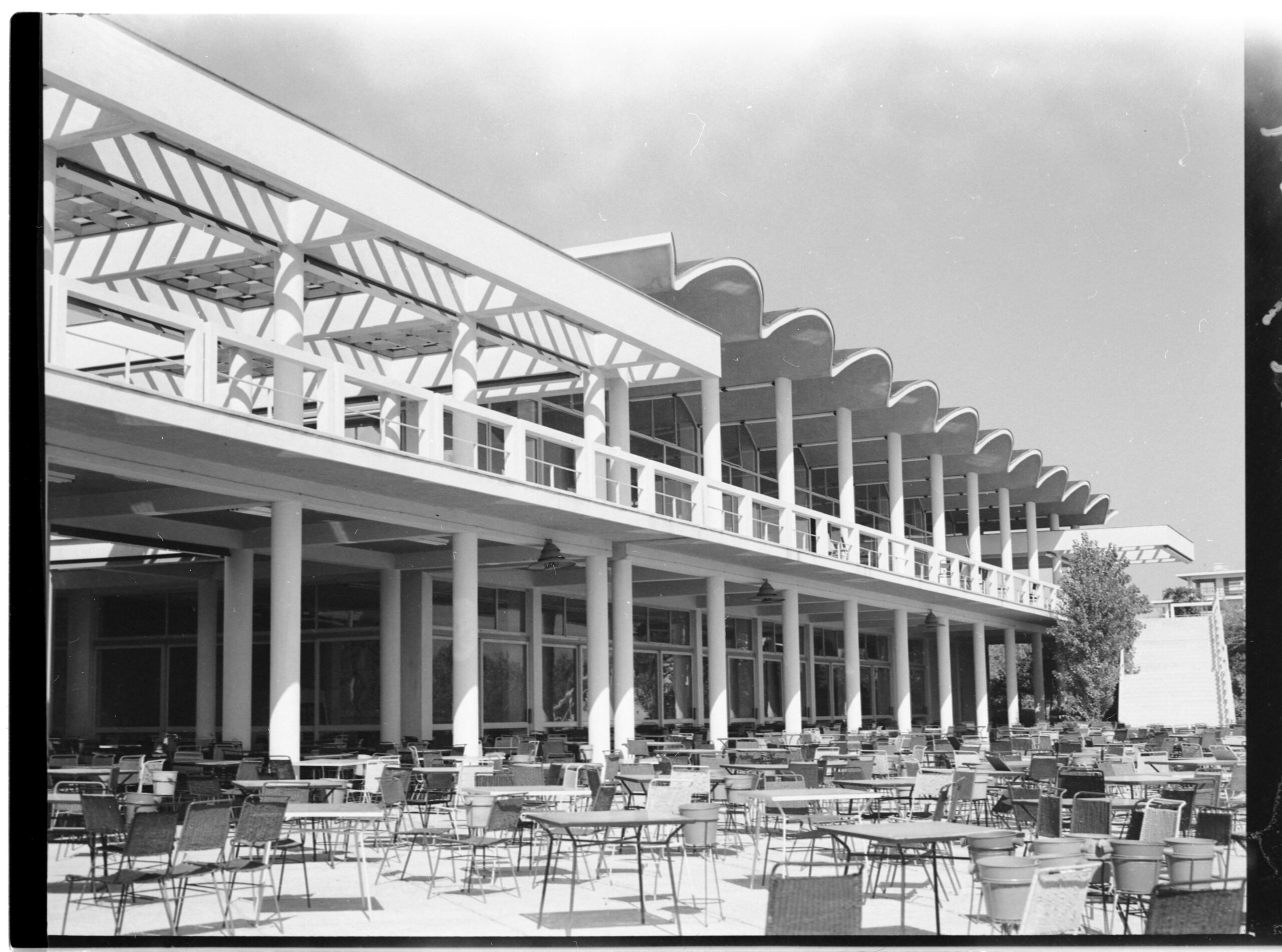
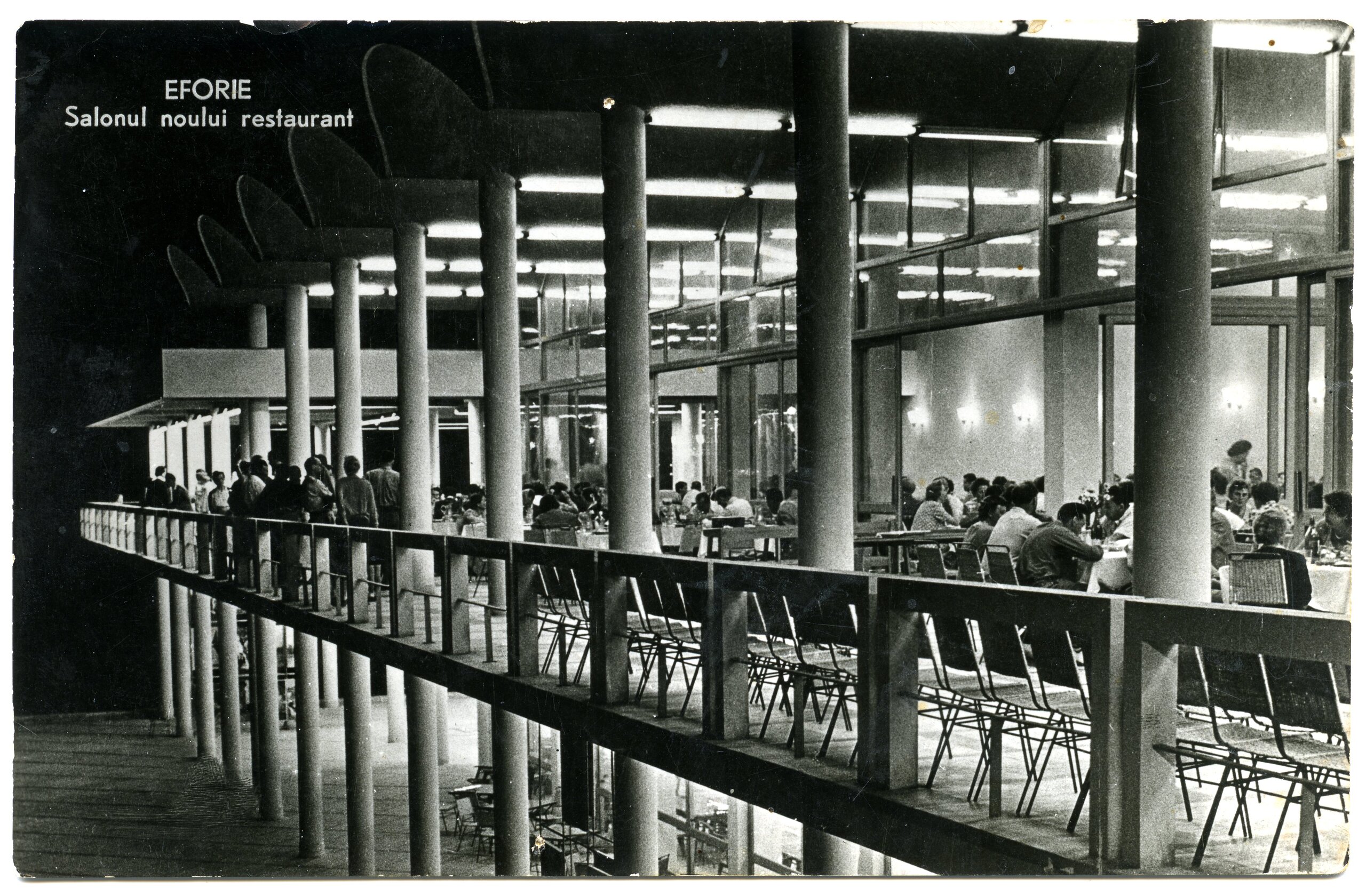
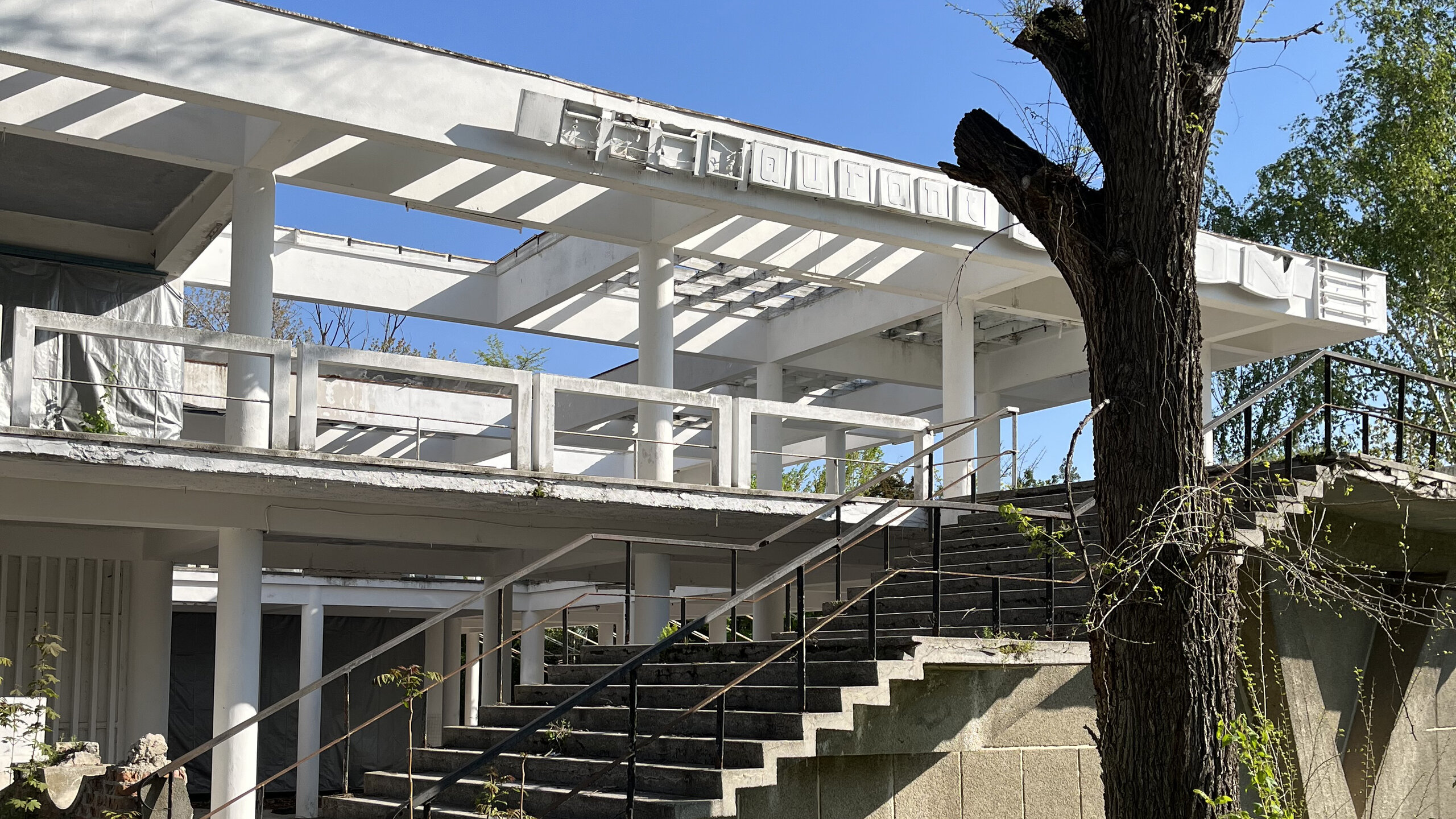
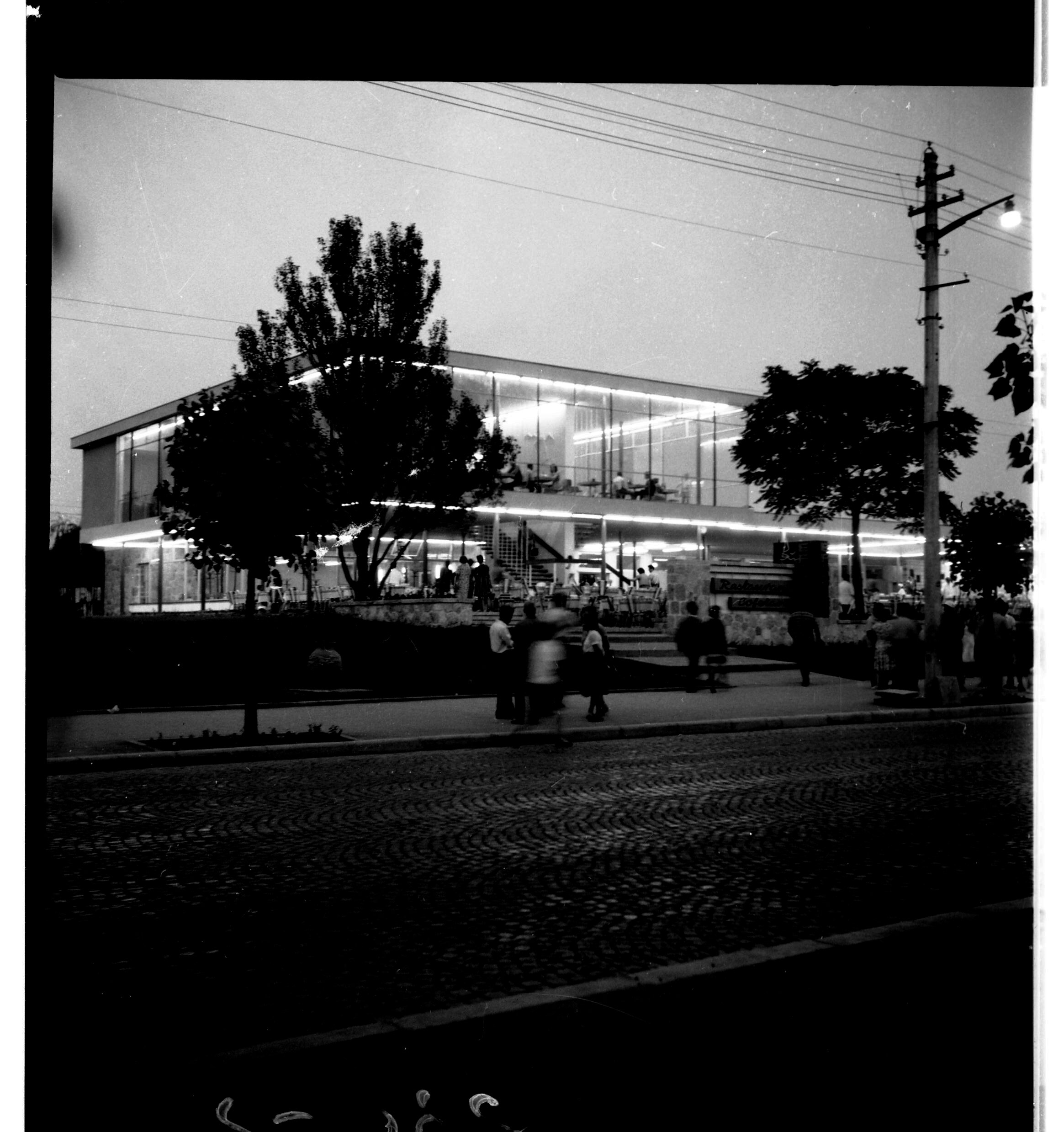
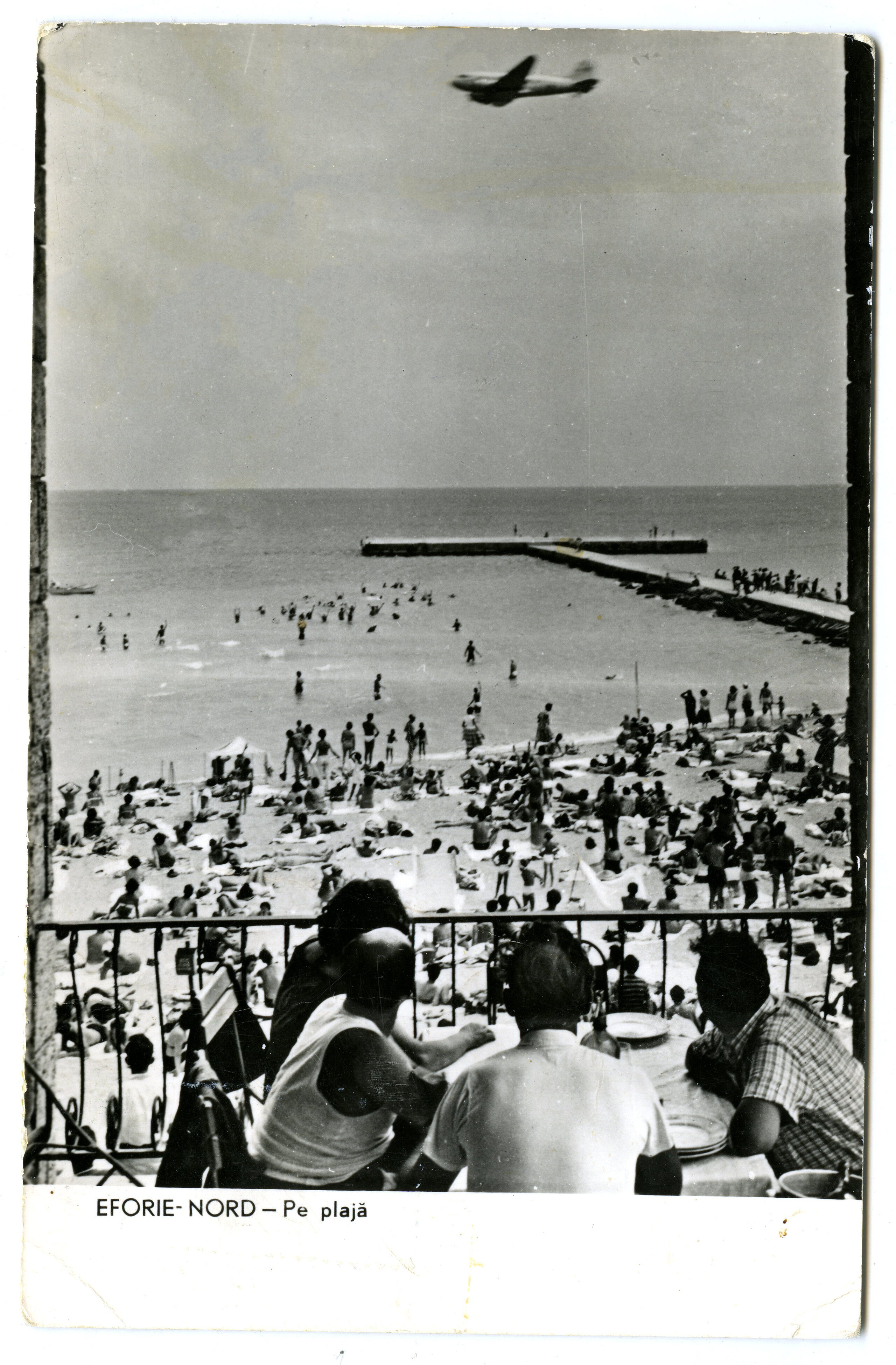
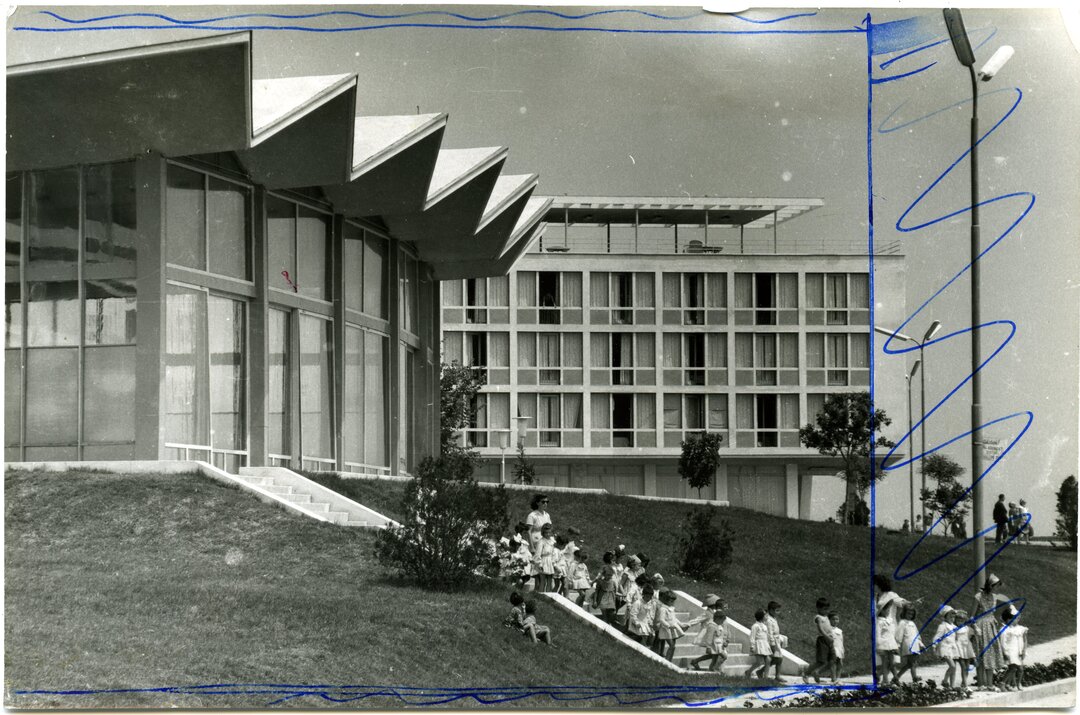
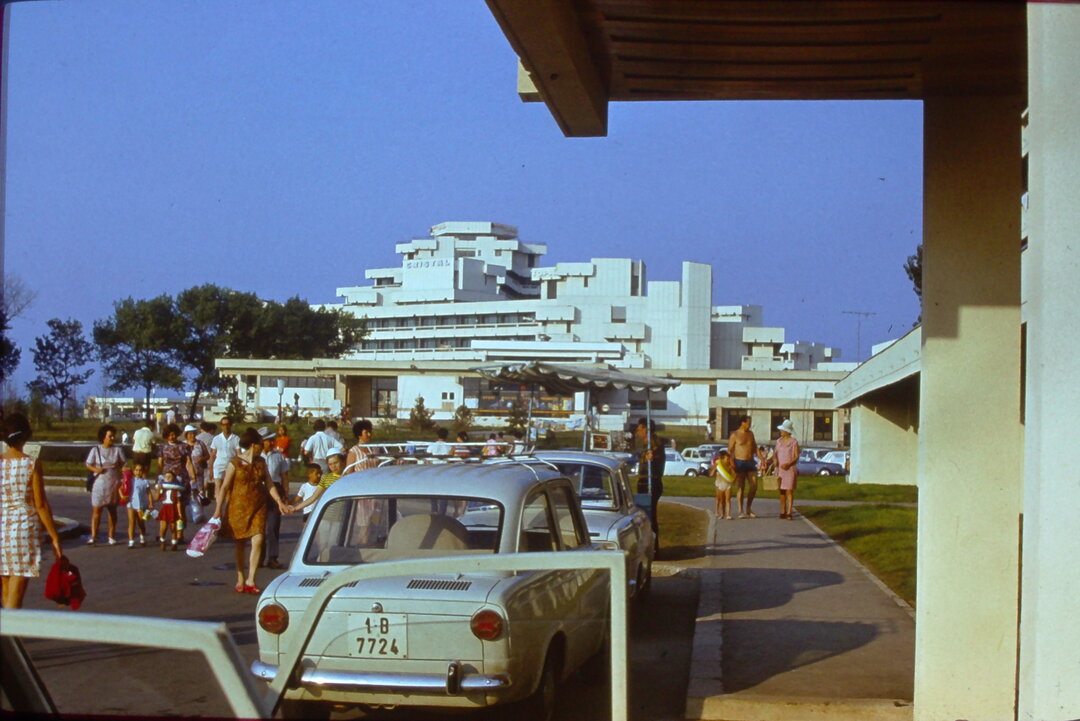
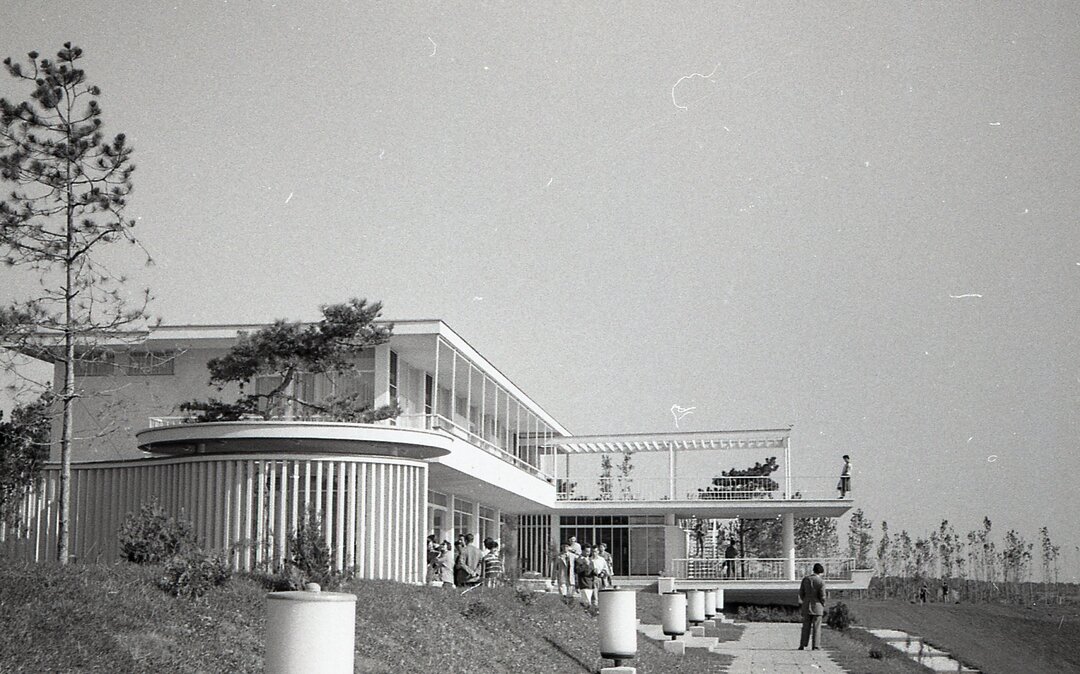
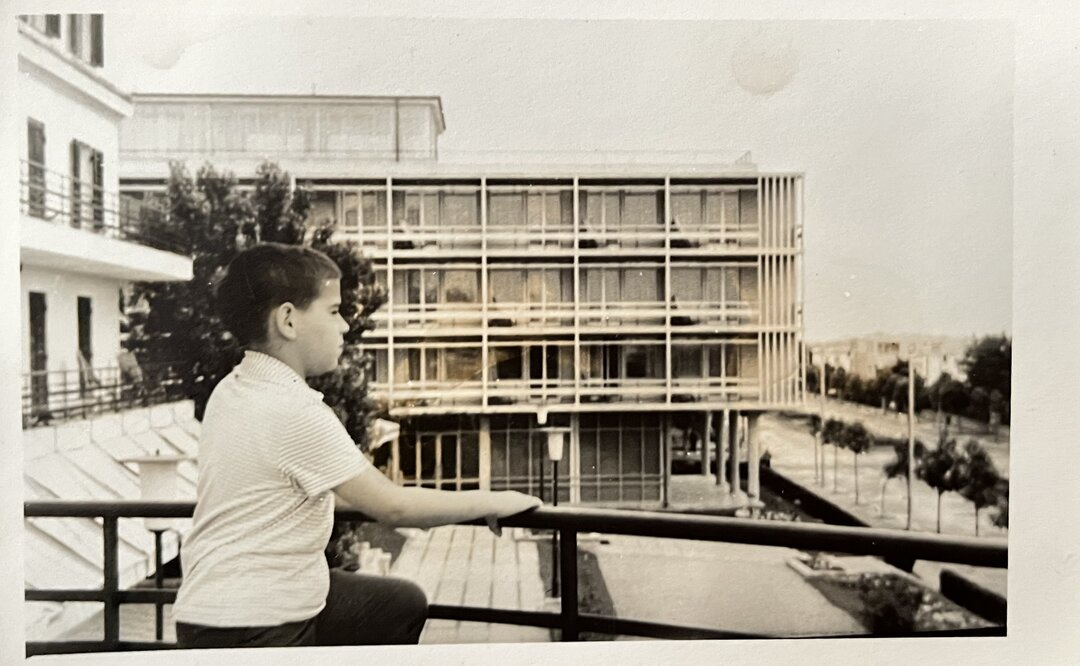
Block D/Restaurant Neon - EforieI13Leisure Center. The construction of the Eforie I Leisure Center, completed in 1957, marked the transition from the socialist-realist architecture, which had been used as a means of expression for the resort's first facilities - from the promenade, the mud baths and the children's colonies - to the modern one. Inside the complex, the Neon Restaurant building, which groups together its common and service facilities, stands out. The space is divided between a canteen-restaurant, a club, a bar and confectionery hall (along with ancillary functions) and shops.
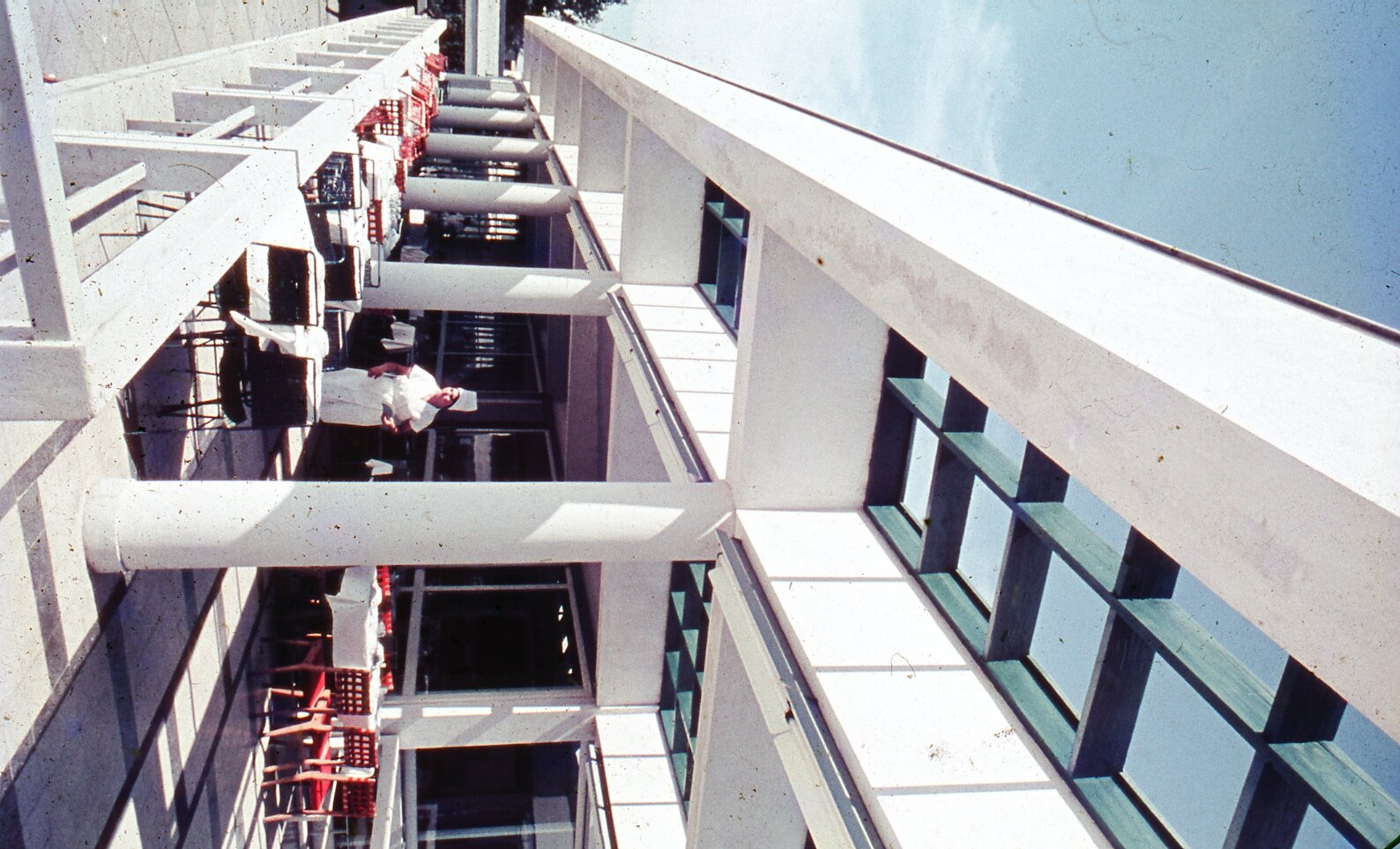
The upstairs terrace of the restaurant (the one covered by the famous concrete arches, like waves) faced the sea, with access from two sides, marked by two monumental staircases. One could enter the enclosure from the direction of the beach and the other from the south side, under the portico where there were various shops (one with newspapers and tobacco), a hairdresser and a pharmacy. The dining areas could accommodate up to 750 people at the same time, a very large number that influenced the scale of the architectural object. In order to control the perception of the space, the choice was made to interpose an interior courtyard - which had a dance floor and a place for an orchestra - and to open all public sides to the natural elements. The enclosing walls were made of glass, the whole enclosure could have been opened at a given moment towards the natural element.
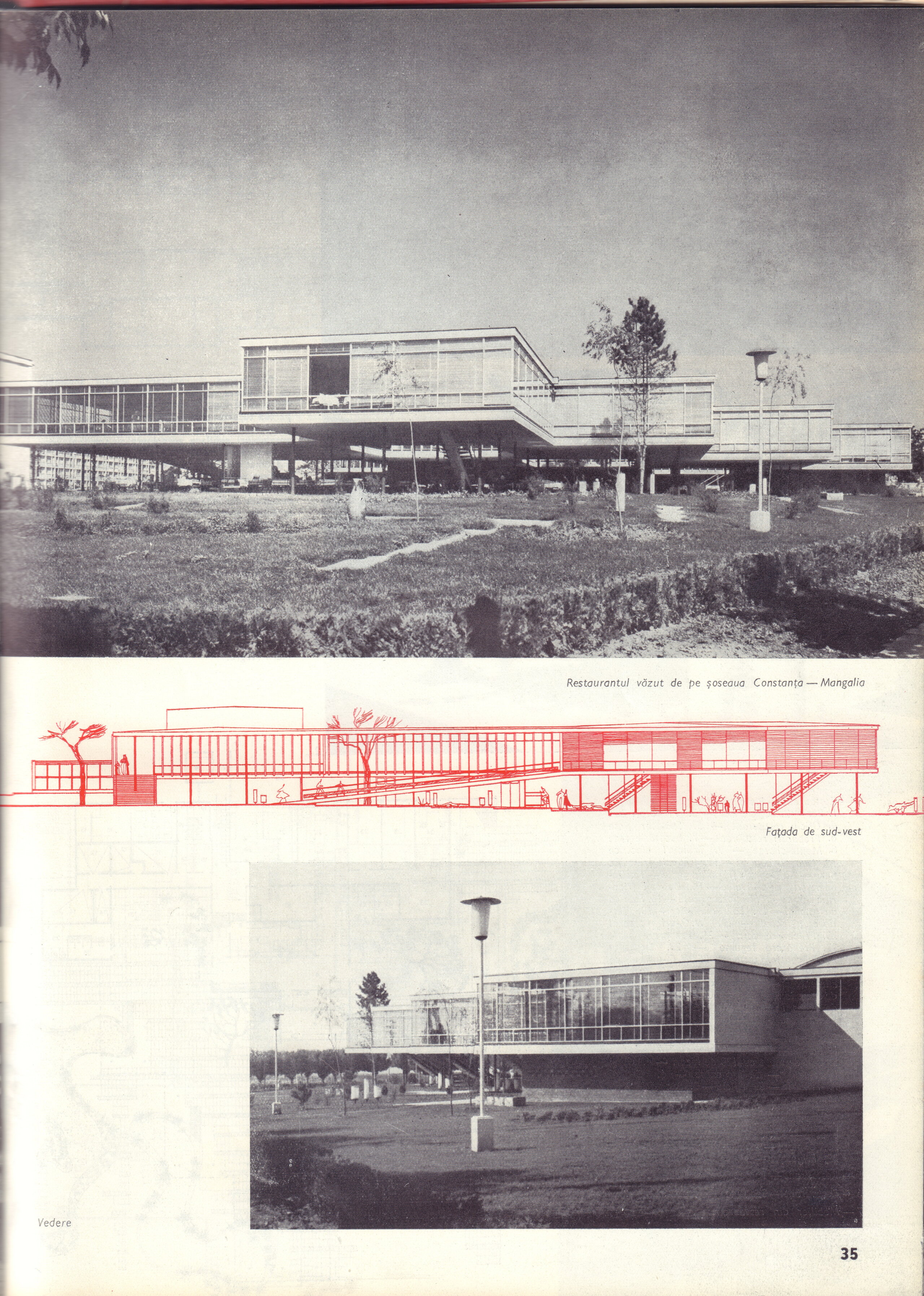
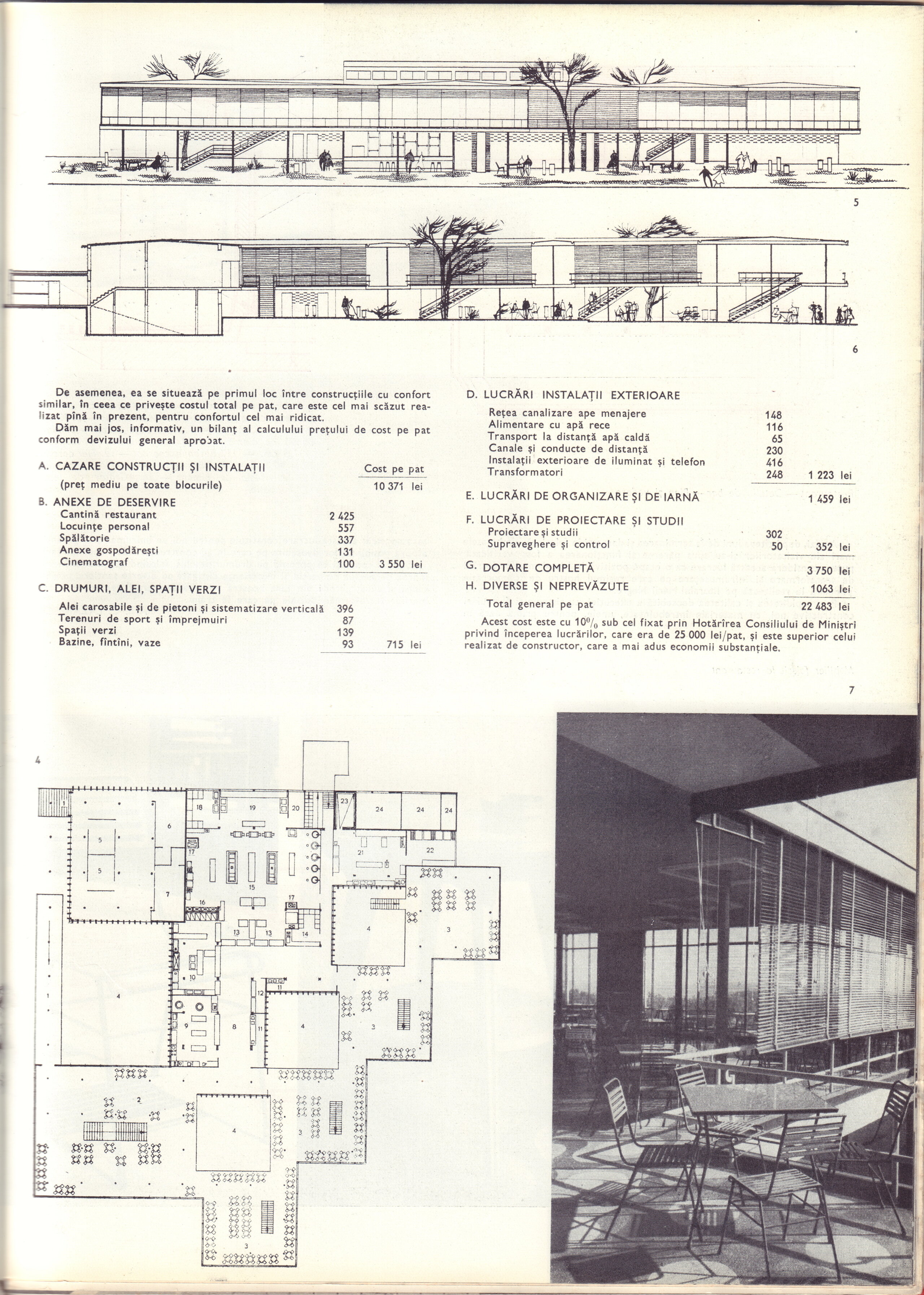
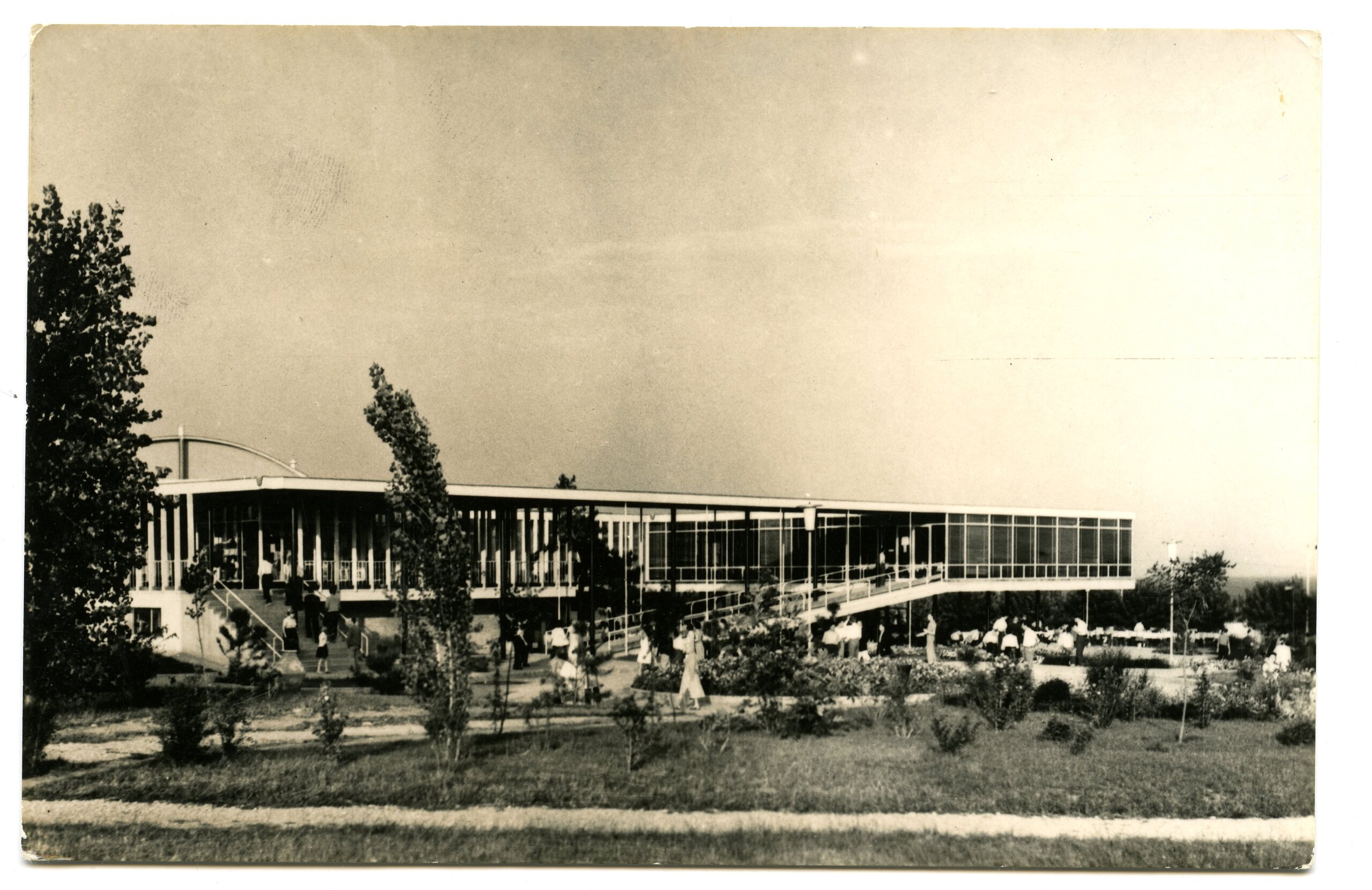
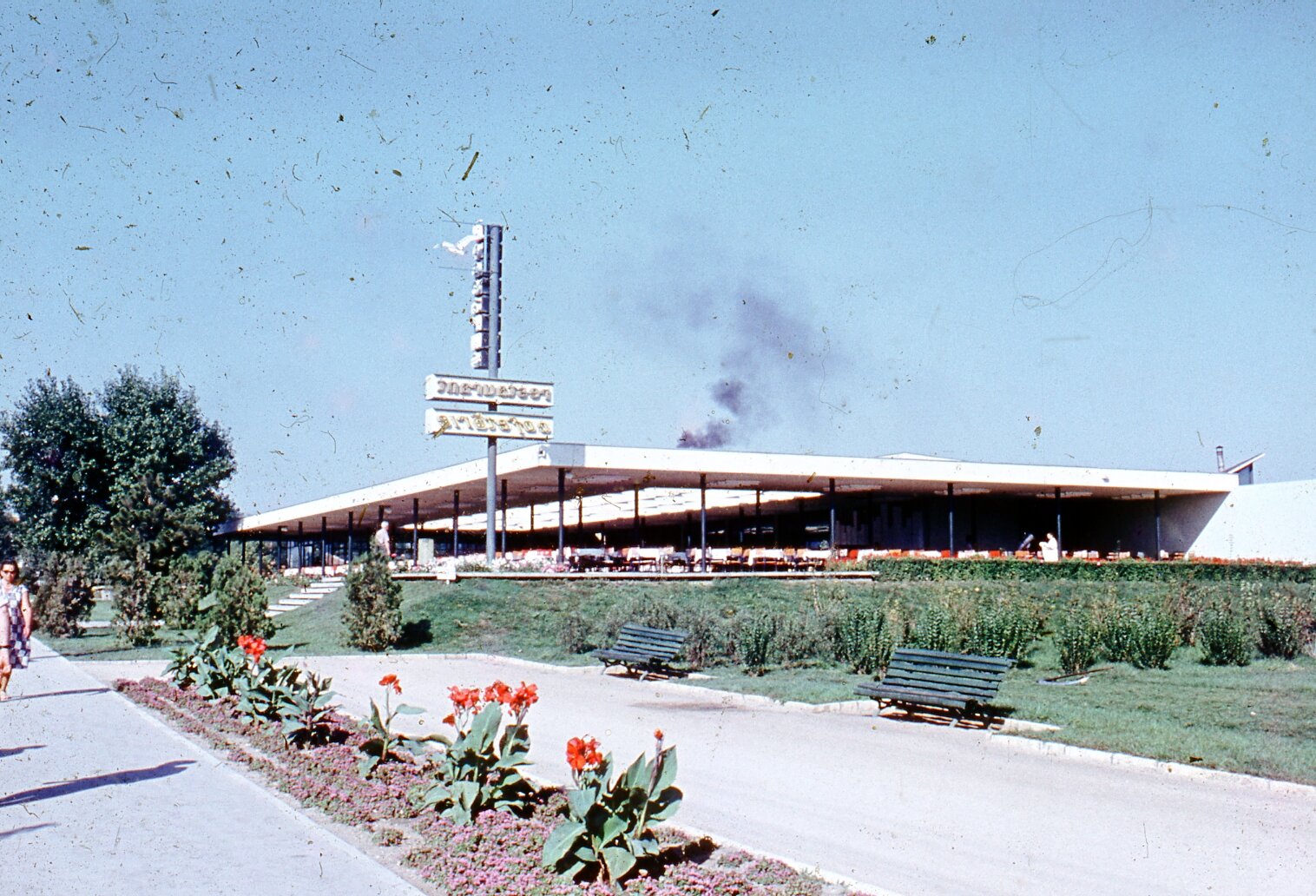
Block D/Restaurant Perla Mării - Centro de Odihnă EforieII14. The Perla Mării Restaurant in Eforie is perhaps the most successful realization of this type of program of the period. On a visual level, it conveys the crystallization of the new direction started with the Neon Restaurant, completed a year earlier. In the contour of a regular plan, on two levels, partially oriented towards the road and further towards the sea, four functions (similar to the first case) are incorporated: a canteen space, a restaurant, shops and services.
The actual restaurant space is located on the ground floor (next to the dance floor, the place for the orchestra and the serving bar), partly covered, partly garden. It communicates with the upper floor - where the fragmented and scaled dining rooms are located - via five sets of stairs and a ramp. After the regular serving hours are over, the whole place turns into a party restaurant, including the upstairs. Also upstairs are two commercial spaces and two barber and hairdresser spaces. Access is via a separate alley behind Block A.
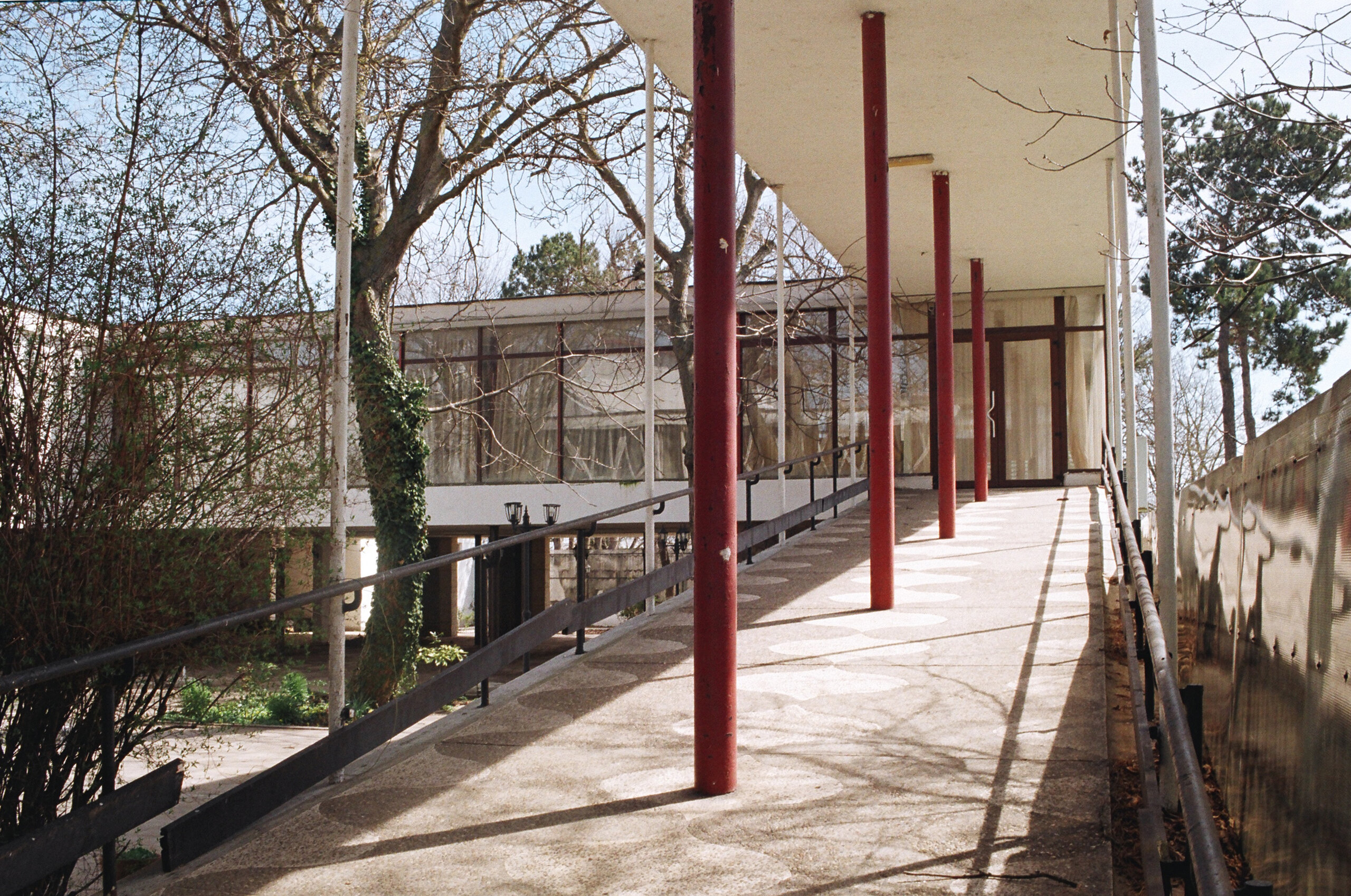
The Perla Mării restaurant project was appreciated at the time both at home and internationally for its architectural expression. With the seaside project, the formal limitations of socialist architecture began to be overcome. Also, through the architects' attempts with different construction forums and materials, we have some new elements. These include the vertical structure made of metal drill pillars (which gave the building its floating appearance, later used in the Eforie Seasonal Shops, the Mamaia and Neptun Shopping Complex), the exterior walls of the first floor made entirely of glass, and the colored aluminum blinds that gave the space a pronounced summer character.
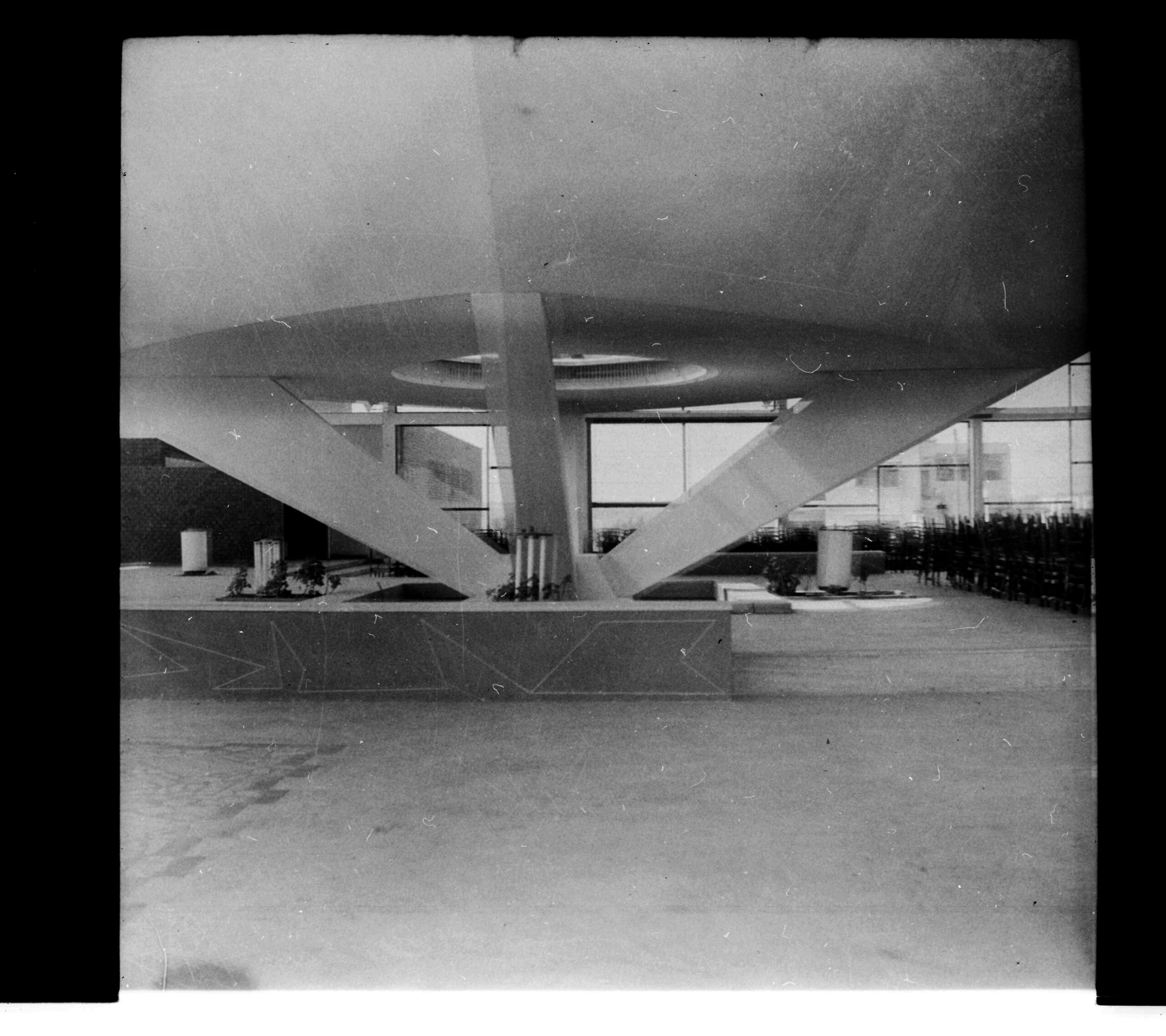
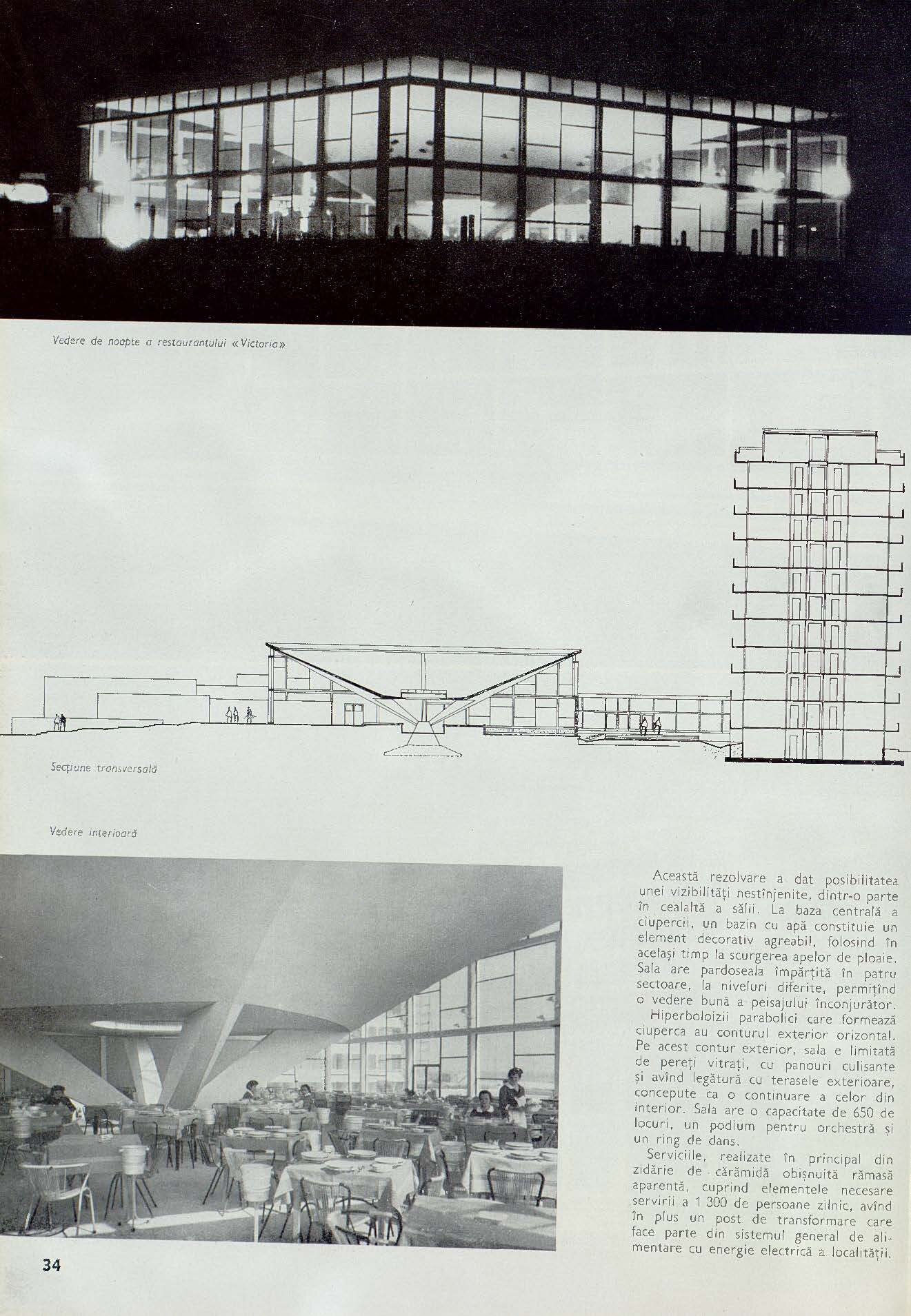
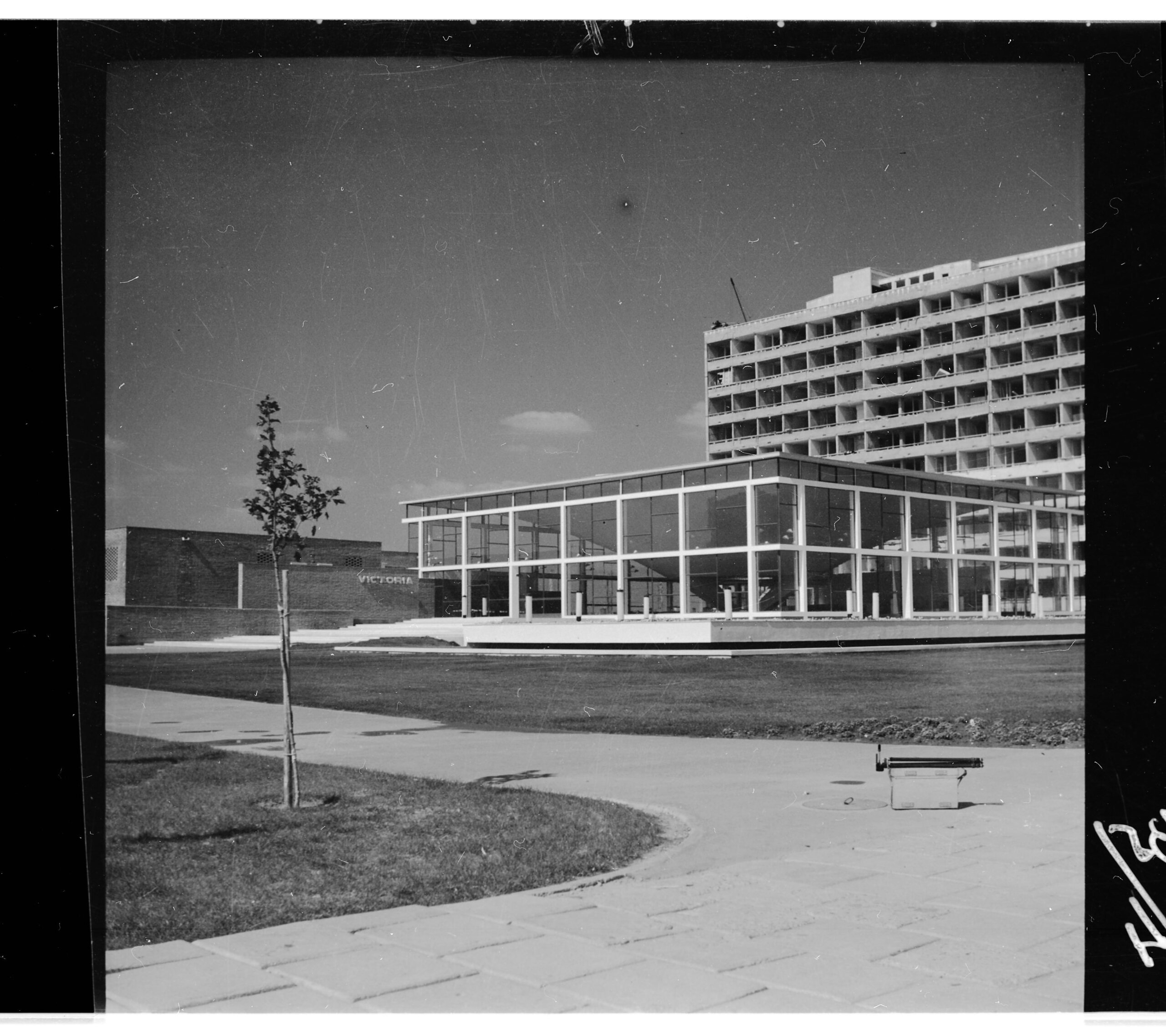
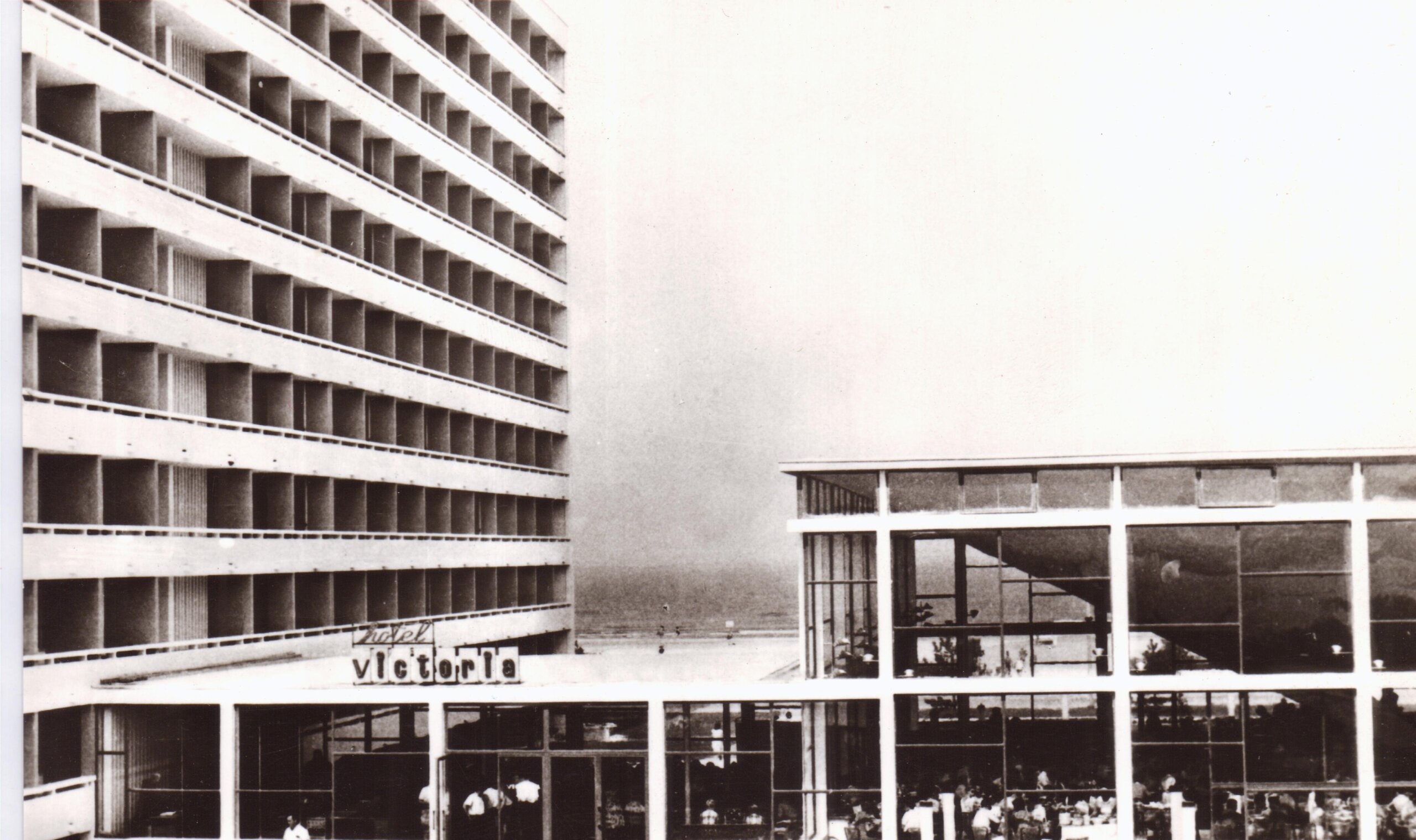
RestaurantVictoria/Mamaia14. The Victoria Restaurant, in Mamaia, belongs to the hotel of the same name and appears in the resort's early 60s systematization plan. This model is repeated in the Mamaia project, in the Hotel Victoria and the Hotel Aurora (however, due to its spectacular but difficult structure, it will never become a typical example).
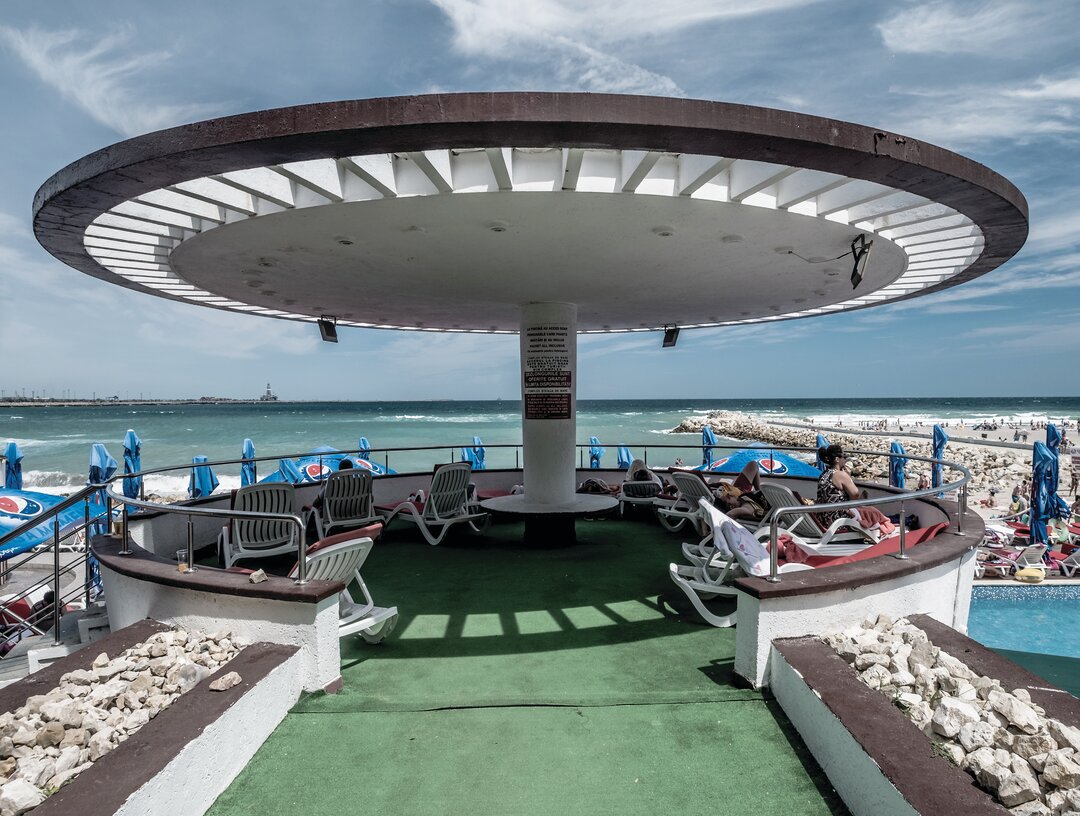
The compositional unit is based on the shape of a square, which allows openings on all sides, towards the natural elements (sea, lake, garden) and the hotel, also providing access by passage. Even if it is attached to the hotel, by its resolution, it is meant to exist as a distinct architectural object within the ensemble. Nor could it be otherwise, thanks to the unified treatment of the facade with movable glass walls, the 650-seat hall being covered by a parabolic hyperboloid. A concrete mushroom, drilled in the middle (it facilitates water runoff and adds one more plane to the communication dimension between exterior and interior) supports the concrete slab and allows perfect visibility inside the hall. A similar covering principle had also been proposed by Marcel Brauer a few years earlier for a railroad station in Connecticut and for the Hunter College Library, New York (1955) - a construction that was also realized at the time.
Unfortunately, the article in RPR's Arhitectura magazine describing the project was published anonymously, unlike the rest of the same series devoted to the seaside. The event15 is not unique and intervened as a form of political punishment for emigrating architects.
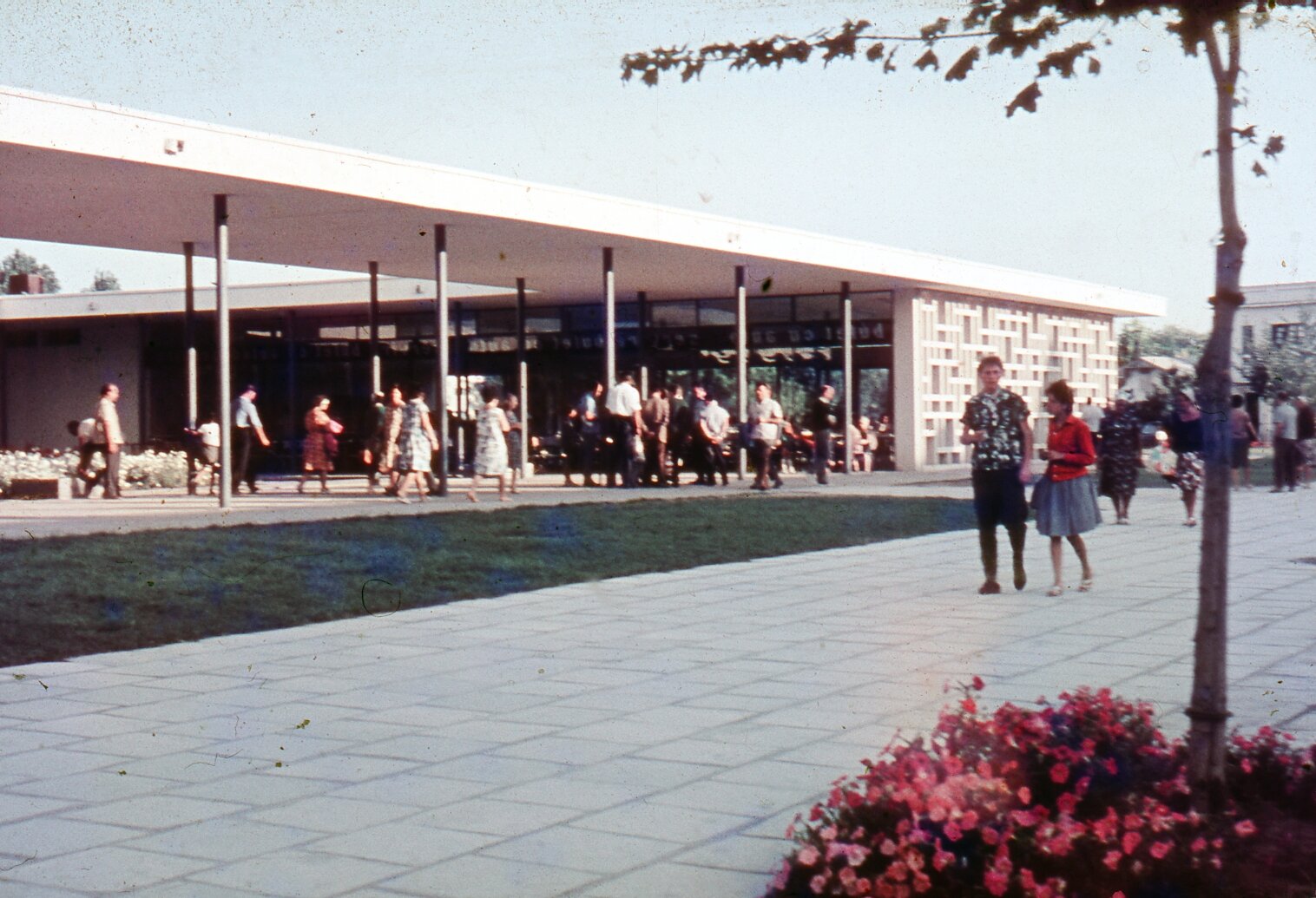
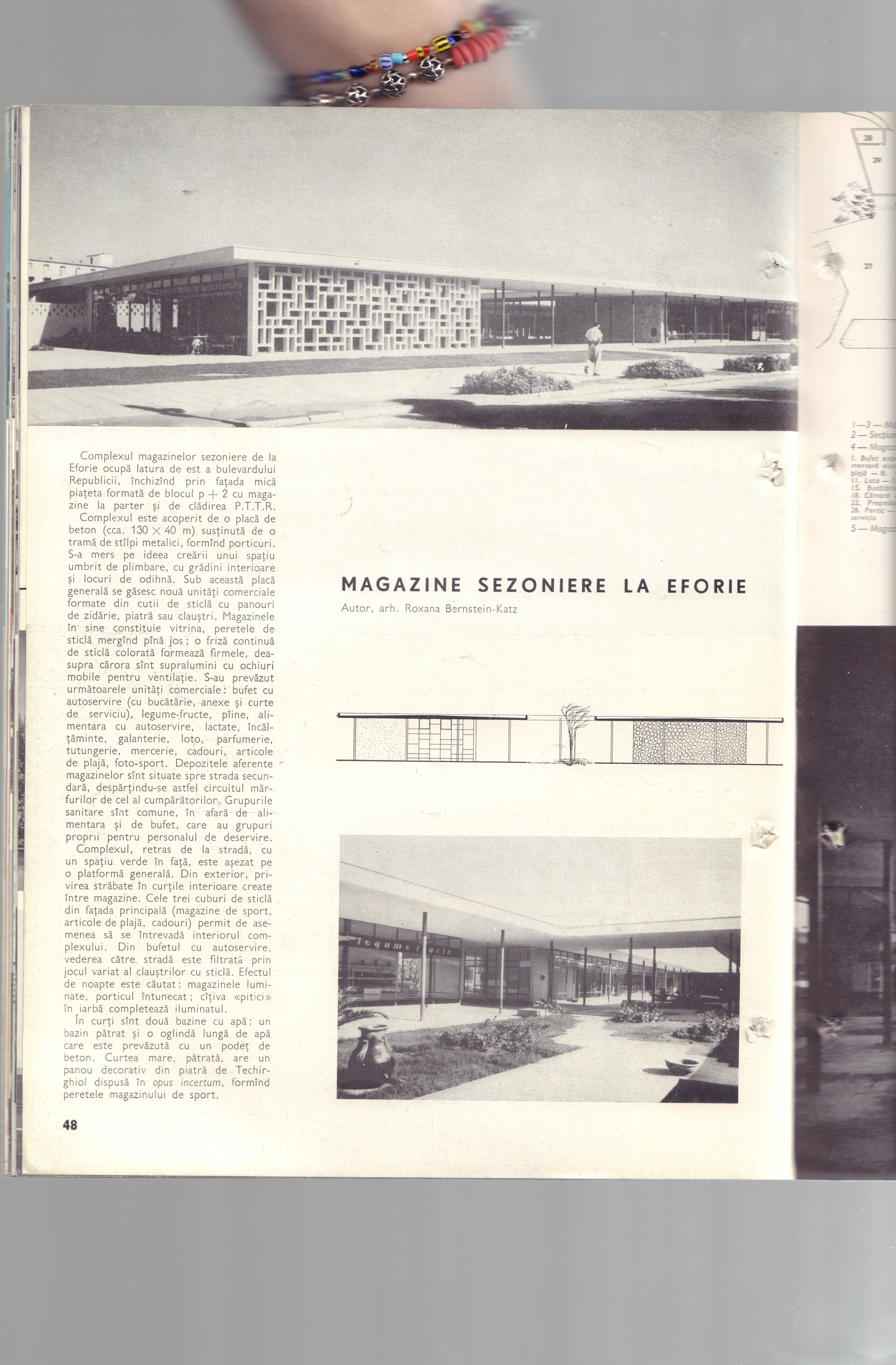
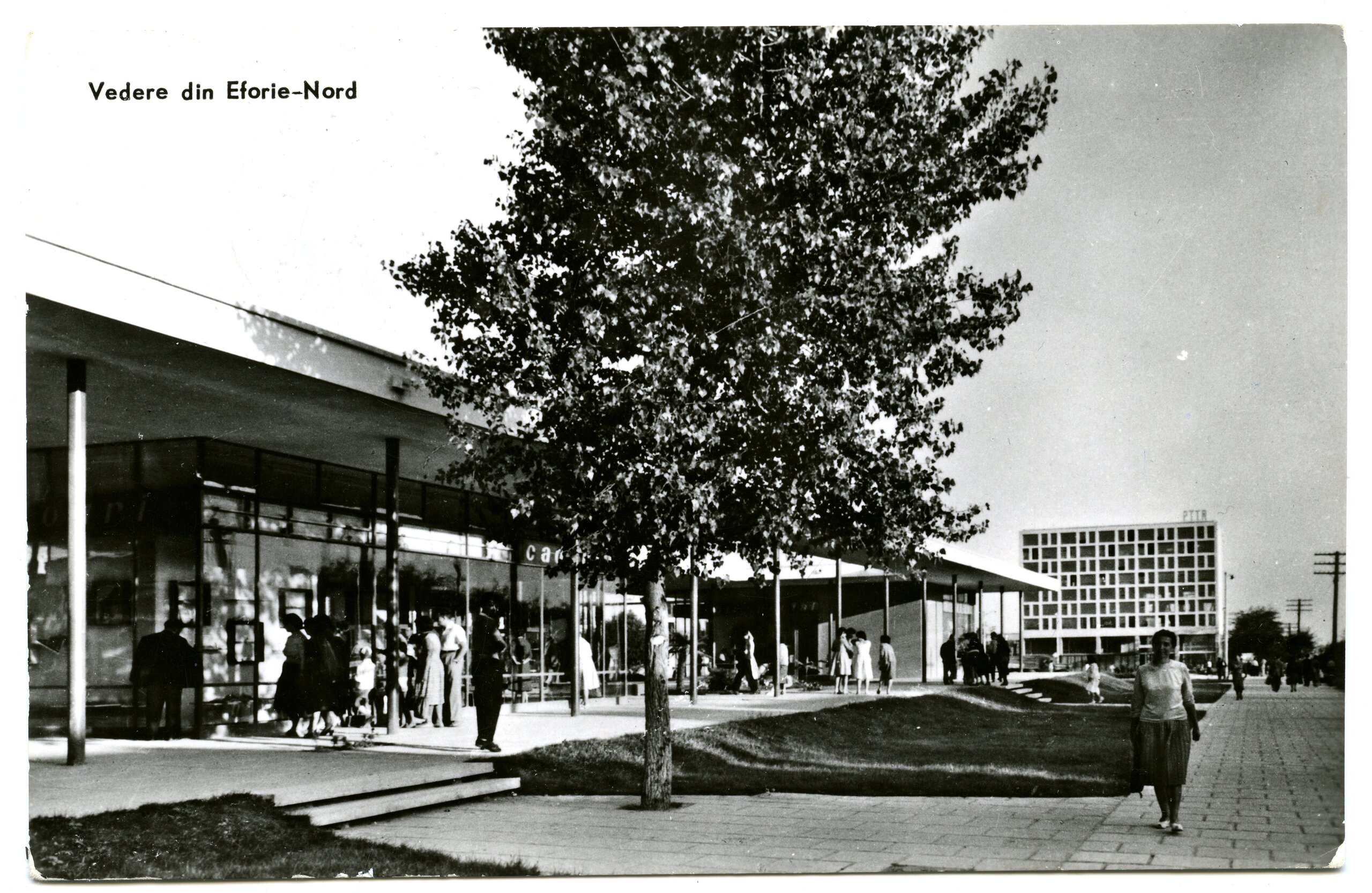
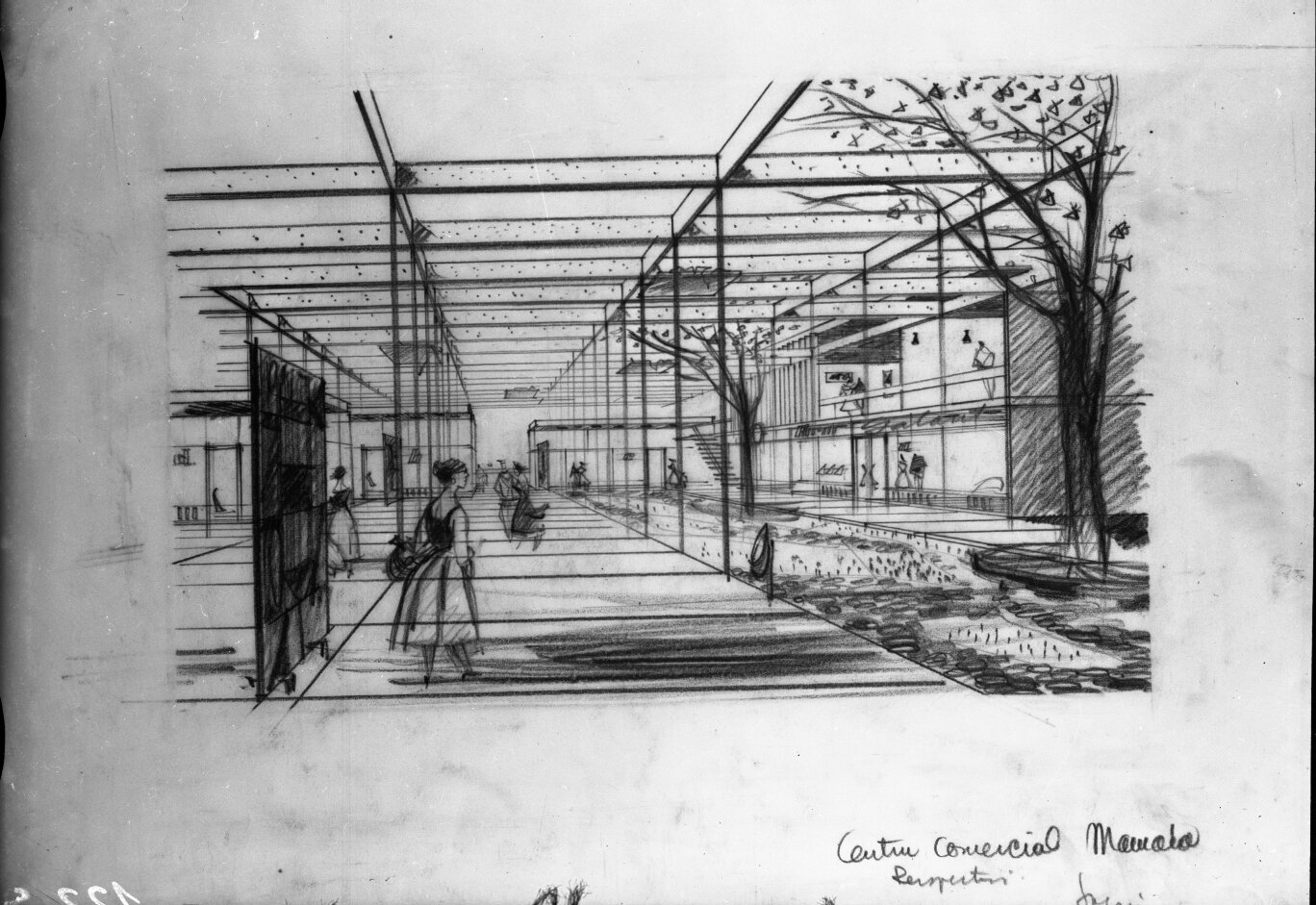
Eforie's SeasonalShops16. The project for the Eforie Nord summer shop complex was the first of its kind in a long typology that has been repeated and adapted both on the coast and in the rest of the country. Based on the idea of a covered promenade, it reworked the shopping street. Several dedicated shops (grocery, lottery, gift, gift, footwear, beachwear and the list goes on), along with a self-service buffet (facing north of the site), served the public from inside glass boxes scattered in a garden. The vitrine became a pronounced architectural element, mediating the subtle transition between indoor and outdoor areas. The passage between the two zones was also enhanced by the compositional unity of the floor, which had a continuous treatment. To support the idea of local character, limestone brought from Techirghiol was used in the decoration of some partitions.
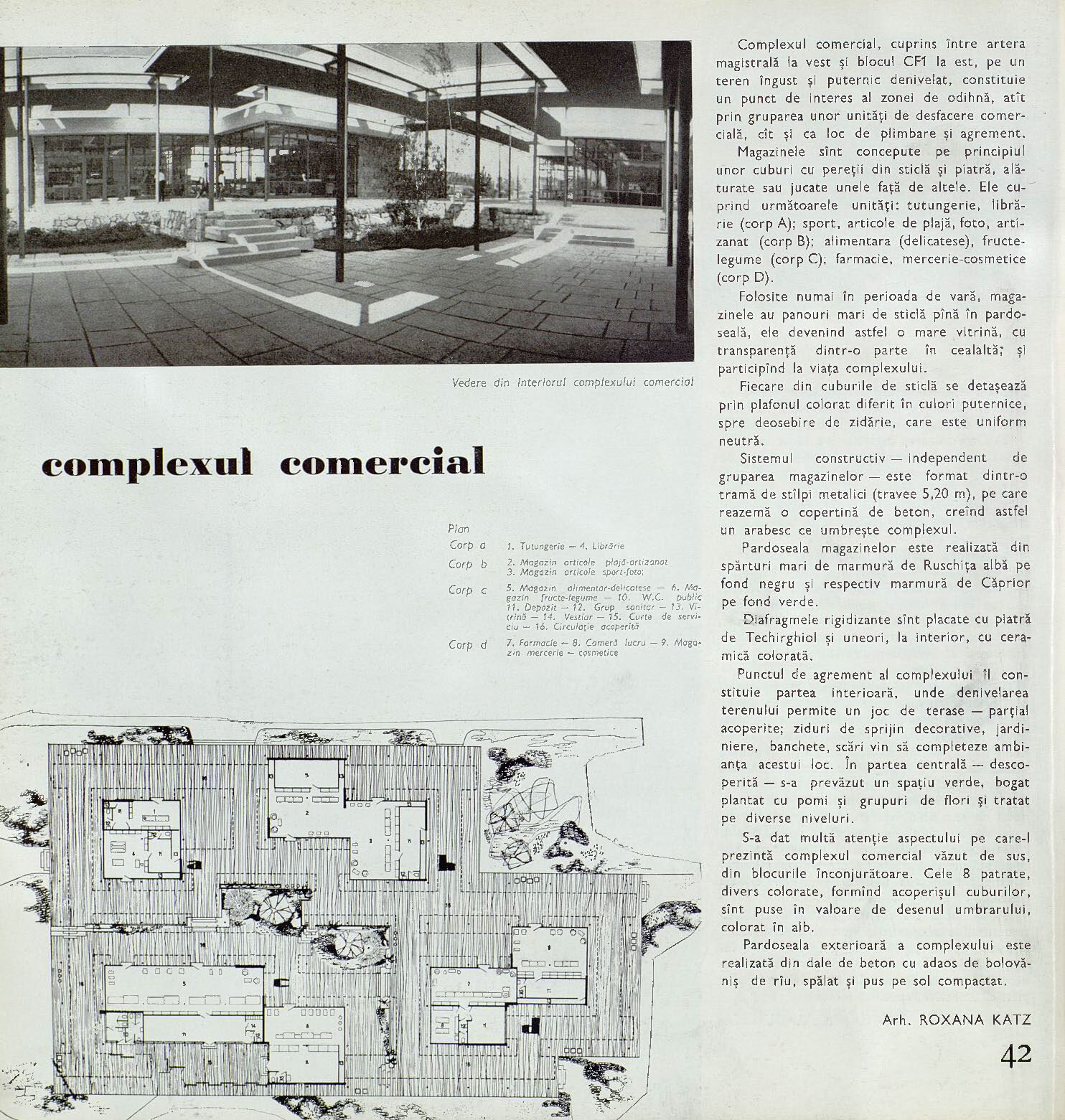
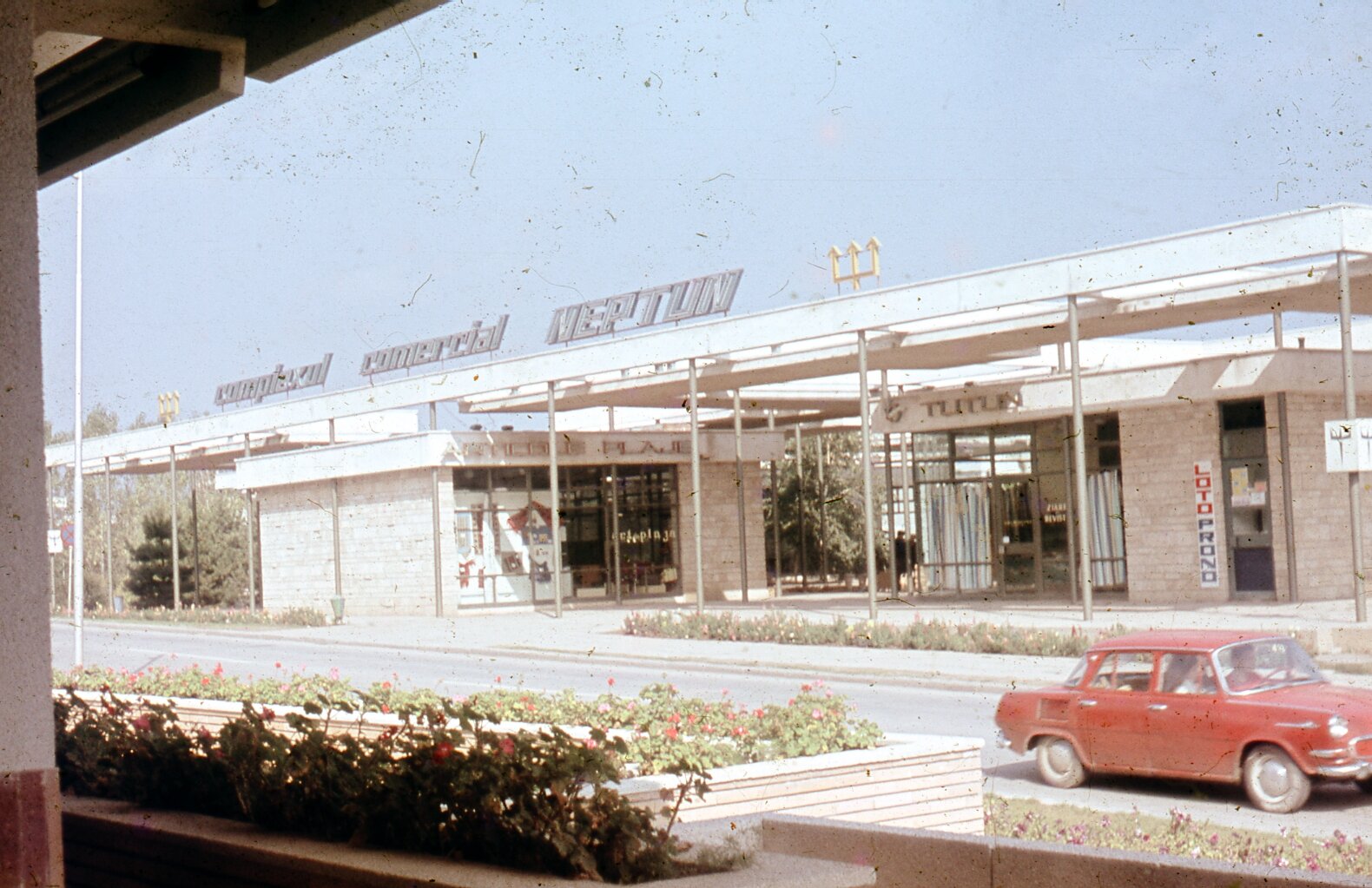
Neptun Commercial Complex (1967)17. The same architectural program, under the signature of the same architect (Roxana Katz), appeared in a more evolved form in 1967 in Neptun. It remained the resort's main commercial center for the next few years, until the larger project that was to appear after the mid-70s. This time, the intention of the trail and the animated traversal of the space is stated in the introductory article, but more importantly, expressed in the site. The enclosure connecting the glass boxes with commercial functions was treated in correspondence with the uneven landform. The result was a superimposition of terraces (some of which were covered to provide shade), connected by staircases and set by planters and seating areas. The center of the complex has been laid out as a large garden, planted with trees and flowers, again retaining the idea of several levels.
The shopping is broadly the same as at Eforie Nord, but with the addition of a bookshop (a slightly cultural function that was first included in the Mamaia shopping complex, along with a library). It retains the idea of metal pillars and regular grid, as well as decorative stone-veneered walls.
Architecture comes with the desire to bring enjoyment to the viewer8, separate from its technical considerations and achievements. It should also physically convey an agreement between the attitude, morality and individuality8 of the architect and the audience he addresses. Or, at least, so said the literature of the time....
PROPAGANDA. The construction of the seaside and the facilities detailed above - not to mention the outstanding architectural quality, especially in the early years - represented a system of visual propaganda attesting to the success of the new regime. The (relative) freedom in design, which ultimately generated these objects, was professionally motivated by various written texts - in the publications of the time - supporting the necessity of these programs for the success and development of the country.
The department stores became exhibition spaces for the achievements of the working people, and architecture was a catalyst between the production and consumption areas5. The way in which goods were presented took on a very important role in meeting the demands of the masses, demands that arose with the rise in the standard of living and culture5. This was seen as the spiritual version of the new material prosperity, due to an unprecedented economic boom8. Of course, there were also more honest accounts of the role of the architect in society as an individual who anticipates the needs of the collective, its desires, and by responding to them, becomes a shaper, without limiting the audience4.
Tourism - especially its commercial and leisure component - was used for similar purposes in the rest of the socialist area. In Yugoslavia, its development, carefully directed by the party, was aimed at raising both intellectual and labor power, in order to fully integrate the individual (collectively) into the state. In our country, hundreds of thousands of foreign tourists, together with the locals, were to return from their vacations with rich images of a country in full development, with a people to match8.
WORKERS' EDUCATION. Workers' education during vacations, also called cultural work at the time, had a special relationship to these entertainment spaces in the way it was carried out. As we began the discussion in the first part, the leisure that was being promoted was an active one, including during vacations, which involved all citizens in activities of a social and political nature. Restaurants and shops become places where propaganda was systematically carried out, being physical sites chosen for cultural work.
A report from the beginning of 1961 on the measures taken to carry out mass educational cultural work during the summerseason19 emphasized the idea that it becomes a powerful tool for the training of all citizens, with the ultimate goal of forming a new type of man. Cultural work was supposed to contribute to the development of asocialist consciousness19 for working people (a wording that appears in the following, simultaneously with the term citizens). Information boards and written press materials, which were constantly updated, were such means (Russian periodicals were, of course, also included in the selection of written press). Even foreign tourists, who had begun to come in 1960, were not spared propaganda, with versions of the texts available in various foreign languages.
A report dated February 14, 1961, under the pretext of the good conduct of cultural work and in appropriatevenues19, asks for an intervention from the People's Council to the I.S.B.C. Eforie, in order to make the space of the canteen terrace and an adjoining room available to the respective persons in charge, the canteen being located opposite Block E of the complex. There was a desire at that time to move Cultural Point No. 2 from Building 11 of the complex on the grounds that it would be an unsuitable space. Initially, I thought they were referring to the Neon Restaurant space, whose courtyard terrace would fit the description. Instead, in a minute in reply dated March 25, 196119, which proposes four cultural points for the summer season of that year, reference is made to one located, in fact, on the terrace of the canteen in the Perla Mării complex. It is mentioned that in future the number of these points will be based on need. However, the Neon Restaurant did not miss out on this circuit either, as its operation was criticized for the lack in the project of special spaces for the N.T.O. propaganda boards and for the radio loudspeakers13. Of course, their absolutely necessary mounting in random and unnatural places created an unpleasant interference with the architecture13.
In a letter from the Communal Household to the People's Council of the Vasile-Roaită Regional Town,19 which came in response to an address of October 12, 1961, the agreement to make available to the Communal Enterprise the canteen No. 13 in the town of Eforie and the canteen with the same number in the town of Vasile Roaită was announced. The contract was to be finalized by April 1962, when the two sites would begin to be prepared for the new tourist season. A clear proof of the idea of the persistence of cultural work, which did not stop even in winter and was a form of training for everyone, not just for those who came on vacation. They are not the only eating places integrated into the dissemination of the new culture. In a list of proposals for the summer of the following year (1962), two of them appear in this respect. Cultural point No. 4, in the Vasile Roaită resort, is proposed to be moved to canteen No. 8, its basic activity being supported by canteen No. 12, in the immediate vicinity. Of course, there was the promise of better education in the newly created conditions. For the resort of Eforie Nord, a cultural center is envisaged at the "Complex", because the existing one - even on the terrace - does not meet the needs. Although the reference Complex is very vague, we can assimilate it to the Eforie I or II Rest Center (the terrace space at Perla Mare was only ceded a few months ago for this purpose), or to the Seasonal Shops in the Center, the prototype of the combined socio-cultural facilities, which could have supported such events.
Continuing the list of immediate wishes, comes one for a more distant future than the next tourist season. For both the Eforie Nord and Eforie Sud resorts, the idea of building two modern cultural complexes19 is proposed, which would correspond to the development of the moment, but also to the then current requirements of the seaside. In a circumstance of great good fortune, in the archives of the former design institute in Constanța are the plans and the proposal for two centers for the distribution of tourists at Eforie Sud. According to the cartouche, the project belongs to the D.S.A.P.C. and is dated No. 59/1968. The proposed site in the north of the resort, at the intersection of Mircea cel Bătrân Street and Republicii Boulevard, comprised two mirror-image buildings overlooking the road and the lake. A second variant was represented by a singular object located further south of the resort, at the end of Stefan cel Mare street, next to the shopping complex (which still exists and functions today). Both sketch plans proposed two generous waiting rooms, facing the street, communicating with the entrance hall to the information desks and a series of staff offices. It is a valid question whether these halls could have accommodated enough cultural education engagements to motivate the need for more dedicated spaces at a relatively inconvenient distance from the railroad station. No traces of the two architectural objects can be seen in the fabric of Eforie Sud, judging by older images (building permits and building notifications are entirely missing from the town hall archives), the first variant may never have been built there, remaining only at the proposal stage. Indeed, traces of demolition could be seen in the plan at one point on the site in Stefan cel Mare Street, near the shopping complex, which, in the extraordinarily rapid evolution of the built volume in the resorts, were naturally covered over.
In all the seaside resorts there were, at that time, points and clubs for carrying out mass cultural and educationalwork19 . Eforiile, Techirghiol (also recorded in the seaside resort monograph of 196820), Costinești and Mangalia. Mamaia, still under construction in 1961, is not listed in the dossier. In the end, we should be a little suspicious and suspect that this whole chain of events may never have been implemented to the level described, even if there are records in official documents.
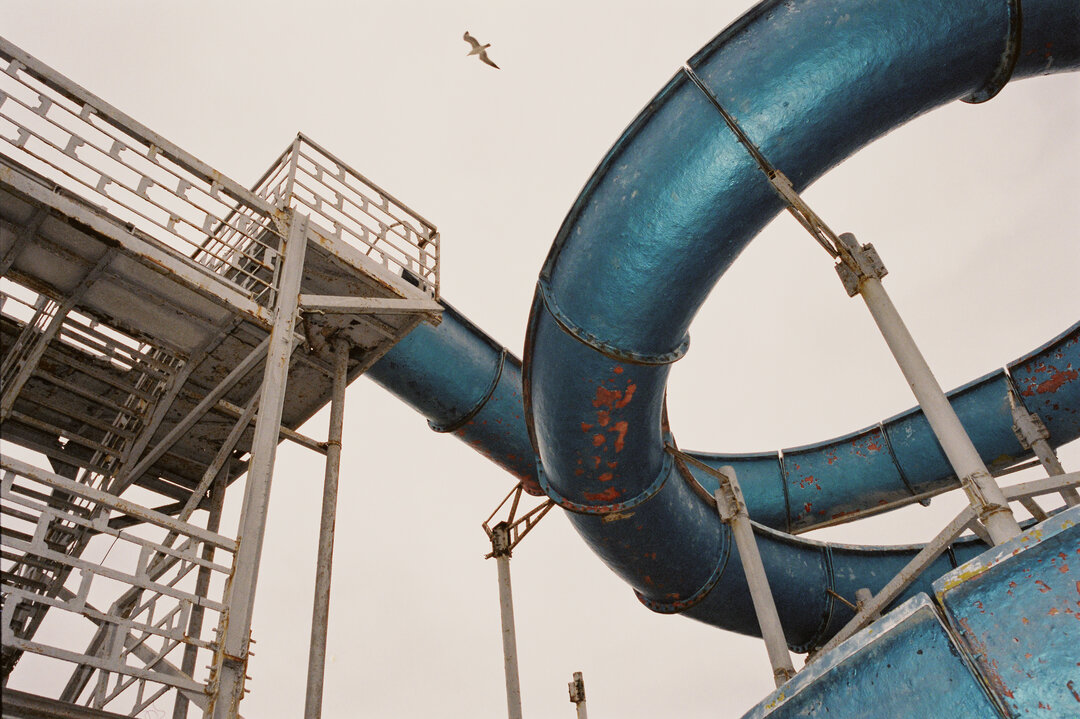
THE PRESENT. There is much to be said and very little good about the present state of commercial and food service facilities. On a very sanguine note of the situation, the great majority of them have been preserved, though in a desolate state. They could, however, be identified as ruins of the period of modern architecture under socialism, which at some point would generate some starting points21.
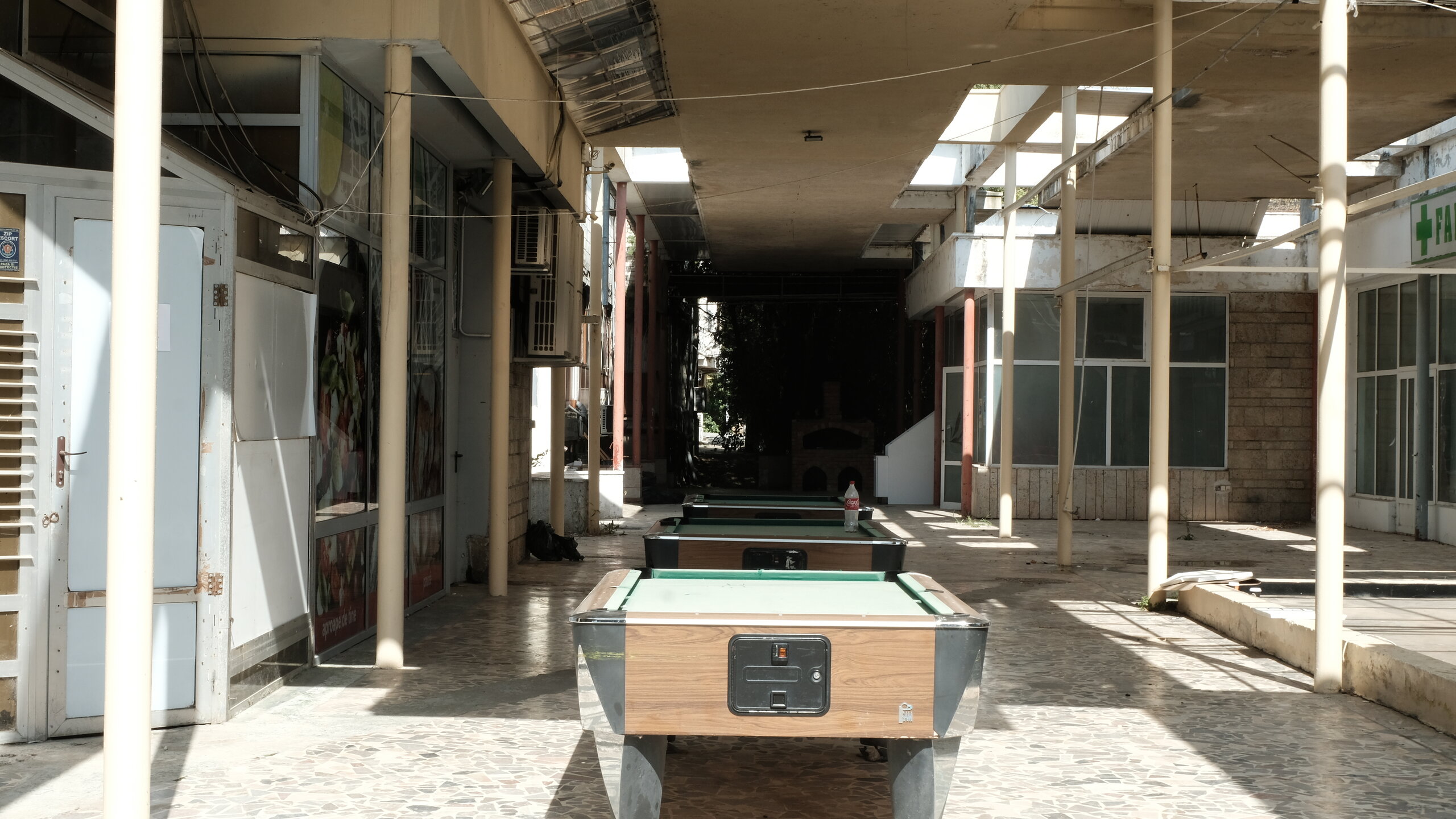
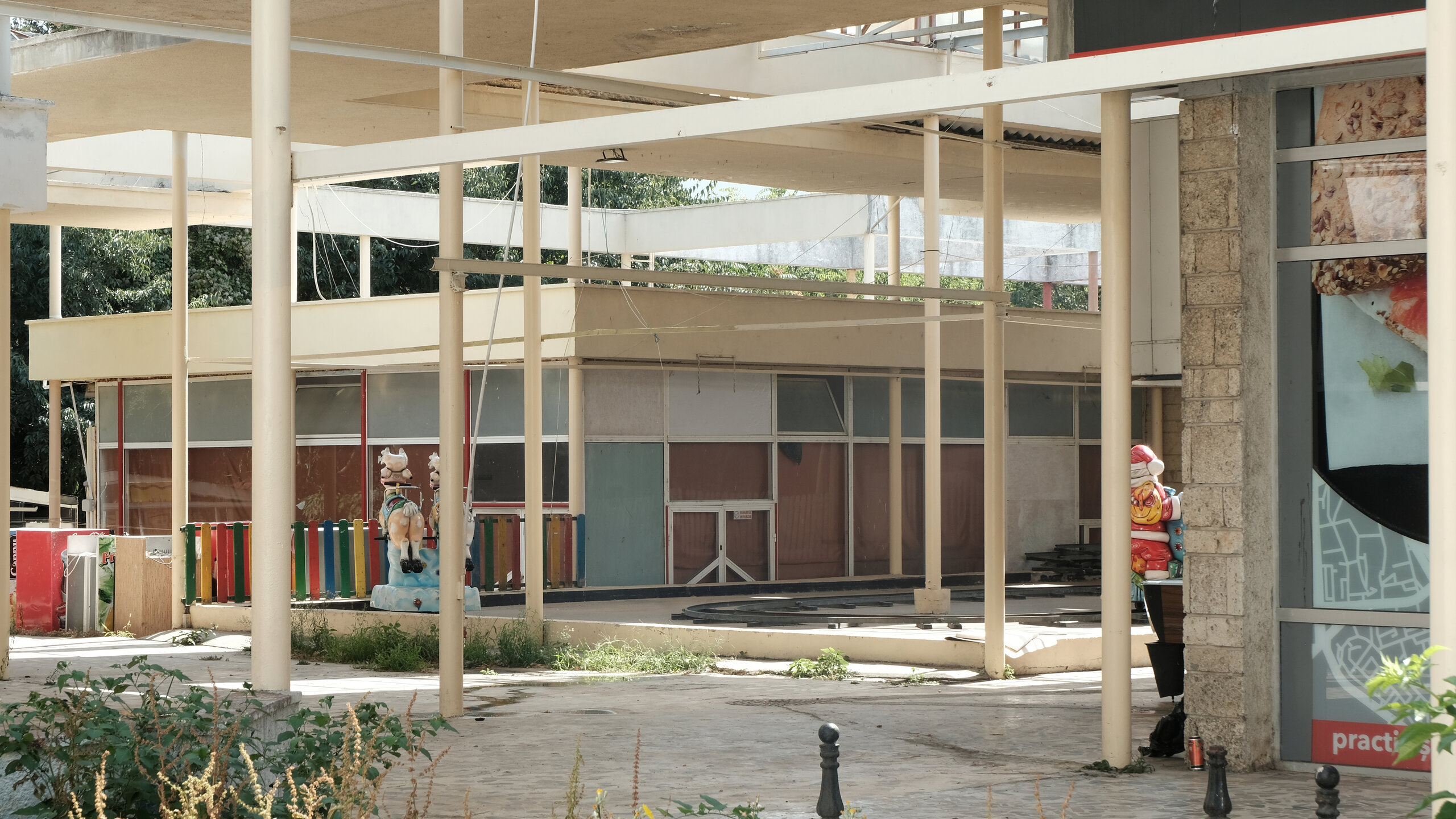
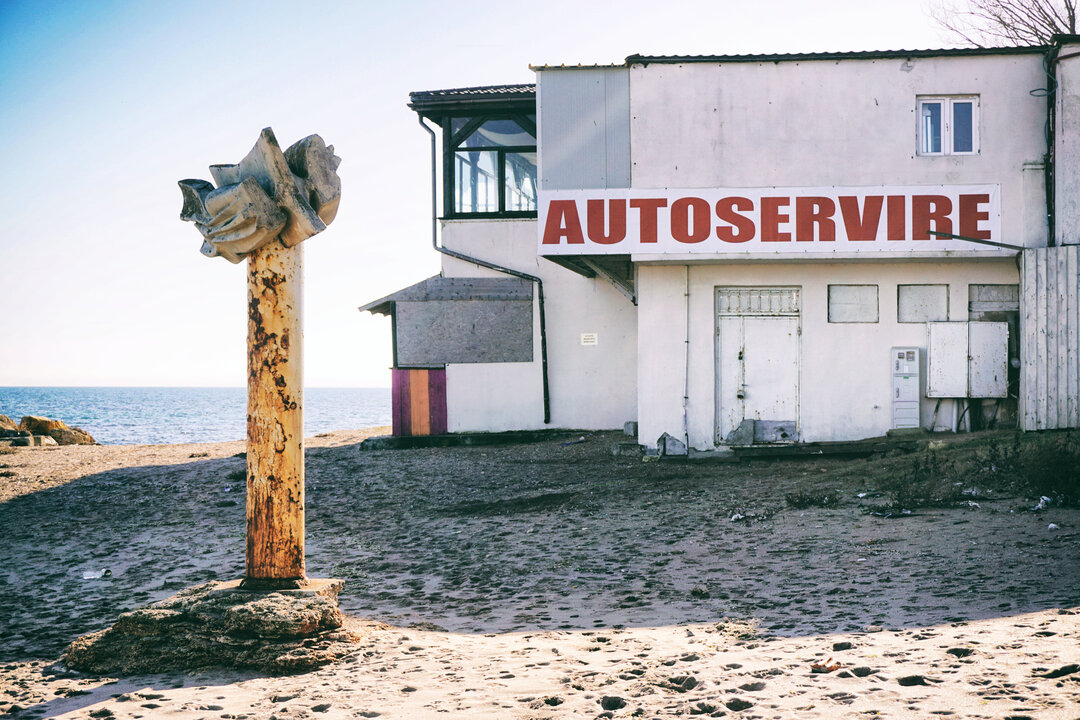
Shopping complexes continue to occupy a central role in resort layouts, which supports their commercial potential. However, their experimental nature and, in particular, their seasonal nature, have done little to keep the original material in good condition. The retail spaces, whose shop windows reached the floor level, enclosed with glazed walls made of metal frames and a single sheet of glass, were not feasible for permanent uses (such as the situation in Eforie Nord, where, after the 1990s, the shops were also used in the winter season), or did not correspond to the new space divisions after privatization. There was the option of opaque enclosures with masonry walls; or the simpler one of PVC improvisations. Of course, radically changing some of the defining elements, such as glass boxes, changes the picture a lot. Then there were the additional additions of volumes to bring other functions to the place (at the Eforie Nord complex, the garden was covered and two restaurant buildings were built on the south side). The facade of the Neptun complex is also changed, becoming almost opaque towards the street, the originally proposed route being easier to see from above. I would prefer the shots where there has not been much intervention on these programs, at the risk of the image of destroyed buildings - until a few years ago, the commercial complex in Mamaia still had the original decorative stone cladding, the concrete beams shading the courtyard and most of the metal elements preserved. No other volumes have been superimposed over the original plan, the only disturbances being the carpentry in modern, inexpensive variants, and the air conditioners. Currently, in an attempt to revitalize the space, the side facing the plaza has been plastered with red billboards. Fortunately, they could be easily removed. The complex in Eforie Sud is in the same situation, except that the building's visibility has been obstructed over time by a minimarket built in the front garden and a wooden cover over the bar on the north side. Recalling the spaces they originally had and the range of shops and services on offer, it is easy to see that they no longer correspond to the current tourist profile (who does not need a bookshop on holiday, although perhaps a fruit or dairy shop would be welcome - there are several hypermarkets in every resort to meet the needs). Also, the materials used, mainly the concrete slabs that covered these assemblies and the exposed metal posts, without constant maintenance and insulation and protective treatments, could not show any form of resistance to the conditions of the area, wind and weather. Of course, these aspects were not taken into account during the design, probably no one at the time expected that they would end up in the personal ownership of several individuals and that they would be managed independently.
The restaurants of the 1960s and even later probably suffered the most after the regime change. Suddenly, these huge canteens, designed to feed hundreds of tourists a day, often in the same day, were limited to breakfast (in the case of those attached to hotels) or turned into self-service. Some of them (as are countless examples in Mamaia, including the Victoria/Aurora) remain in operation throughout the year to host various festive events. This brings with it the removal of glass boxes totally open to nature and massive closing interventions. In the case of the two mentioned above, the interior spaces have gone through several rounds of refurbishments, the original image being replaced with a generic hotel restaurant setting. Unfortunately, they ended up reflecting the commercial tastes of the time, rather than architectural principles. But where budgets have been smaller or the original canteens used only for money-making purposes (some tourists not being touched by the quality or integrity of the premises), they have remained closer to the image of the beginning. The Perla Mării restaurant, though in decay, has not had major changes made, apart from the huge advertisement facing the street and a metal covering blocking its visibility. Meanwhile, colored aluminum blinds have been replaced with white curtains. It still operates now, exclusively in summer, under the same formula of a dining area on the ground floor (the upstairs is most likely closed), accompanied late at night by music and a party atmosphere. No one can enjoy the uncovered terraces any more, their constant care being problematic. The Neon restaurant, on the other hand, has been closed for many years and almost entirely overgrown. Again, this might not be the worst of it, as no one has gotten around to irreversibly altering the building. Its enormous size makes it very difficult to sell and use exclusively for dining, and not competitive with the extraordinarily large number of establishments in the resort. Finally, at least they have kept their original function and have not adopted other inventive uses (the Danube restaurant in Neptun houses a summer clothes market on the street side). At the same restaurant, on the opposite south-east side, the facade and carpentry have been redone very close to the original image, an example of good practice. It seems that it is sometimes good for these spaces to be shared, with at least one of the owners having a chance to do an honest job. There is also a new building site in sight at the disused Magura restaurant in Eforie Sud. We can hope for a more sensitive approach, given the modernization of the Cosmos restaurant next door (a more tectonic and stylized version of the Perla Mării restaurant has been fitted with heat-insulating metal panels).
Things may be moving in a positive direction, which is becoming increasingly necessary in today's seaside resorts. The taverns and shops reflect the state and direct offer of tourism today. Perhaps the passage of time will help to shape a different perception of them, linked more to their architectural qualities and their significance for our collective memory, but until then there is still time to wait and intervene.
NOTES
1 Cezar Lăzărescu: Arhitectura construcțiilor turistice moderne din România, Editura Meridiane, Bucure;t, 1972, p. 4, p. 17.
2 Cezar Lăzărescu, "Cronică a arhitecturii pentru turism", Revista Arhitectura RPR, 2/1972, pp. 35-43.
3 Dan Adrian, interview with prof. em. dr. dr. arh. Cezar Lăzărescu, in Ileana Lăzărescu, Georgeta Gabrea, Vise în piatră - in memoria prof. dr. dr. arh. Cezar Lăzărescu, Capitel, București, 2003, p. 118.
4 Dorina Suflet - Dotări social-culturale în ansambluri noi de locuit (doctoral thesis, supervisor prof. em. dr. dr. arh. Cezar Lăzărescu), Institute of Architecture "Ion Mincu", Bucharest, July 1979, p. 26.
5 ***, "Unități Comerciale", Revista Arhitectura RPR, 1/1962, p. 4.
6. Ion Sachelarie, "Design of catering and tourist facilities", Revista Arhitectura RPR, 6/1966, pp. 14-16.
7 Oscar Snak (Director of the Center for Studies and Design for the Promotion of Tourism of the Ministry of Tourism of the S. S. R. Romania), "Tourism, an important form of leisure", Arhitectura RPR, 2/1972, pp. 44, 45.
8 Cezar Lăzărescu, Gabriel Cristea, Dinu Gheorghiu, Anca Borgovan, Arhitectura românească contemporană/ L`architecture roumaine contemporaine, Editura Meridiane, Bucharest, 1972, p. 6, p. 24, p. 94, 172.
9 Anca Borgovan, "Loisir", Revista Arhitectura RPR, 2/1972, pp. 2-3.
10 Angela Pavelescu, "Loisir, element of formation and development of the human personality, element of intellectual and physical balance, restorative and constructive rest", Revista Arhitectura RPR, 2/1972, p. 13.
11 Cezar Lăzărescu, "Arhitectura - filozofie a beauului și a utilului", "O viață într-o carte", in Ileana Lăzărescu, Georgeta Gabrea, Vise în piatră - in memoria prof. dr. arh. Cezar Lăzărescu, Capitel, București, 2003, pp. 5-6, p.9, p.23.
12 Little information and stories about Richard Neutra's visit, in a conversation with Mac Popescu, in his office (summer 2023).
13 Stopler N., 'Block D (restaurant-club), Eforie I Leisure Center', Arhitectura RPR magazine, 8-9/1958, 25-35. Author: arh. C. Lăzărescu. Co-authors: N. Stopler, A. Solari Grimberg. Collaborators: L. Popovici, M. Laurian, V. Krochmalnic, V. Petrea, A. Aioanei, H. Gross, J. Rosenber, N. Florescu, R. Sohn.
14 Cezar Lăzărescu, "Block D (the restaurant), Eforie II Leisure Center", Revista Arhitectura RPR, 5/1959, 25-40. Authors: Cezar Lăzărescu, L. Popovici. Collaborators: Virginia Petrea, P. Focșa, Antonina Aioanei, Gabriela Gheorghiu, Anca Borgovan Ionescu, J. Rosenberg, Gh. Dorin.
15 Practice that I learned about in a discussion with prof. dr. dr. arh. Mircea Ochinciuc, member of the design team at the time of the Europa Hotel in Eforie Nord, early 2024.
16 Roxana Berstein-Katz, "Seasonal shops at Eforie", Revista Arhitectura RPR, 4-5/1961, p. 48.
17 Roxana Katz - "Complexul Comercial" (Mangalia-Nord leisure complex), Revista Arhitectura RPR, 1/1968, p. 42.
18 Karin Taylor, Hannes Grandits - 'Tourism and the Making of Socialist Yugoslavia: An Introduction', Yugoslavia`s Sunny Side - A History of Tourism in Socialism (1950s-1980s), Hannes Grandits, Karin Taylor, Central European University Press, New York, 2010, p. 3.
19 Reports and correspondence with higher and subordinate bodies, cultural activity. File no. 10/1961, Vasile Roaită, National Archives Constanța.
20 Monografia Orașului Techirghiol, inv. 127, fond 132 , Primăria Techirghiol, Arhivele Naționale Constanța.
21 Cosmina Nidelea - Ruine moderne, Ruinele comunismului, Paideia, Bucharest, 2021, p. 16.