VES-EL - Design: Gareth Neal & Zaha Hadid

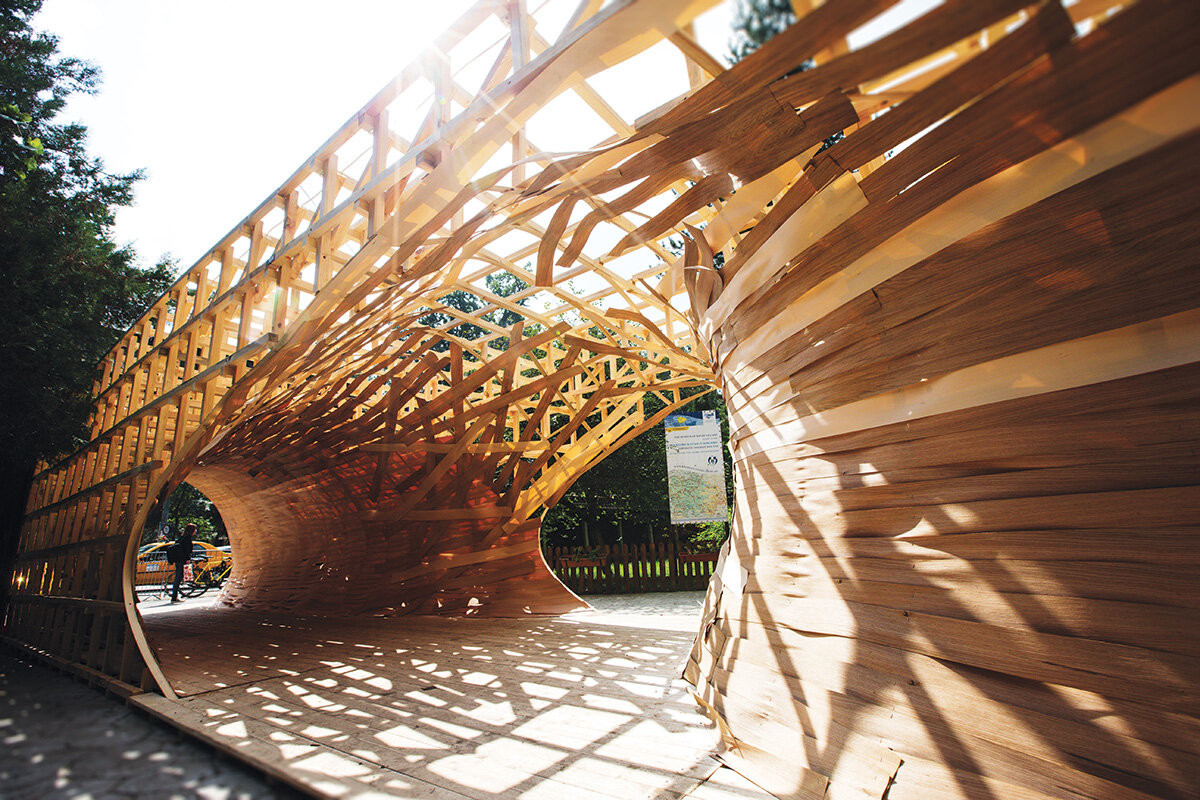
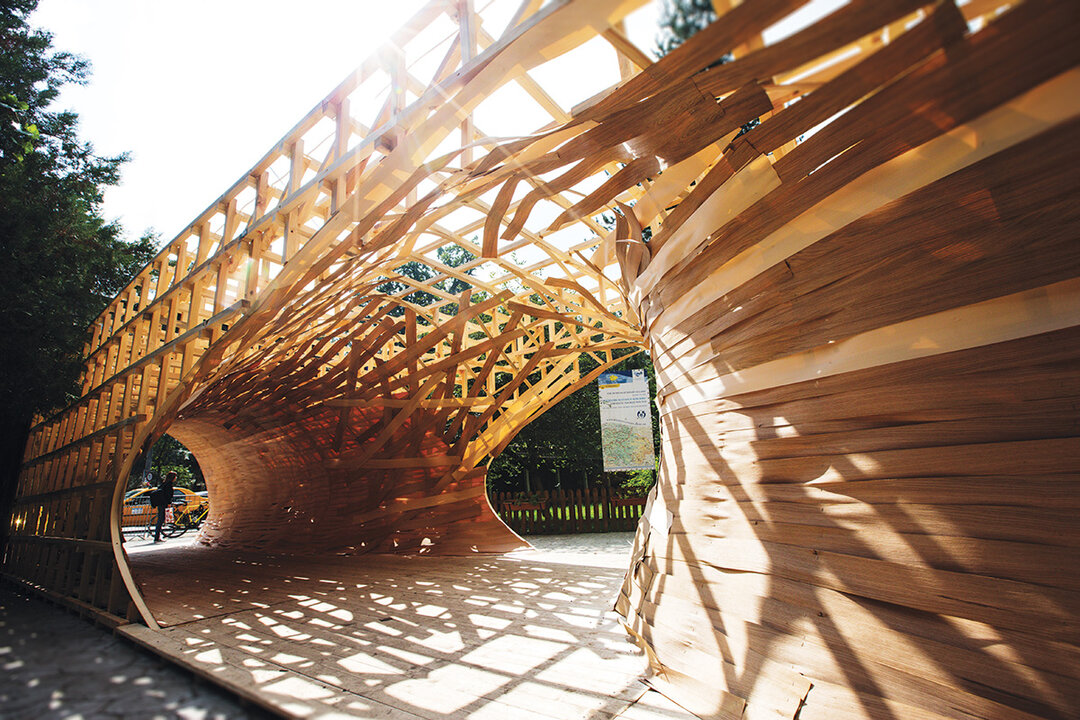
"Hidden Nest" is an experimental project that functioned, for 3 days, as an access "device" in the Bănățean Village Museum, during the 10th edition of the Plai Festival. The challenges that this project incorporated were found in the design process (identification of the optimal shape) and the execution part, conditioned by the limited materialization period, the fixed budget and the small and fluctuating staff of the working team.
During the design phase, we constantly referred to the requirements stipulated in the design theme launched by the beneficiary, where the access gate had to mark the entrance to the festival, to naturally direct the flow of participants to the two areas of interest prioritized in terms of importance, to integrate into the existing built environment immediately adjacent (volumetry of the museum gate, the buildings present and local materials) and, from the point of view of architectural plasticity, to instill the idea of naturalness through form and material. Thus, the architectural object arose from the negotiation between the desires of architectural plasticity and the constraints of context, budget and time: how can I create a functional object that fits naturally into the existing context? How can I build it at minimal cost and at the same time make it a noticeable architectural presence? What kind of building material is easily sourced, hand-processed and assembled/disassembled so that the project can be completed in 7 days? These are the questions that animated our thoughts throughout the design process, and the final product embodies the sum of the answers that we considered optimal.
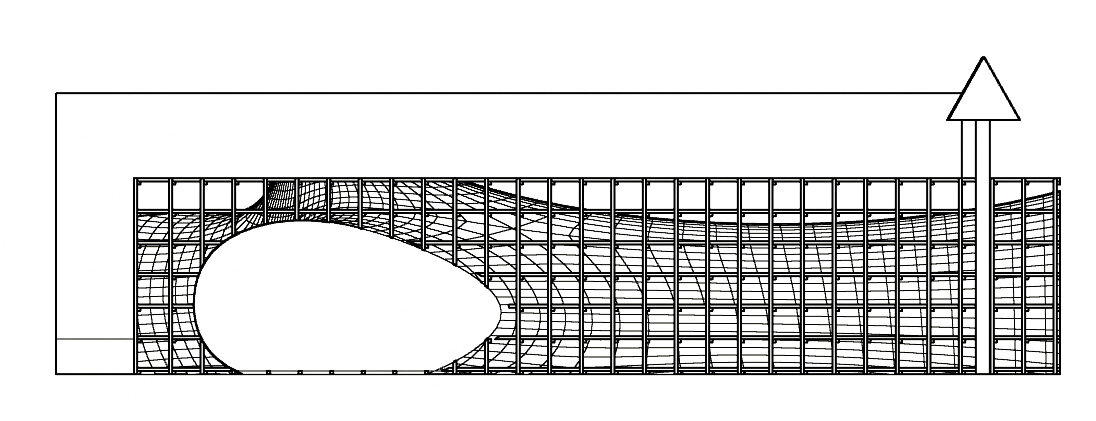
The requirements analysis we concluded with a few keywords, namely: orthogonal, organic, permeability, multidirectionality. Thus, we opted for a volumetry that encompasses the orthogonal-organic duality, illustrated by the two components of the access gate: the full and the excavated volumes, in an equal volumetric ratio. The purpose of the 1:1 volumetric ratio is to give the viewer the opportunity to perceive two volumetric entities simultaneously.
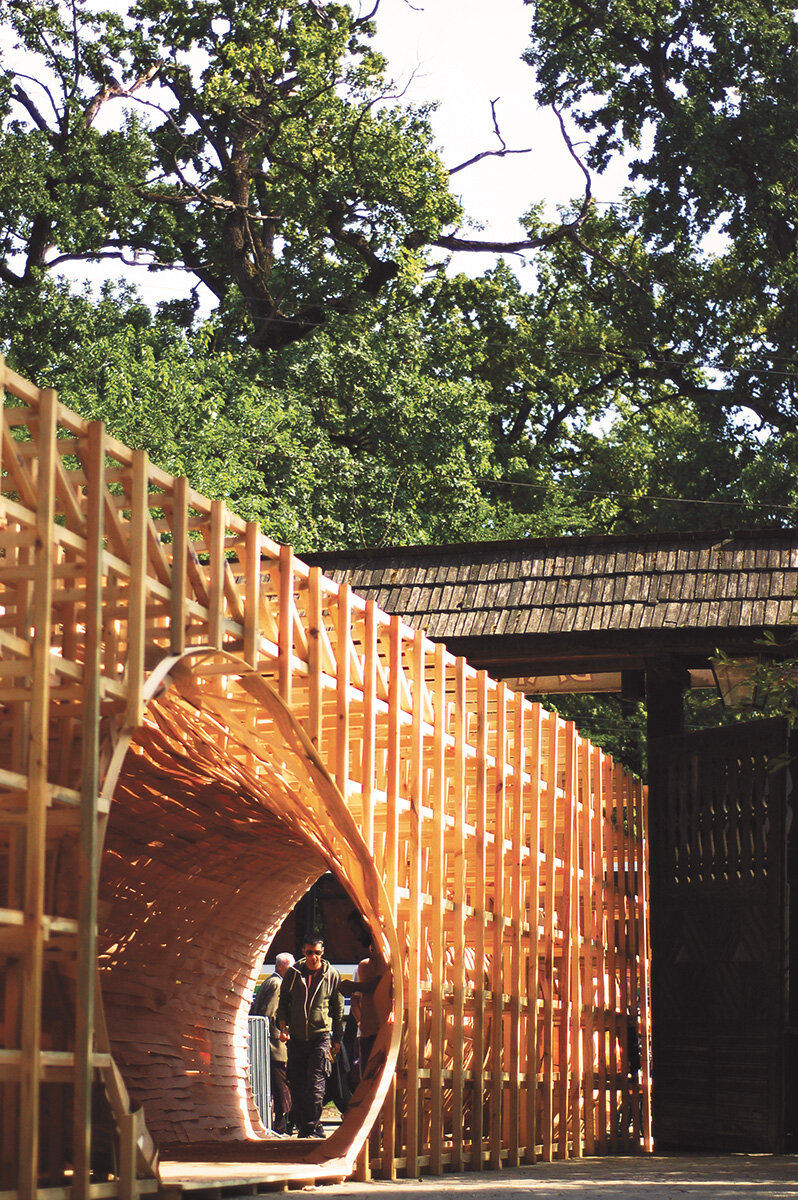
The full component defines the maximum volume that the architectural object occupies. The choice for a simple, parallelepipedic geometric contour arose from the need to integrate into the existing built landscape which is dominated by the rigor of the vertical line and Cartesian system. We ruled out the option of a well-defined volume because we felt that it would have been a striking presence in the landscape of the Banat Village Museum and therefore decided to dematerialize it in a way that would not contrast with the specificity of the site. The dematerialization we translated it into a spatial grid whose module is 45 x 45 x 45 cm, made of pinewood cabinets, square section 4.5 x 4.5 cm. The choice of the modular spatial grid arises from the desire to create a perceptually permeable delimitation of the access apparatus, through which both the configuration of the interior space and the surroundings can be observed from the outside.
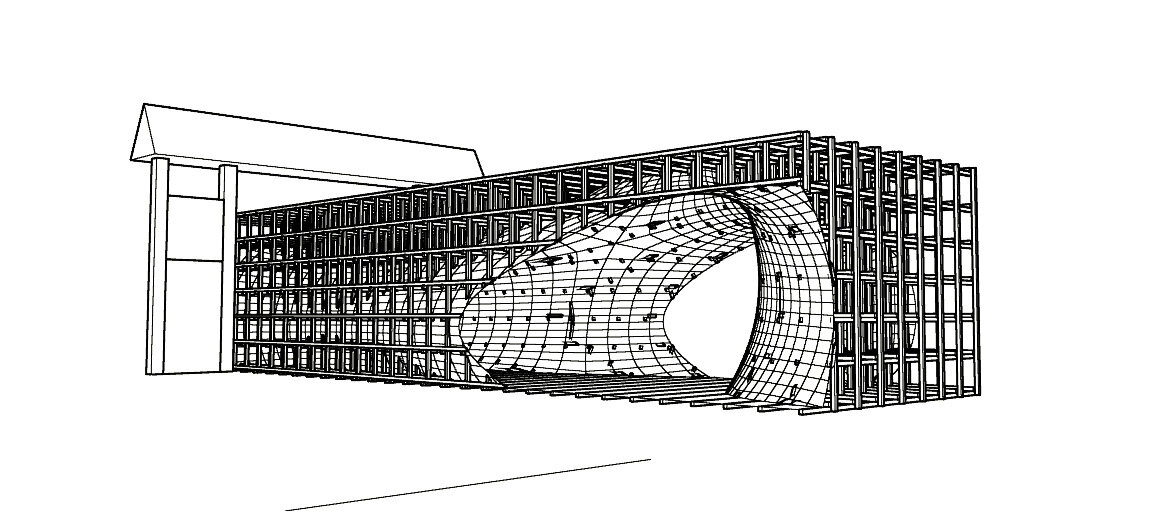
The second component concerns the empty volume, the excavated mass. For its configuration we analyzed the natural pattern of the weaver bird's nest, and more precisely - the access funnel into it. Starting from this example of organic origin and the requirements of the design theme, we decided that the architectural object should make use of the funnel concept as a means of absorption, but also dissipation of the flows of festival participants. In order for such phenomena to occur simultaneously, the access apparatus brings together a system of single and double funnels. The number, orientation and sizing of these were determined according to the existing circulation on the site and the need for interior lighting of the space created. Since a single funnel implies unidirectionality, in Hidden Nest we have incorporated a network of 4 funnels that intersect in a single place: 3 funnels take over the pedestrian circulation and the fourth one is intended to supplement the natural light inside the path generated by the other three. The proposed excavation system is based on the simplest model of multidirectionality - the "Y" symbol, which is manifested concomitantly between the access from outside, the accesses inside the museum space and the sky.
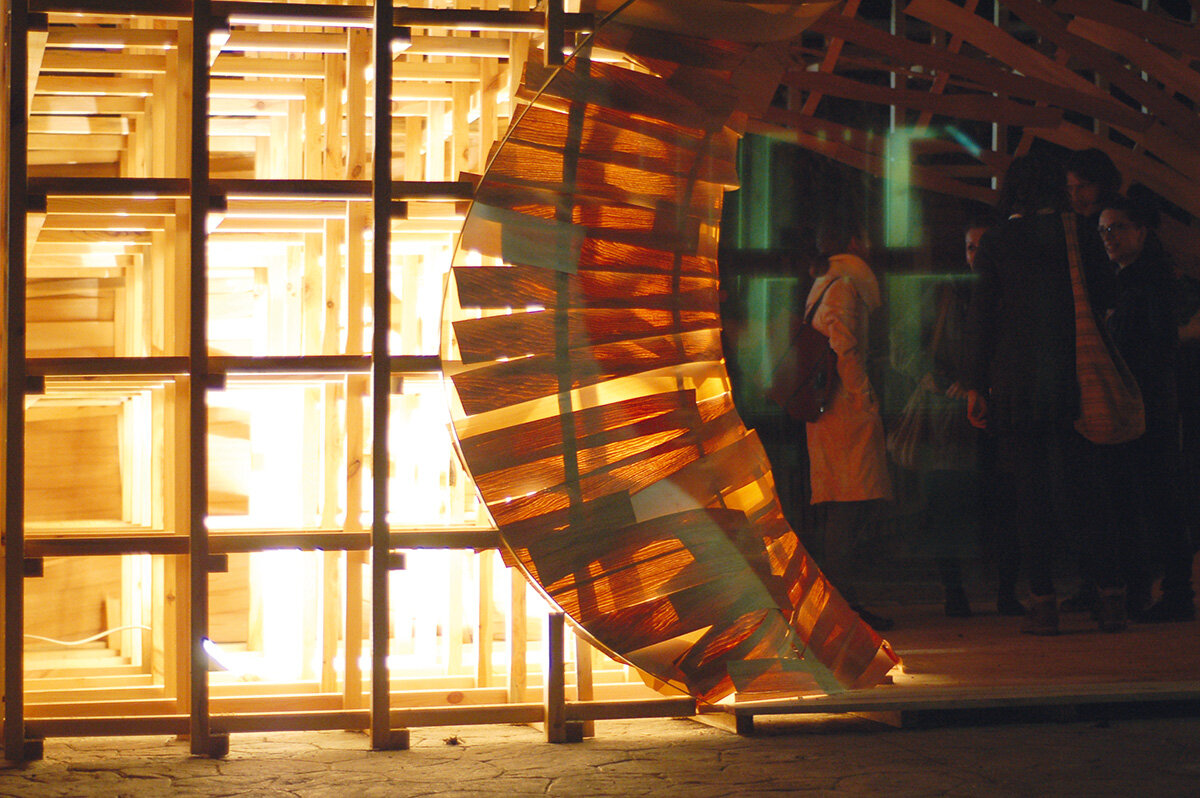
The variable permeability of the lining of the interior space interprets the dynamics of the weaver bird's nest in a fixed form, by arranging the veneer collars in an orderly and uniform manner mixed with weaves at different angles. The maximum point of transparency is reached in the upper area of the skylight by gradually thinning the veneer weaving thus marking the point of distribution of circulations, but also to create the visual link between the spatial grid and the sky.
By joining together the two constituent parts of the volumetry (the maximum volume of inscription and the network of funnels) we generated the body of the access apparatus in which the organic form and the elements of the spatial grid coexist.
The digital modeling tools we used in this case consist of the Rhinoceros modeling program together with the Grasshopper plug-in (visual programming platform) and the Kangaroo component - the interactive simulation, optimization and formal generation engine that uses the laws of physics for surface relaxation, which facilitated the obtaining of the organic shape of the excavated space. Parametric modeling proved to be the effective design technique in this case due to the flexibility it gives to the process of determining the optimal shape, combining the useful with the enjoyable through the playfulness of the many iterations that occur along the way.
As far as the execution is concerned, our role was not limited to the status of designers, as we actively participated in the entire construction process by organizing and directing the construction site, processing the construction material and assembling the component parts. The main difficulties encountered during the execution were related to the site logistics - the work team consisted of 2 permanent (new) members - and the unfavorable weather conditions which delayed the initially estimated completion date. Interestingly, the project, with its unique volumetry, managed to provoke curiosity and fascination from the very beginning of its construction, which naturally led to the expansion of the work team by involving volunteers, making it possible to complete the object on time.
Even though the lifespan of the architectural object was short, we consider the impact to have been positive, as measured both by the feedback received from the beneficiary and by the survey of those who had the opportunity to interact directly or indirectly with this project. I appreciate that the merit of this temporary architectural object lies in the opportunity it offered to the public to understand in a new sense the usual term 'gate': a complex device that articulates two environments, and the transit becomes an experience in itself.
Project name: Hidden Nest
Function: experimental pavilion with access device function
Beneficiary: Plai Festival
Designer: edukube, Giurea Diana B.I.A.
Execution: Zoran Popovici, Diana Giurea, Gabriela Pap, Flavius Emanuel Holotescu, Laurențiu Caragia, David Cuciuc
Area: 48,52 square meters
Location: Timișoara, Romania
Finalized: September 11, 2015
Deadline: 7 days
Building materials: pine wood cabinets, veneer
Investment value: 2.000 euro