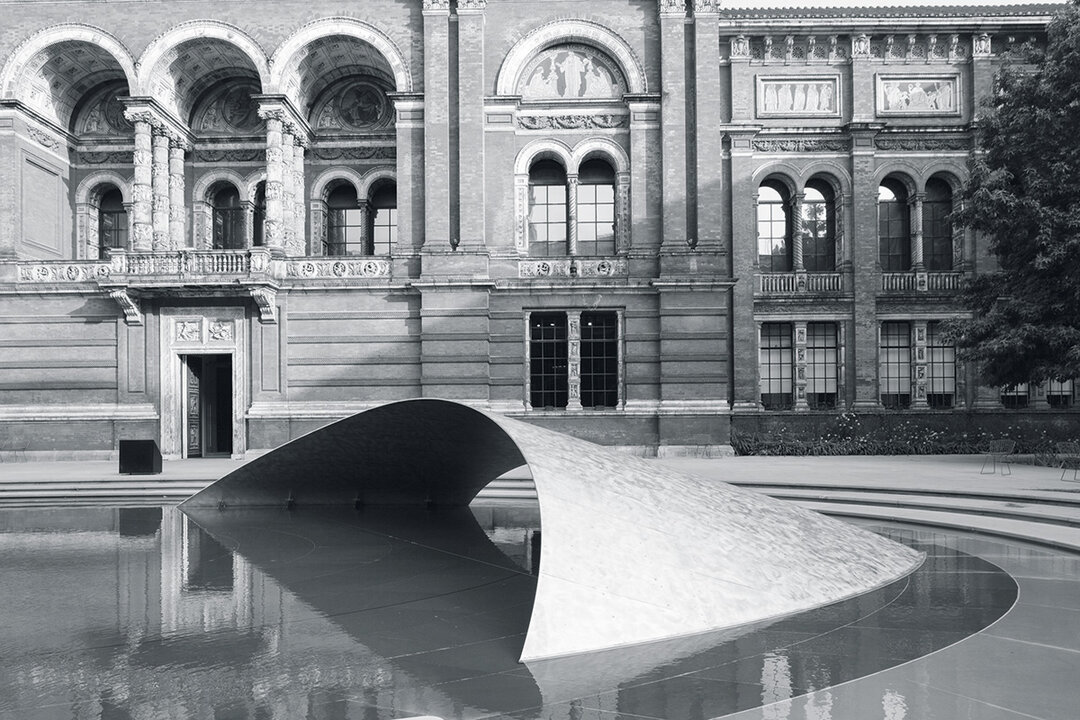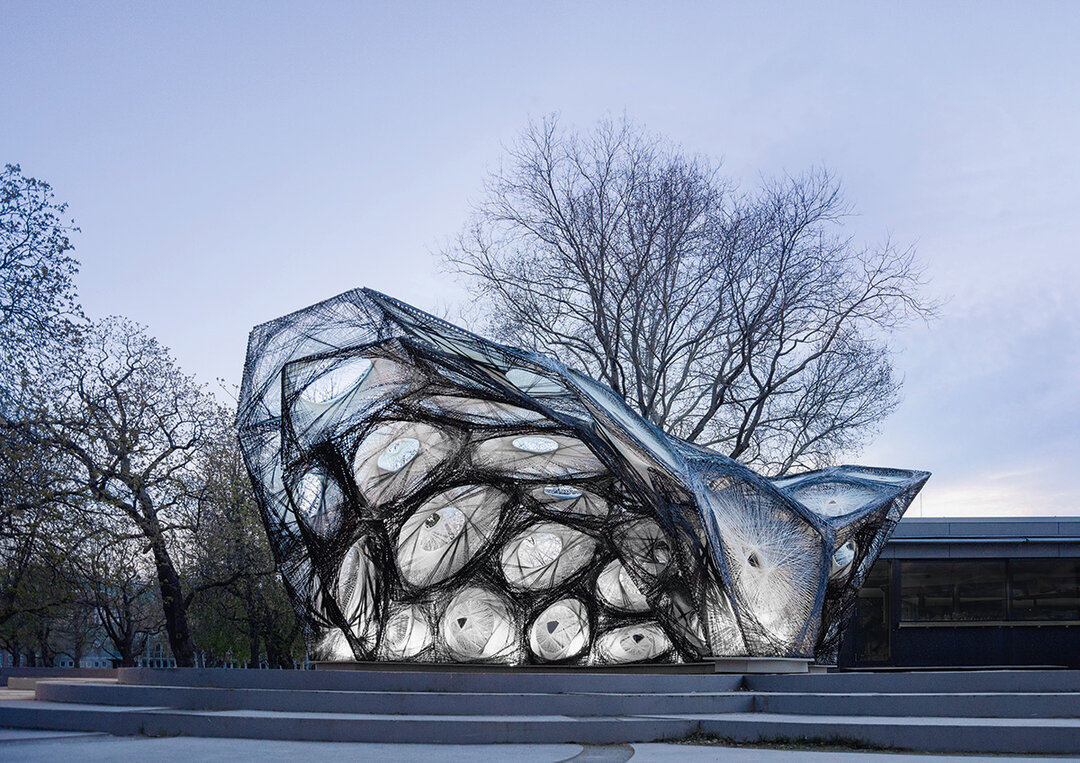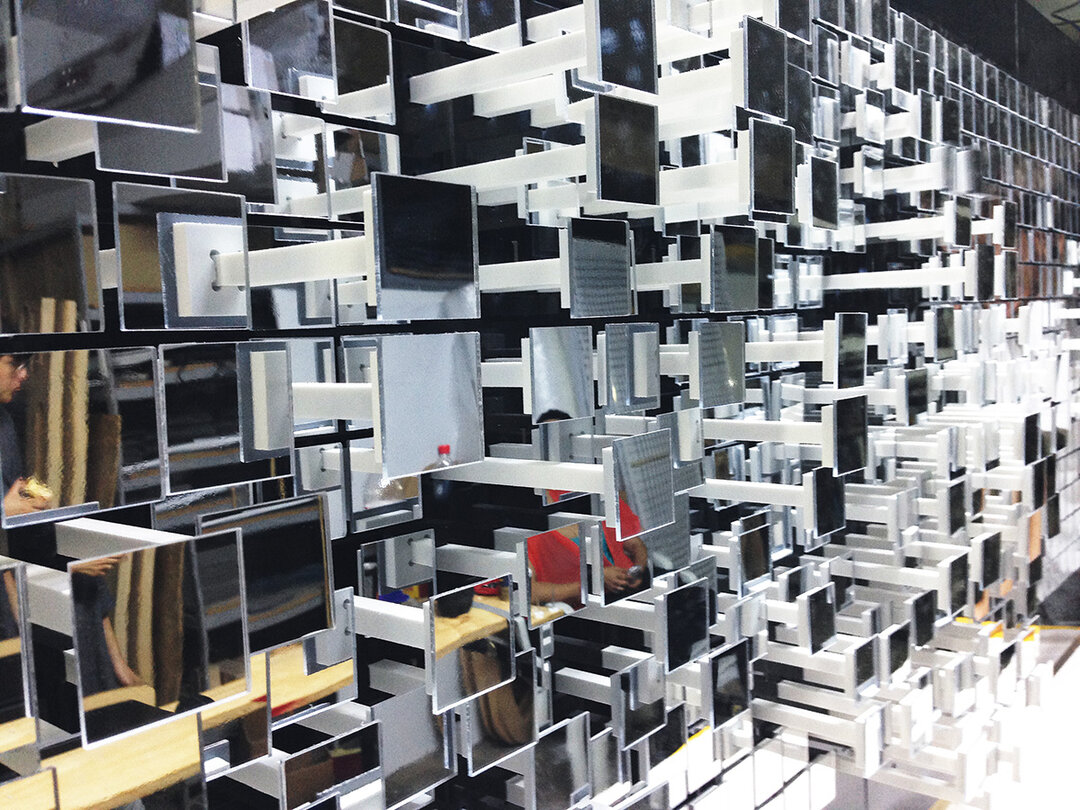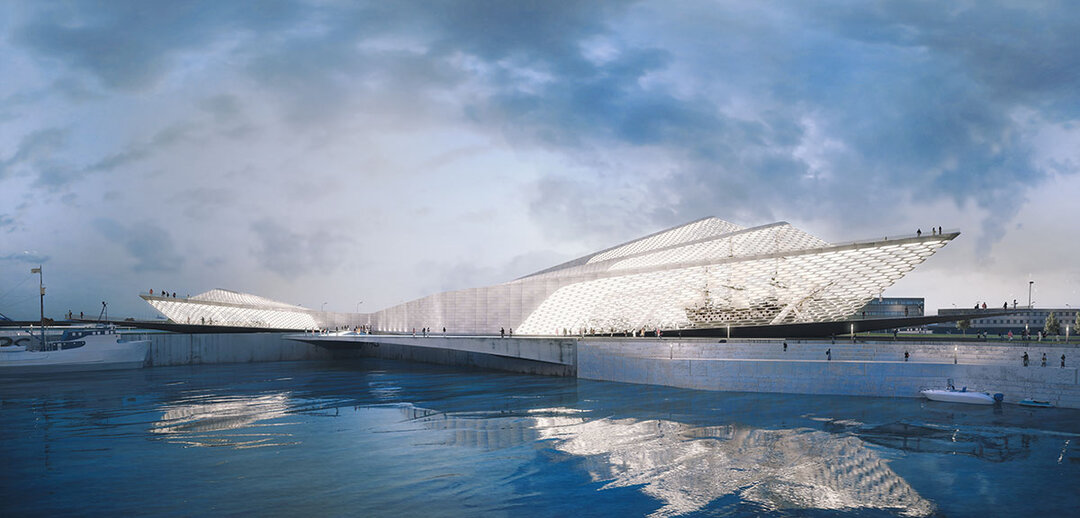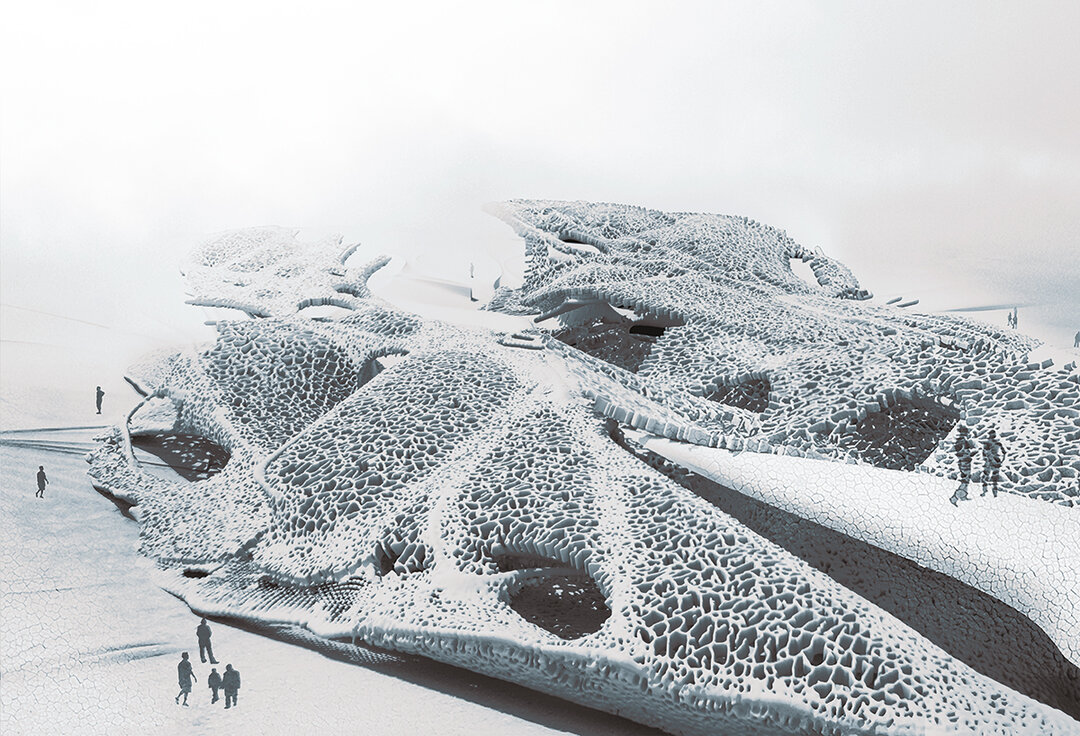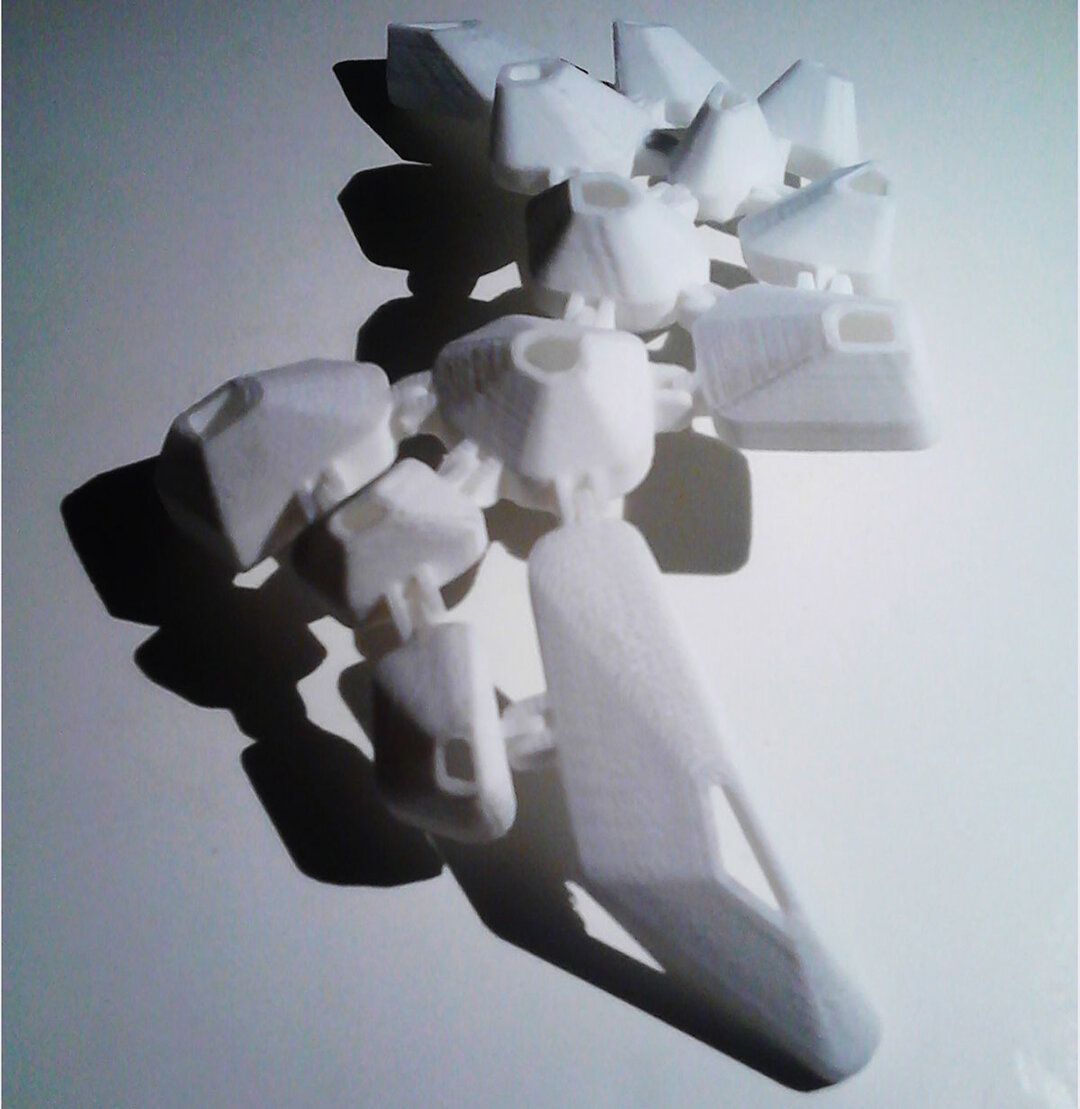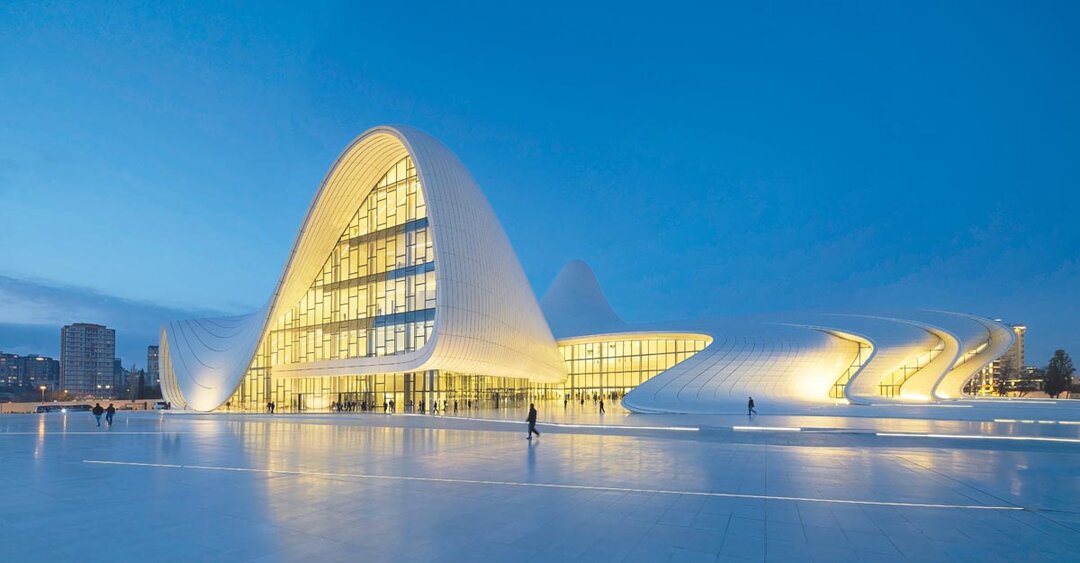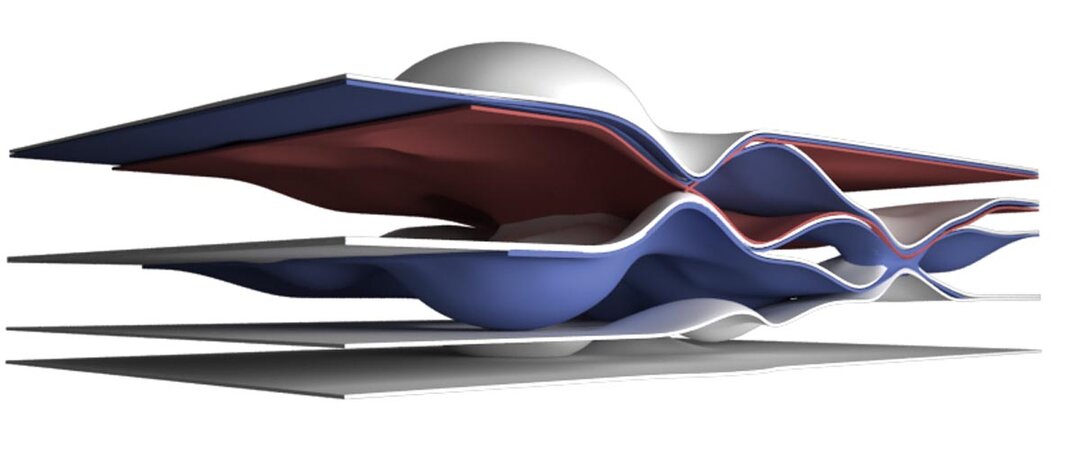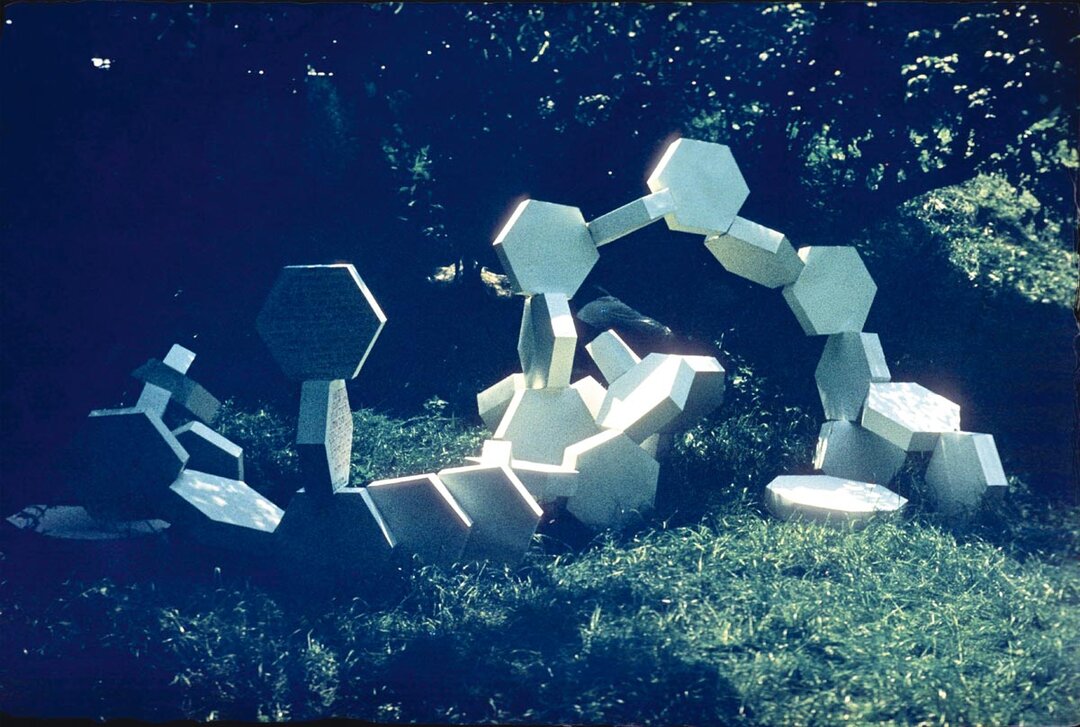
VES-EL - Design: Gareth Neal & Zaha Hadid

The world exists independent of our mindset and is not limited to an independent individual or behavior that disregards or denies society as a whole. In a new material ecology, this phrase transpires as an increase in the interdependence of social processes, a world in which we must assimilate and operate complex, collectively and individually manifested social, political, economic, cultural and environmental parameters. We should no longer think in terms of a detached, isolated, quasi-feudal world, an anachronistic and esoteric place, where architecture's response to global viewpoints and modes of operation is an anachronistic and anarchic one, translated into disparate objects, but on the contrary, an adaptable discourse is needed that reflects the social function of architecture. The core competence of architecture has always been to articulate, in a responsible way, the complexity of built space through material processes. The material processes inherent in architecture result in physical-material objects. The world is made up of physical objects that exist outside, independent of our mind. Under the umbrella of materialism, as a philosophical field, all phenomena, including mental phenomena as well as consciousness, are all effects of the material factor. Material interactions take place, in architecture, between the users of space (sentient beings) and the physical objects (designed objects) with which they interact. Materialism is described by Deleuze and Guattari, in their work Capitalism and Schizophrenia, as a departure from the old thinking of the 19th century, through concepts such as self-consciousness, lines of flight, deteritorialization and territorialization, swirling, abstract machineries, immanence, networks, networks, bodies, plateaus, consolidation, territory, boundaries, signification, structure, fields, order, environment, connectivity, manifestation, form, framing...1. The direct link between architectural processes and their capacity to produce affect is activated by consciousness. Consciousness meaning the state of realizing and responding to one's environment, both interior and exterior. The latitude of the affects of architecture should structure and help individuals or collectives to navigate the built environment with greater fluidity. Every society is dependent on its built environment because it comprises places and spaces where people live, work and recreate on a daily basis. Our contemporary global society is experiencing an alert development driven in large part by technology and its ability to produce information and increase connectivity between individuals. This information-driven society has been described as the Network Society, Knowledge Society, Post-Fordist Society, Post-Modern Society, Post-Industrial Society or Information Society, terms set to describe the transformations that have begun from the 1970s to the present day, transformations that are reshaping the fundamental way in which society functions. These theories are based on the assumption that society in general is being reshaped under the auspices of access to information and the monetization of information, which in turn creates a new economy and a new type of social behavior. The critical argument is that, although information is much more easily accessible in the contemporary world, we should not perceive a completely different society2; in fact, it can be seen as an evolution. This evolution, built on existing societies and cultures, offers an endless unfolding of possibilities. Social actors are exposed to a variety of environments, both virtual and physical. The changes taking place in society, brought about by deindustrialization and the growth of information-based processes, are reflected in all layers of societal functions as evolutions. Architecture as an autopoietic functional system has the capacity to be informed and to produce affects that fully integrate contemporary societal needs, therefore, in turn, it has to develop its discourse and practice.
Architecture in the 21st century faces a paradigm shift. This is a need generated, on the one hand, by a new globalized society, the Network- and/or Information-Society and, on the other hand, by the need for coherence in the architectural discourse itself. A new paradigm is needed to respond to the increasingly complex and accentuated demands of our global society. The call to stop scattered architecture has been made widely in the profession, both academically and professionally, through the avant-garde (speculative architecture) or through mainstream architectural discourse. There is an inherent sense of a need for a qualitative way of materializing the abstract world in the global physical environment, coming from the abstract needs of sociology, economics, politics, ecology or engineering, to the material processes that architecture can provide and is solely responsible for the affects it can produce. Architecture shapes function and orders social communications through its construction. Architecture's paradigm shift is called PARAMETRICISM3 and it is unique in its ability to negotiate a vast unfolding of informational layers and to layer them in a discrete and gradual way in order to create a fluid length of differentiations. It provides a new framework for architectural processes and defines this discipline as an independent autopoietic4 system. The style aims to evolve and unify the global discourse of architecture, as the rightful successor of modernism, to culminate the efforts and put an end to the modernist crisis.
The parametricist paradigm is set to operate under three main agendas: the Organizational (physical), the Phenomenological (perceptual) and the Semiological (communicational) Project. Part of the aim of parametricism is to make architectural practice aware of the potentially contained semantics, to achieve a higher level of correlation between form and function, and the various layers of information that can transpire through the physicality of architecture. The semiological project is built on F. de Saussure's philosophical concept of semiology, semiology, and aims to improve the navigability of the environment it defines. De Saussure exemplifies how everything receives meaning through language. Language is a framework for verbal communication: 'Words are not merely vocal labels or communicative adjuncts superimposed on a given order of things. They are collective products of social interaction, essential tools through which people constitute and articulate their world". We can articulate the purpose of architecture as a framework for social communications (e.g.) if "the meaning of a word (sign) is its use" (L. Wittgenstein) and "if a space has meaning, the meaning of space is given by its use" (P. Schumacher) it follows that space as a framework for communication. By assuming an abstract translation of words as units or elements, which carefully crafted articulate and give coherence to complicated structures (primary distinction between semiotics and semiology); we can assume that architecture has the same inherent potential. We often refer to architecture as having its own languages and syntaxes, in the same way that linguistics has syntaxes and semantics. The syntaxes of architectural materiality are translated into parametricism through semiological design, through the framing of social communications by architectural elements. An informed architecture addresses the importance of the navigability of space and the individual's ability to orient themselves with confidence and ease in order to make new connections and have meaningful experiences. Users of space are sentient, social beings, not just bodies pushed through an amorphous physical construct. In order to be able to navigate, we first need to understand what is happening in a given environment (functional typology); who to expect in a given part of the territory (social typology); where we are in relation to others and the possible alternative uses of the building (residential typology). Consistent design heuristics help to improve and produce coherence in the built environment; in parametricism there are both formal and functional heuristics, defined with negative and positive values, which meaningfully articulate formal, functional and social criteria. The heuristics are the engine for articulating and correlating different parametric designs as solution states according to their problem state.
avoid straight lines, avoid right angles, avoid corners, avoid primitive geometries such as squares, triangles and circles, avoid simple repetition of elements, avoid juxtaposition of unrelated elements or systems, avoid familiar typologies.
Hybridization, morphing, de-territorialization, deformation, iteration, use splines, nurbs, generative components, script instead of modeling, consider all forms as parametrically malleable, differentiate gradually (with varying degrees), inflect and correlate systematically.
Avoid thinking in terms of essences, avoid stereotyping and strict typologies, and avoid functional assignments into strict and discretely separate zones.
Think in the sense of graded activity fields, about variable social scenarios calibrated by variable event parameters, think in the sense of actor-act networks.7
I would like to address the issue of DECISION-MAKING and how exactly we have to make decisions, both in terms of developing a parametric model and in terms of perceiving a space and the affects it produces. Decision making as a cognitive process is defined in psychology as the ability to select a belief or a course of action among several possible alternatives. Decision making has psychological, cognitive and normative research perspectives. Decision making is seen as a continuous process, embedded in interaction with the environment.
In economics, Herbert Simon described the capacity of individuals to make decisions as limited. Simon defines this concept as Bounded Reason, meaning that decision-makers (individuals) can only reach a "satisficing"5 outcome, even if the intention is to make rational decisions and maximize utility through optimization. Bounded Reason is a concept based on three main criteria or constraints: in any given circumstance, (1) there is only a limited amount of information available regarding the possibility and consequences of decisions; (2) the human brain has only a limited capacity to evaluate and process the available information; (3) there is only a limited amount of time to make decisions. This concept can be easily abstracted to all decision-making processes, as it is a general concept that refers to all the limitations that decision-makers have to manage. These limitations of reason turn the decision-making process into a process that is based on unwritten rules or habit. Habituation was described in the American Journal of Psychology (1903) as follows: 'A habit, from the point of view of psychology, is more or less a fixed way of thinking, willing, or feeling, acquired by previous repetitions of a mental process'.
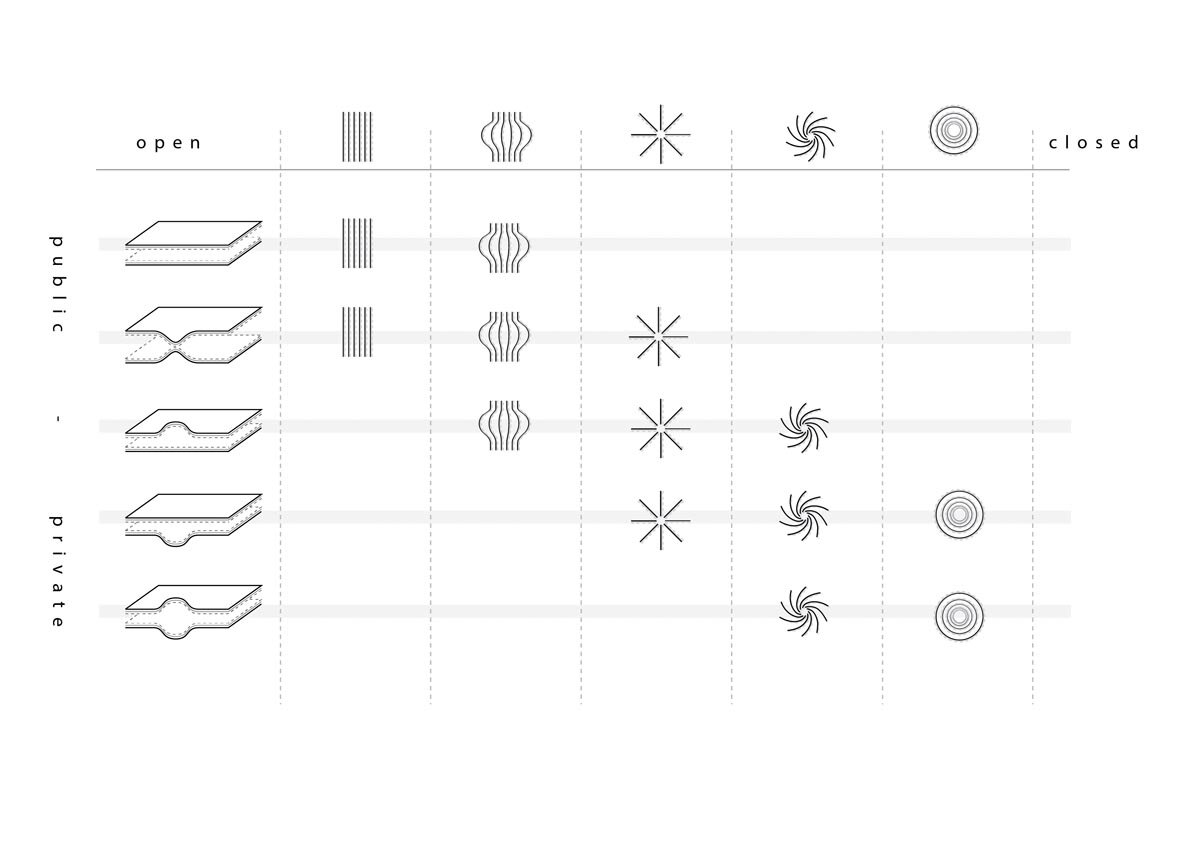
The link between architecture and decision-making is established in the environment that must be constantly navigated by all individuals participating in social functions. The environments in which individuals interact are largely governed by the physical-material construction of architectural processes. By this we can assume that architecture directly and constantly influences most of the decision making processes of all individuals in the ubiquitous navigation of space. In an ever-changing social environment, where interactions and information exchange are key to its functionality and evolution, architecture's core competence to articulate and frame social communications is empowered by the Semiotic Project. This enables a faster decision-making process of its social actors. When we navigate space, we subconsciously learn how to orient ourselves. We create our own rules based on simple dichotomies that make decision making possible: tall and short, inside and outside, light and dark, open and closed, solid and transparent, etc., then we transform them into positive or negative environmental stimuli. In the built environment, these stimuli transpire through architectural elements; they will help us to navigate the space, like orienting compasses, receiving meaning through their use.
"The system should keep users informed of what is happening, through an appropriate response in a reasonable time."6 In architecture, time is perceived through the user's movement through the space and visual interactions with its surroundings. For the user to remain informed, the system should provide a clear legibility of its components and their respective meanings in the territories it defines. The gradual variation and alteration of elements in the system keeps the user aware of their relative movement and position in relation to the parts of the system, while maintaining the balance and consistency of the system's constructed form.
For a system to be readable and to have the ability to inform its users about their relationship to the system and its parts, it must articulate the various potential functionalities with identifiable elements through known operations. The construct must be able to convey a message to its user and make it clear what it is about. In less abstract terms, one should be able to identify the architectural elements as signifiers, in terms of visibility, position, mass, degree of accessibility, materiality, etc., which in turn may signify a particular function, social affiliation or area of territory.
A building needs to have multiple possibilities to be navigated, it needs to be open and flexible, it needs a multiplicity of views and a complex circulation system that can offer a multiplicity of choices. Users should be able to navigate the built environment in a myriad of ways, avoiding bottlenecks. If a user needs to change their movement route, the possibility of short routes and long routes should be introduced for the different categories of land users. The fast routes of communication or movement will be mainly used by experienced users, while the longer and more indirect routes will be mostly used by inexperienced users, who will be always in a field that gives them maximum visibility and a high opportunity of cognizance. The functionality of the system must be informed by the formal appearance of its architecture. Form must give meaning to function, in a new definition of binomial correlation.
Consistency in language and design operations is preferable in order to reduce the risk of biasing influences. Users should not wonder whether the same type of operation or articulation of architectural elements has different semantics if they are encountered in different areas of the territory. A set of rules and conventions can be established for geometric differentiations of spatial and social hierarchies. If there is consistency across the territory in the rules of articulation and connectivity of different similar parts, the user will gain confidence, thus becoming less biased. The argument can be made for consistency in exchange for similarity, consistency as harmony or compatibility in exchange for endless repetition and modularity. When there is a consistent design language throughout the built environment, the choices become clearer and easier for any of its users to make.
"The problem space defines a set of problem-states between which the solution-state must be found."7 Given the vast area of possibilities that can be generated by contemporary computational design methods, a multitude of problem-states can be found. In fact, in order to have the ability to select the best problem-state that is appropriate for the solution-state, we would have to traverse and test to examine a larger amount of data than the time available to solve the problem. We can aim for the optimal result by optimization methods or we can aim for the satisfactory solution that can provide a problem-state suitable to achieve the goal-state. This issue is related to "satisficing", Simon's definition, and the limitations of constrained optimization.
A solution-state is reached by generating and testing different problem-states. These problem-states are created by computational models that will allow the study and testing of complex systems and their behavior by computer simulations. Problem-states comprise all available information existing in a given instance, formulated by symbolic systems corresponding to conceptual, modeling and evaluation systems in three states: initial state, intermediate state and final state - the goal (P. Schumacher). The problem-space is tested against three main agendas: the organizational, phenomenological and semiological dimensions of the project. To produce the architectural order, these dimensions produce two binary distinctions: organization and articulation of architectural processes. The order proposed by Parametricism is advanced through design processes such as parametric interarticulation, parametric accentuation, parametric figuration, parametric semiology, parametric reaction , parametric ecology and deep relation. The goal-state of discourse is to achieve deep relating in the totality of the built environment.
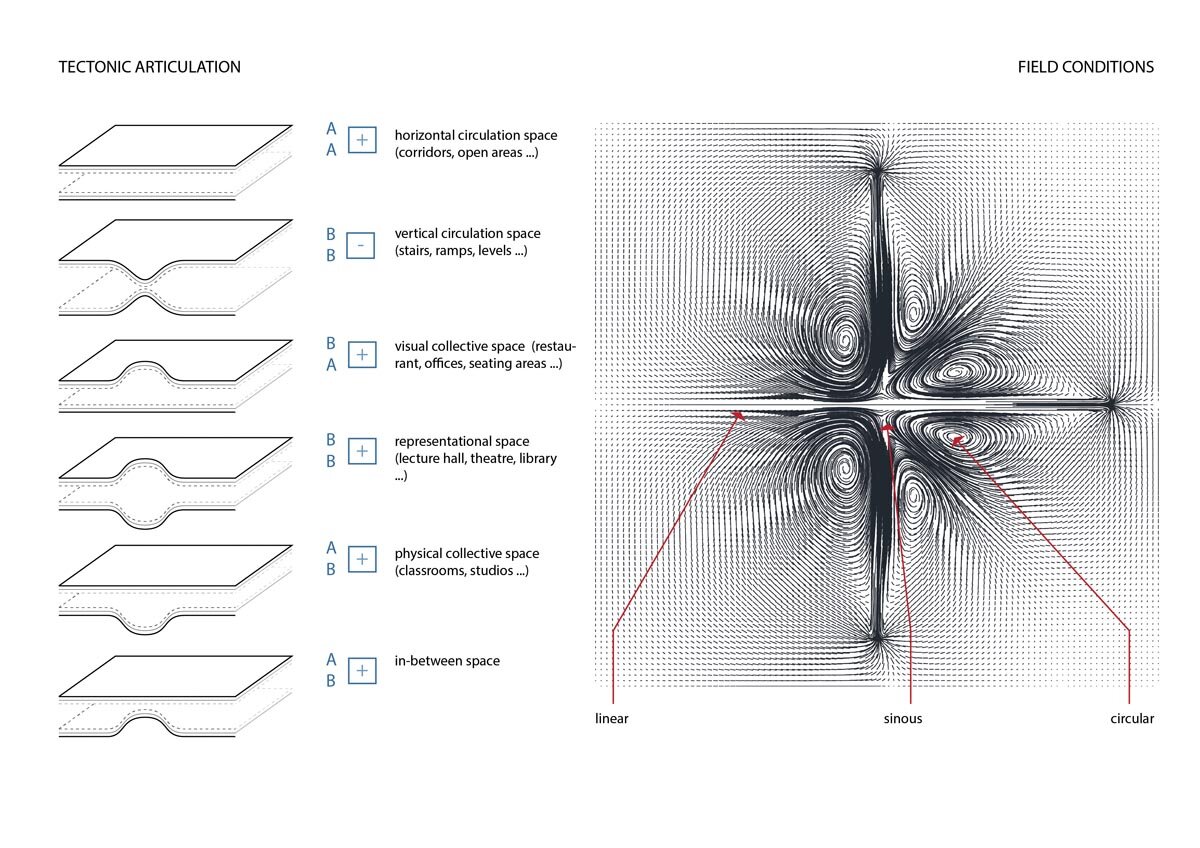
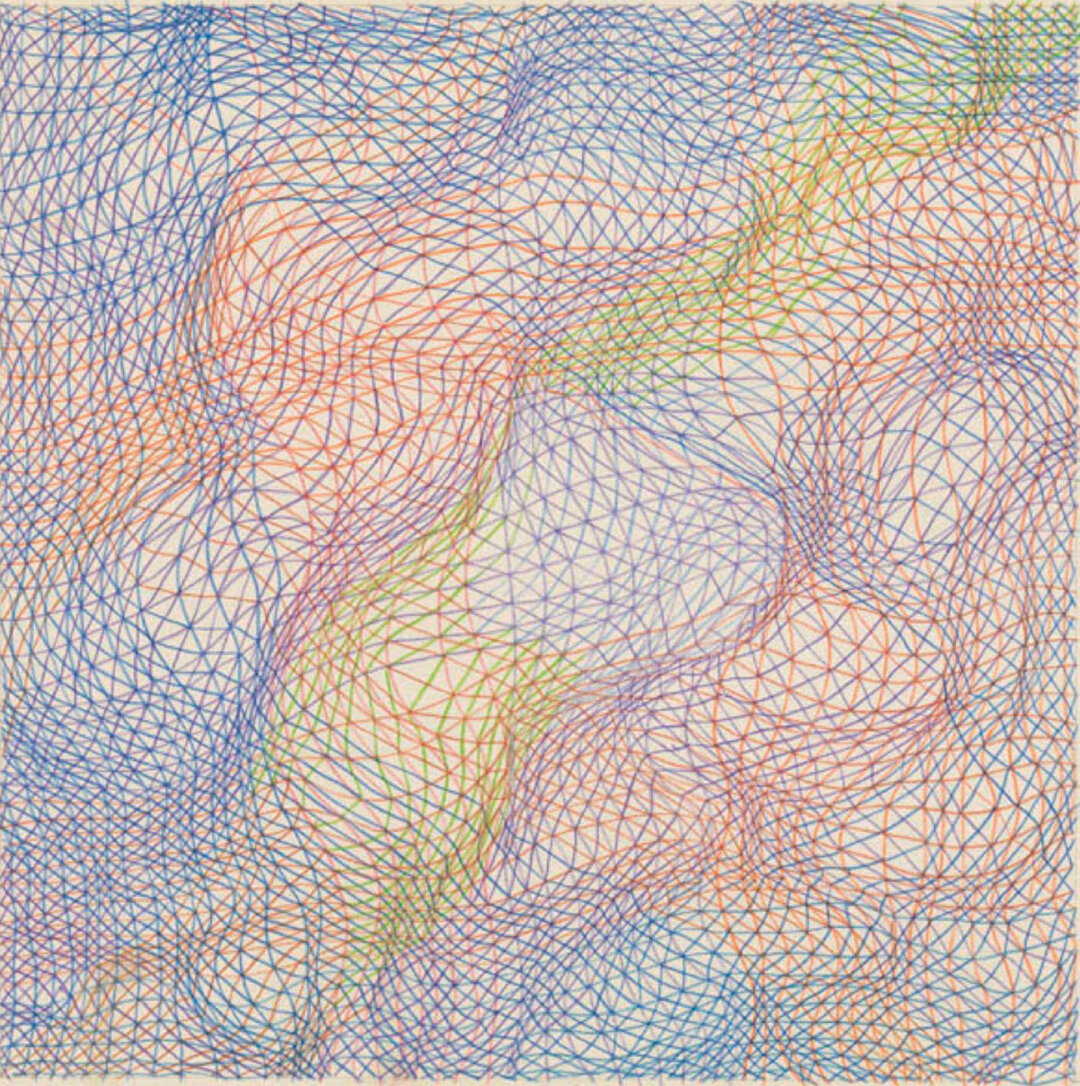
"All grids are fields, but not all fields are grids."8 The field issue has been taken up by architectural discourse, through Frei Otto or Stan Allen, and prepares the ground for Parametricism to break away from the rigidity of Modernism. Frei Otto makes a remarkable study of nature-inspired patterns of human organization in vernacular formations9 and Allen makes abstract studies of possible field and system formations to prove a more integrated solution to the full-goal problem of architectural composition. Allen proposes rethinking the figure in relation to the field, not as an individual, clearly demarcated object to be read in contrast to a stable (static) field, but more precisely as an effect of the field itself. Taking these premises into account, we assume fields as having a much greater capacity to integrate parameters that are found in both the initial-state and the problem-state of the project and have a higher probability of arriving at a solution (goal) state of the project in a much more satisfactory way. Site conditions, functional, social and environmental factors can be integrated and correlated into such symbolic systems through methods of differentiation, juxtaposition and variation; establishment and reversal of hierarchies; spatial positioning in terms of marginality and centrality; levels of importance, inside/outside/edge/middle ground, center vs. periphery, served areas vs. service spaces, proliferation through repetition and iteration. The malleability, complexity and parametric manifestation of the fields result from their inherent fractal systems and the adaptive potential of L-type, Mandelbrot, dynamical subsystems - such as fluid or particle dynamics, diffusion-limited aggregation (DLA), self-organizational subsystems such as: Voronoi, cellular structures, spontaneous magnetizations, crystallizations; geometric systems: triangulations, recursive self-referential subdivision, geo-networks; behavioral systems: flock formations or "cellular automata"; path optimizations (Frei Otto), urban networks (Hiller).
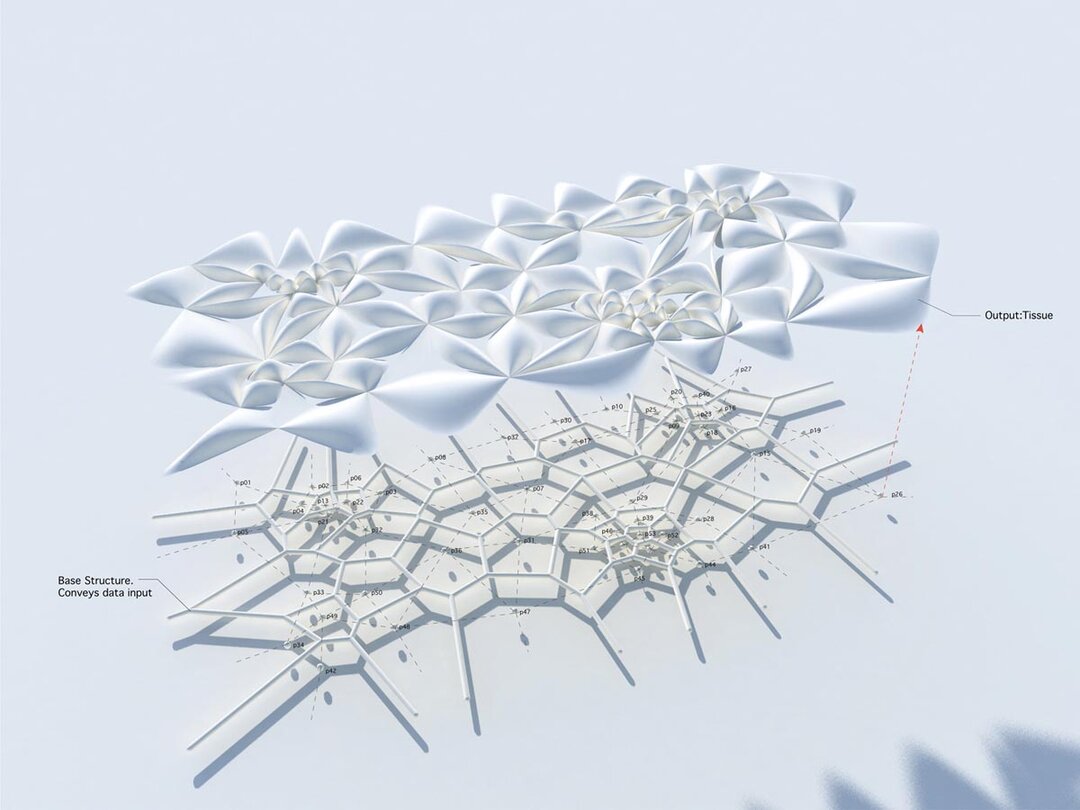
The decision-making process that eventually reaches the satisfactory level of aspiration starts from the level of process generation and testing methods. We assume that the task is to articulate a programmatic requirement, such as an urban pateu with three main layers of social functions to be integrated into an existing context and environment. We can generate several symbolic systems at the conceptual level that can relate to any of the aforementioned systems. Through the method of analysis we can identify all the characteristics of the given environment and context and extract the main abstract and physical components of the initial state. By research methods we will find the satisfactory or adequate symbolic system that can be applied in situ, taking into account the formal, functional and social criteria of the problem-space, and test the possible reciprocal relations that can be established between the problem-space superimposed on the solution-space. These reciprocal relations can be established by if-then sentence query methods. We can reduce the number of symbolic systems employed by implementing the generate-and-test method and local optimizations. A parametric model employed early in the process, such as Galapagos (Grasshopper) or self-organizing systems based on pre-coded reciprocity relations and integrated with their genetic algorithm (COD), can achieve rapid reductions of variables and preferences in the system and faster selection of a genotype based on satisfactory phenotypes can be achieved. The optimized system that satisfies our expectations will have the testability to visibly integrate the formal, functional, social and environmental criteria of the problem space. The achieved optimum will become the subject of optimization processes through local manipulations of the field in order to obtain a higher degree of correlation. Deep relatedness is achieved when all system components are correlated and interrelated. To interpolate the different scales being worked on by redundantly applying the same system to different scales of the territory is a method by which to refine the model further, depending on the strategies involved. The correlation between field, mass and building sub-systems is made possible by systematically layering the symbolic systems employed in the problem-space, achieving a gradual transition and a systematic differentiation of typologies and scales. By utilizing a variety of symbolic systems mediated by generative occurrences, new and unexpected solutions can be found and tested against the goal-parameters that are involved in the problem-space.
"Whether a designed space will function well as an effective orientation space, and whether it will facilitate communicative events or planned encounters, is not easy to ascertain. Agent simulations, scenario planning and people facilitation could come close. The key point here is that any given planning space is only as good as its predictive powers over the next execution space, and ultimately over the processes of the building's life as a setting for social communications. On the other hand, the design process in any problem/planning space is only as good as the simplification of the problem that its abstractions achieve. These two criteria have opposite implications and need to be balanced."10
1 Deleuze, Gill & Guattari, Felix (1980) Mille Plateaux, volume 2, Capitalisme et Schizophrenic, Les Editions de Minuit, Paris.
2 Webster, Frank (2002) The Information Society Revisited. In: Lievrouw, Leah A./Livingstone, Sonia (Eds.) (2002) Handbook of New Media. London: Sage. pp. 259.
3 Schumacher, Patrik (2008) Parametricism as Style - Parametricism Manifesto, London; presented and discussed at the Dark Side Club, 11th Architecture Biennale, Venice 2008.
4 Luhmann, Niklas.
5 Simon, A. Herbert (April 1984). Models Of Bounded Rationality And Other Topics. In Economics. The MIT Press.
6 Schumacher, Patrik (2012), The Autopoiesis of Architecture - A New Agenda For Architecture, ed. John Wiley & Sons Ltd, London, p. 298.
7 Nielsen, Jakob (1994). Usability Engineering. San Diego: Academic Press. p. 115-148.
8 Allen, Stan (1999) Points + Lines, New York.
9 Otto, Frei (2009) Occupying and Connecting, ed. Axel Menges.
10 Schumacher, Patrik (2012), The Autopoiesis of Architecture - A New Agenda For Architecture, ed. John Wiley & Sons Ltd, London, pp. 298.
The world exists independent of our minds and is not bounded to one individual or independent behavior that doesn't take into account or neglects society as a whole. In a new ecology of matter, this transpires as an increased interdependency of social processes, a world where we need to take-in and operate, independently & collectively manifested complex parameters such as social, political, economic, cultural or environmental aspects. We are no longer to think of a world detached, isolated, as a quasi-feudal, anachronistic and esoteric place, where the architectural response to global views and modi-operandi is irrational and anarchical, translated into loose objects, but rather a more responsible adaptive discourse that reflects architecture's social function is needed. Architecture's core competency has always been that of articulating, in a responsible way, the complexity of the built environment through material processes. The inherent material process of architecture result in physical, material objects. The world is made-up of physical objects that exist outside, and independently of our minds. The material interactions in architecture occur between space-users (sentient beings) and the physical objects (designed objects) they interact with. Materialism is presented by Deleuze & Guattari, in their Capitalism and Schizophrenia, as an escape from the old XIXth century thought, through concepts such as self-awareness, lines of flight, deterritorialization vs. territorialization, swarming, machines, assemblages vs. organisms, abstract machines, immanence, networks, networks, bodies, plateaus, consolidation, territory, limits, signification, structure, structure, fields, order, milieu, environment, connectivity, emergence, form, frames ...1. The direct link between architecture's processes and its capacity to produce affects is enabled by consciousness, it meaning the state of being aware of and responsive to one's surroundings, both interior and exterior. The latitude of architecture's affects should structure and help individuals and/or collectives navigate with a higher degree of fluency the built environment. Every society is dependent on its built environment as it encompasses places and spaces where humans live, work and recreate on a daily basis. Our contemporary global society is faced with a fast pace development driven mostly by technology and its ability to produce information and increase connectivity between individuals. This information driven society has been described as Network-Society, Knowledge-society, Post-Fordist Society, Post-Modern Society, Post-Modern Society, Post-Industrial Society or Information Society terms coined in order to describe the transformations that started in the 1970's until today, transformations which are reshaping the way in which societies fundamentally work. These theories are based on the presupposition that society in general is being reshaped under the auspices of information access and the monetarization of information which in turn produces a new kind of economy and social behaviour. Critiques argue that if information is much more accessible in the contemporary world, it does not need to be perceived as a totally different society2; in fact it can be viewed as an evolution. This evolution, built upon existing societies and cultures, offers an exhaustive array of possibilities. Social actors are being exposed to a manifold of milieus, both virtual and physical. The changes that occur in society, driven by deindustrialization and an increase of information based processes, are reflected throughout all layers of societal-functions as evolutions. Architecture as an autopoietic societal-function has the capacity to be informed and to produce affects that fully integrate contemporary societal needs, therefor in turn needs to evolve its discourse and practice.
Architecture in the21st century is confronted with a PARADIGM SHIFT. This is a need that is in part generated by a new globalized NETWORK SOCIETY or/and IFORMATION SOCIETY and on the other hand, the need for coherence in the architectural discourse itself. A new paradigm is needed in order to respond to the increasingly more complex demands of our global society. The call-out to stop generalized garbage-spill architecture has been made across the field, both in academia and practice, in avant-garde (speculative architecture) or mainstream fashion. There is an inherent, general feeling for a more qualitative way of materializing our abstract world into the physical world space. Reaching out from the abstract need of sociology, economy, politics, ecology or engineering to the material processes that architecture can provide and is sole responsible for its affects. Architecture gives form to function and orders social communication through its construct. Architecture's new paradigm shift is called PARAMETRICISM3 and it is unique in its ability to negotiate a vast array of information layers and superimpose them seemingly and gradually, in order to create a flowing longitude of differentiation. It provides a new framework for architectural processes and defines the discipline as an independent autopoietic4 social-system. This style is meant to evolve and unify architecture's global discourse, as a rightful successor to Modernism, peak the efforts of Post-Modernism and end the crisis of Modernism.
The parametricist paradigm is set to operate under three main agendas: The Organisational (physical) The Phenomenological (perceptual) and The Semiological Project (communicative). Part of Parametricism's aim is to render potentially embedded semantics conscious to architecture's practice in order to achieve a higher degree of correlation between form and function and the various layers of information that can transpire through architecture's physicality. The Semiological Project is based on the philosophical concept of semiology given by the linguist F. de Saussure and it aims at improving the navigability of the environment it defines. De Saussure exemplifies how anything acquires meaning through language. Language as a frame for communications: "Words are not mere vocal labels or communicational adjuncts superimposed upon an already given order of things. They are collective products of social interaction, essential instruments through which human beings constitute and articulate their world". We can articulate architecture's goal as framing social communications (e.g.) "the meaning of a word (sign) is its use." (L. Wittgenstein) => => "if a space has meaning, the meaning of a space is its use." (P. Schumacher) = space as a frame for communication. By assuming an abstract translation of words into units or elements that carefully crafted articulate intricate and coherent structures (main distinction between semiotics and semiology); we can assume that architecture has the same inherent potential. We often refer to architecture having its own language and syntax in the same way as linguistics has syntax and semantics. The semantics of architecture's materiality is translated into Parametricism trough the Semiological Project, by framing communications into architectural elements. Informed architecture addresses the importance of navigating space and orienting one's self with confidence and ease in order to establish new connections and have meaningful experiences. The users of space are sentient, social beings not mere bodies funnelled through an amorphous physical construct. In order to navigate, we need to understand, first of all, what is going on in a given environment (function type); who to expect in a certain part of a territory (social type); where we are in respect to others and possible alternatives of the building's available usability (location type). Consistent designs-heuristics help improve and cohere the built environment; in Parametricism there are both Formal and Functional Heuristics defined with negative and positive values that articulate meaningfully the formal, functional and social criteria. These heuristics are the drivers for articulating and informing the various parametric models as solution sates in accordance to their problem state.
avoid straight lines, avoid right angles, avoid corners, avoid rigid geometric primitives like squares, triangles and circles, avoid simple repetition of elements, avoid juxtaposition of unrelated elements or systems, and avoid familiar typologies
hybridize, morph, deterritorialize, deform, iterate, use splines, nurbs, generative components, script rather than model, consider all forms to be parametrically malleable, differentiate gradually (at variant rates), inflect and correlate systematically
avoid thinking in terms of essences, avoid stereotypes and strict typologies, and avoid designating functions to strict and separated and discrete zones
think in terms of gradient fields of activity, about variable social scenarios calibrated by various event parameters, think in terms of actor-artefactnetworks7
I would like to address the issue of DECISION-MAKING and how we are bound to make decisions, both in how we elaborate a parametric model and speculate on how we perceive physical space and its affects. Decision-making as a cognitive process is defined in psychology as the capacity to select a belief or a course of action among several alternative possibilities. Decision-making has psychological, cognitive and normative research perspectives. The decision-making process is regarded as a continuous process integrated in the interaction with the environment.
In economics, Herbert Simon describes the capacity of individuals for decision-making to be bounded. Simon defines this concept as Bounded Rationality, meaning that decision makers can only make satisficing5, even if they intend to make rational choices and maximize the utility through optimization. Bounded Rationality is a concept that is based on three main criteria or constraints: under any circumstance, (1) there is only a limited amount of information that is available over possibilities and their consequences; (2) the human mind has only a limited capacity of evaluate and process the information available; (3) there being only a limited amount of time to make decisions. This concept can easily be abstracted to all decision-making processes, as it's a general concept that refers to the limitations that decision-makers have to manage. These bounds on rationality make the process of decision-making rely on rules of thumb or habit. Habit was described as following in the American Journal of Psychology (1903): "A habit, from the standpoint of psychology, is a more or less fixed way of thinking, willing, or feeling acquired through previous repetition of a mental experience."
The link between architecture and the decision-making process is established in the environment that has to be constantly navigated by all individuals that participate to societal functions. The milieus that individuals interact in are mainly governed by the physical, material build-up of architecture's processes. By this we can assume that architecture is directly and constantly influencing the majority of the decision-making processes of all individuals with regards to ubiquitous spatial navigations. In a constantly evolving social environment, where interaction and the exchange of information is key to its functionality and evolution, architecture's core competency to articulate and frame social communication is empowered through The Semiological Project. This allows a faster decision-making process of its social actors. When we navigate space, we are subconsciously learning how to orient ourselves. We create rules-of-thumb based on simple dichotomies that make distinctions possible: high & low, inside & outside, light & dark, opened & closed, solid & transparent etc., we then transform them into positive or negative environmental incentives. In the built environment, these incentives transpire through architectural elements; they will help us navigate space as compasses for orientation, acquiring meaning through their use.
"The system should always keep users informed about what is going on, through appropriate feedback within reasonable time."6 Time in architecture is perceived through the movement of the user in space and the visual interactions with its proximity. In order for the users to stay informed, the system should provide a clear legibility of its components and their respective meaning throughout the territory it defines. The variation and gradient alteration of the elements throughout the system keeps a user aware of its own movement and relative position to the system's parts, maintaining in the same time consistency and balance of its build form.
In order for a system to be legible and for it to have the capacity to inform users on how they should relate to it and its parts, it needs to articulate the different functionalities it may have with identifiable elements with known operations. The construct has to be able to send a message to its user and let the user know what it's talking about. In less abstract terms, one should be able to identify architectural elements as signifiers, relative to their visibility, position, massing, degree of accessibility, materiality, etc. which in turn can all signify a specific function, social affiliation or area of the territory.
A build-up needs to have multiple possibilities to be navigated, it needs to be opened and flexible, it needs a multiplicity of vistas and a complex circulatory system that can provide a multiplicity of choice. The users should be able to navigate the built environment manifold, avoiding dead-ends. If a user needs to change track in its movement, the possibility for fast tracks and slow tracks needs to be introduced for the different categories of users involved in the usage of a territory. The faster ways of communication or circulation are going to mostly be used by the informed experienced users, while the slower more indirect paths will mostly be used by the unexperienced users who will always stay in a field that offers them maximum visibility and a high degree of cognition opportunity. The functionality of the system needs to be informed by the formal aspect of its architecture. Form should give meaning to function, in a new definition of the binomial correlation.
A consistency in the design language and operations is preferred in order to reduce the risk of biases. Users should not have to wonder if the same type of operation or articulation of architectural elements has different semantics, if found in different areas of a territory. A set of rules and conventions can be established for differentiating through geometrical operations, distinct spatial and social hierarchies. If there is a consistency throughout the territory with regards to rules of connectivity and articulation of the different similar parts, the user will gain confidence and therefore less bias. When there is a consistent design language throughout the built environment the choices become clearer and easier to make for any of its users.
"The problem space defines the set of problem states among which the solution states must be found"7. Given the vast array of possibilities that can be generated through contemporary design specific computation methods, a manifold of problem states can be found. In fact, to be able to select the best problem state that suits our solution state, we would have to go through and test or examine a greater amount of data then the time available to our problem solving timeframe. We can aim for the best result by methods of optimizations, or we can aim for the satisfactory solution, which would give a suitable problem state for a goal state to be reached. This problematic is tied back to Simon's definition of satisficing and the limitations of optimization under constraints.
A solution state is reached by generating and testing different problem states. These problem states are made up by computational models which will allow the study and testing of complex systems and their behavior through computer simulations. The problem states include all available information existing at any given instance, formulated via symbolic systems corresponding to the conceptual, modeling and evaluation systems in three states: the initial state, the intermediate state and the goal state (P. Schumacher). The problem space is tested against the three main agendas: the organizational, the phenomenological and the semiological dimensions of the project. In order to produce architectural order, these dimensions set-up two binary distinctions: the organization and the articulation of the architectural processes. The order proposed by Parametricism is advanced through design processes such as Parametric Inter-Articulation, Parametric Accentuation, Parametric Figuration, Parametric Semiology, Parametric Responsiveness, Parametric Ecology and Deep Relationality. The goal state of the discourse is to achieve a deep relationality in the totality of the built environment.
"All grids are fields, but not all fields are grids."8 The problematic of the field, has been taken on by architectural discourse, through Frei Otto or Stan Allen and sets the ground for Parametricism to demarcate itself from the rigidity of Modernism. Frei Otto makes a remarkable study of patterns of human organizations inspired by nature in vernacular formations9 and Allen makes abstract studies of possible field formations or systems, in order to prove a more integrated solution for the figure-ground problematic of architectural compositions. Allen proposes to rethink the figure in relation to the field, not as a clearly demarcated and individual object that reads against a stable (static) field, but rather as an emergent effect of the field itself. Considering these premises we assume that fields have a higher capacity to integrate parameters found both in the initial state and in the problem state of a project and have a higher probability of success in reaching a solution/goal state of the project in a more satisfactory form. Site conditions, functional, social and environmental layers can be integrated and correlated within such symbolic systems through methods of differentiation, juxtaposition and variation; establishment and reversals of hierarchies; spatial positioning with regards to marginality and centrality, levels of importance, inside/outside/on the border/in between conditions, center vs. periphery, serviced vs. service areas, proliferations through repetition and iterations. The parametric malleability, complexity and manifestations of fields results out of their inherent fractal systems and their potential adaptation of different subsystems such as L-systems, Mandelbrot systems, dynamic systems such as fluid dynamics or particle systems, diffusion limited aggregation (DLA) systems, self-organized systems such as: voronoi, cellular structures, spontaneous magnetizations, crystallizations; geometrical systems: triangulation, recursive self-referenced subdivision, geo-webs; behavioural systems: swarm formations or cellular automata; path-optimizations (Frei Otto) urban networks (Hiller).
The decision-making process that ultimately reaches the satisficing aspiration level starts at the level of generate-and-test methods of the process. Supposing the task is to articulate a programmatic requirement such as an urban block with three main layers of social functions that need to be integrated onto an existing context and environment. We can generate several symbolic systems at the conceptual level that rely on either of the aforementioned systems. By methods of analysis we can identify the given environment' and context's characteristics and extract the main abstract and physical constituents of the initial state. By means of research we could find the best suitable or satisfactory symbolic systems that can be applied on site, taking into consideration the formal, functional and social criteria of the problem space and test the possible reciprocal relations that can be established between the problem-space over the solution-space. These reciprocal relations can be established by means of inquire into if-then prepositions. We can reduce the number of symbolic systems engaged by using methods of generate-and-test and by local optimizations. A parametric model that is engaged in the earliest stages of the process, such as Galapagos (Grasshopper) or self-organising systems, based on reciprocal relations pre-coded and embedded in their genetic algorithms (CODE), can yield to rapid reductions of variables and biases in the system and a faster genotype selection based on satisfactory phenotypes. The optimized system that satisfies our goals will have the ability to test against seemingly integrating the formal, functional, social and environmental criteria of the problem space. The optimum reached would then be subjected to optimization processes by local manipulations of the field in order to achieve a higher degree of correlation. A deep-relationality is achieved once all components of the system are interrelated and correlated. Zooming in and zooming out (redundantly applying a system to various scales), can be one method of further detailing the model, depending on the strategies implied. The correlations between field, massing and subsystems of the building blocks are possible by applying a systematic layering of the symbolic systems engaged in the problem space, achieving a gradient transition and systematic differentiation in topology and scale. By the use of manifold symbolic systems and by means of emergence, new, unexpected solution states can be found and tested against the goal parameters that are implied in the problem space.
"Whether a designed [...] space will work well as effective orientation space, and whether it will facilitate the envisaged encounters and informal communication events, is not easy to ascertain. Agent simulations, scenario planning and people animation might come close. The key point here is that each planning space is only as good as its predictive power over the next execution space and ultimately over the life-process of the building as frame for social communication. On the other hand, the design process in each problem/planning space is only as good as the simplification of the problem its abstractions achieve. These two criteria have contrary implications and need to be balanced."10
1 Deleuze, Gill & Guattari, Felix (1980) Mille Plateaux, volume 2, Capitalisme et Schizophrenic, Les Editions de Minuit, Paris.
2 Webster, Frank (2002) The Information Society Revisited. In: Lievrouw, Leah A./Livingstone, Sonia (Eds.) (2002) Handbook of New Media. London: Sage. pp. 259.
3 Schumacher, Patrik (2008) Parametricism as Style - Parametricism Manifesto, London; presented and discussed at the Dark Side Club, 11th Architecture Biennale, Venice 2008.
4 Luhmann, Niklas.
5 Simon, A. Herbert (April 1984). Models Of Bounded Rationality And Other Topics. In Economics. The MIT Press.
6 Schumacher, Patrik (2012), The Autopoiesis of Architecture - A New Agenda For Architecture, ed. John Wiley & Sons Ltd, London, p. 298.
7 Nielsen, Jakob (1994). Usability Engineering. San Diego: Academic Press. p. 115-148.
8 Allen, Stan (1999) Points + Lines, New York.
9 Otto, Frei (2009) Occupying and Connecting, ed. Axel Menges.
10 Schumacher, Patrik (2012), The Autopoiesis of Architecture - A New Agenda For Architecture, ed. John Wiley & Sons Ltd, London, pp. 298.